
Summary
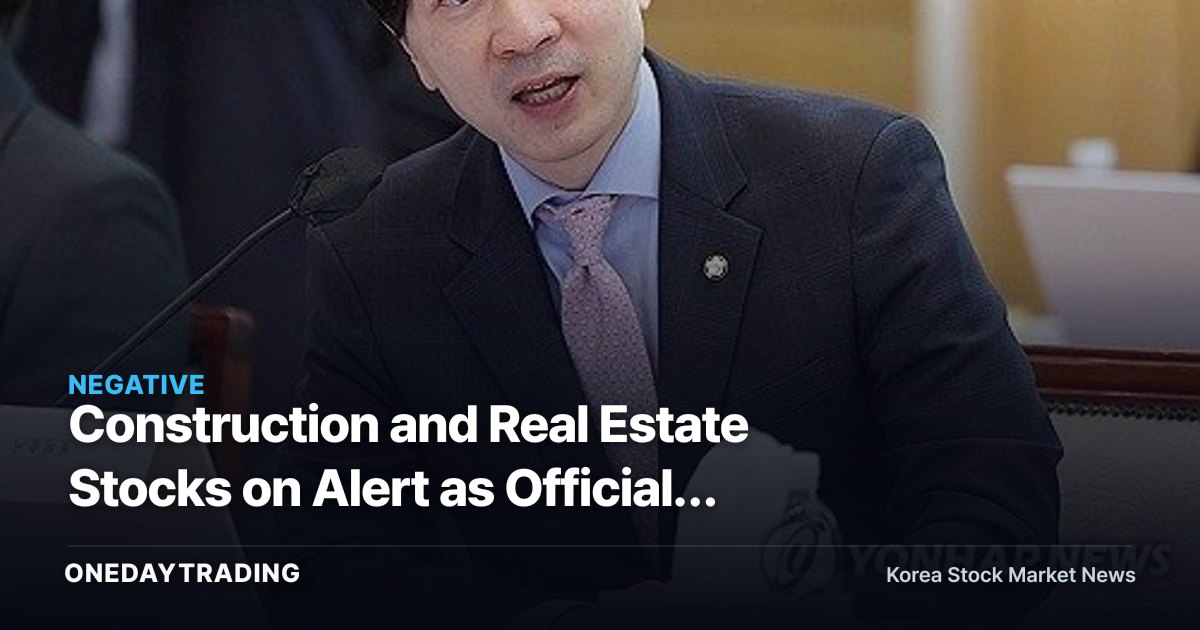
Political tensions have intensified over Policy Chief of Staff Kim Yong-beom's assessment of a "record-breaking boom" and his reference to normalizing property taxation. On the surface this is a debate over economic conditions, but from an investor's standpoint the more important signal is the policy direction toward tightening property holding taxes once again. This is a variable that directly touches demand and sentiment across the construction, real estate, and REIT sectors.
What Happened
Kim Yong-beom, the Presidential Chief of Staff for Policy, assessed Korea's economy as enjoying a "record-breaking boom" while also raising the need to normalize property taxation. In response, the People Power Party pushed back strongly, calling the view detached from the economy people actually feel — essentially asking whether officials are "living in a different world." It sets up a head-on clash between the government's read of a strong economy and the opposition's emphasis on the hardships of everyday life.
The economic assessment itself is closer to political rhetoric, but the phrase "tax normalization" is a term loaded with policy intent. Typically, "normalization" implies raising property holding tax burdens — such as the comprehensive real estate tax and property tax — that had been eased, or readjusting the realization rate of officially assessed property values. The market is trying to read from this single word where the center of gravity of future tax reform is headed.
Structural Background
Korea's real estate market moves with trading volume, prices, and holding tax burdens interlocking like gears. When holding taxes are tightened, the carrying costs for multiple-home owners rise, increasing selling pressure while dampening new buying sentiment. The effects spread to the housing divisions of builders — directly tied to demand for new supply such as pre-sales and redevelopment — to REITs that rely on rental income, and even to real estate brokerages and proptech firms linked to transactions.
That said, tighter taxation does not immediately trigger price declines. Because supply shortages, interest rate trends, and conditions in the jeonse (lease deposit) market all act simultaneously, taxation should be viewed as just one of many variables.
Impact on Stocks and Sectors
- Large-cap construction stocks: If tighter holding taxes cool housing demand, slowing pre-sale and redevelopment demand could weigh on the margins of builders with large housing exposure.
- Real estate REITs: Higher holding taxes can raise asset management costs, pressuring dividend capacity.
- Building materials and interiors: Tied to transaction and moving demand, downstream demand weakens when the market contracts.
- Banks and financials: Household loan growth is affected by shifts in mortgage demand.
Bullish vs. Bearish Scenarios
On the bullish side, if the perception of a strong economy holds true, solid income and employment could support demand-driven real estate and domestic consumption, and if policy is implemented gradually, the shock would be limited. On the bearish side, if tax normalization actually translates into legislation and holding tax burdens rise quickly, an influx of multiple-home listings and shrinking transactions would increase valuation pressure on construction and real estate-related stocks. At this stage it remains at the level of remarks, so uncertainty over the intensity and timing of policy is the biggest variable.
Investor Action Points
- Check the strength of language on holding taxes and assessed property values in the government's tax reform proposals and real estate measures.
- In builders' quarterly earnings, review the trend in new orders and pre-sale volumes in the housing division.
- For REITs, look at dividend yields, borrowing rates, and changes in holding tax costs together.
- Track the policy implementation stage step by step — whether it stays at the level of remarks or takes concrete shape through legislation and enforcement.
Hyundai E&C Through Real-Time Data
Hyundai E&C's latest closing price is 128,600 won (-3.45% vs. the previous day), and the signal light combining foreign and institutional supply-demand (order flow) with news and momentum is 🟡 Neutral · Wait-and-See. With positive and negative signals mixed, this is a zone to watch.
- ▼ Trend Alignment — short- and mid-term downward alignment (intraday -3.5% · 1 week -18.3% · 1 month -7.7%)
- ▲ News Flow — 5 positive catalysts vs. 0 negative catalysts — positive catalysts dominate
Recent related news is favorable, with 5 positive catalysts and 0 negative catalysts.
※ Price and foreign/institutional supply-demand (order flow) data are provided by Korea Investment & Securities (KIS) and are as of the time of publication.
This article is content automatically summarized and analyzed based on the original news. View original (Yonhap News)