
Summary
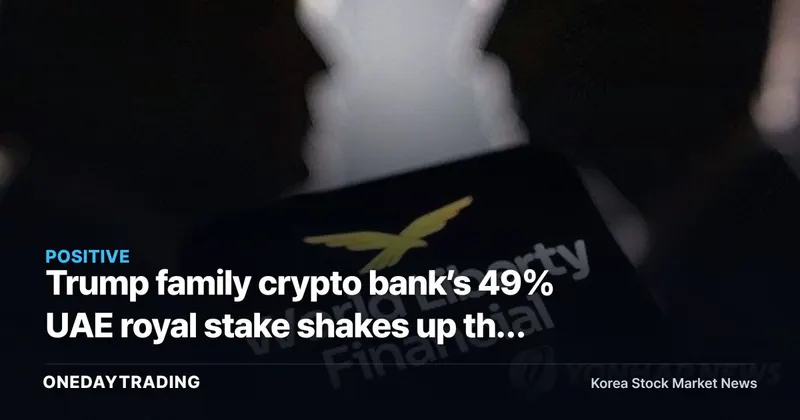
The fact that UAE royal capital has taken a 49% stake in WLTC Holdings, the holding company behind the Trump family’s crypto bank, means this story is less about coin prices than about the institutional entry of a stablecoin payment network. More important than where the money came from is who gets licensed and who collects the fees.
For Korean investors, the first thing to watch is the regulatory premium on trading and payment infrastructure stocks (ticker) such as Coinbase, Circle, and Robinhood, rather than Bitcoin itself. That said, as conflict-of-interest concerns grow, final approval and business expansion could slow further.
The Background
The key point from the WSJ report is simple. Sheikh Tahnoun bin Zayed Al Nahyan, the UAE president’s brother and national security adviser, secured a 49% stake in WLTC Holdings, the bank holding company for World Liberty Financial, the crypto finance firm tied to the Trump family. This structure is linked to a trust-bank-style license for handling the stablecoin USD1.
The market also took note of the U.S. Office of the Comptroller of the Currency (OCC) granting WLTC a preliminary conditional approval. It is not a final license yet, but the crypto project has passed its first gate to move beyond a simple issuer and into a banking framework. USD1 is being discussed at around a $4 billion market capitalization, and the fight has now shifted from coin prices to who controls the gatekeepers for issuance, custody, and settlement.
The issue is less the transaction itself than its symbolism. When foreign royal capital and the business interests of a U.S. president’s family overlap inside one company, the market tends to price in regulatory and political risk before growth potential.
Structural Context
Stablecoins are not volatility assets; they are channels connecting payments and settlement. That means the core of this business is not token price, but deposit management, on- and off-ramp fees, custody, and exchange services. Once banking approval is attached, the source of profits becomes clearer, but AML, sanctions, and reserve management also become much stricter.
What the market is watching here is the interest rate. If licensing and institutional credibility are added, valuation multiples can expand, but if political scandal deepens, the discount rate rises too. The same event creates both a positive catalyst and a burden. WLTC’s structure, which is closer to a trust bank than a deposit bank, is also important. This model is less about lending and more about trust and toll collection.
Impact on Stocks and the Industry Sector
- Coinbase is the sector bellwether that reacts first when regulatory clarity improves. As stablecoin trading and custody grow, the quality of recurring fees matters more than trading volume.
- Circle could benefit from the expansion of new stablecoins like USD1, since broader adoption lifts the entire market, but intensifying competition may cap the valuation upside.
- Robinhood gets a boost in trading activity when retail capital flows back into crypto and tokenized assets. However, when volatility eases, leverage expectations weaken.
- PayPal becomes more relevant as the overlap between payment networks and dollar-linked assets widens. Still, the pace at which that shows up in revenue is slower than the regulatory timeline.
- MicroStrategy is less a direct beneficiary of this news than a barometer of risk appetite. If regulatory easing lifts expectations for Bitcoin prices, it may react indirectly.
Bull vs. Bear Scenarios
The bull case is straightforward. If WLTC clears final approval and the business conditions, stablecoins could be re-rated as financial infrastructure rather than a side channel for crypto trading. In that case, the multiples of exchanges and payment platforms could expand before coin prices do.
The bear case is more realistic. If conflict-of-interest concerns intensify, approval could be delayed and the business model could remain confined to a narrow set of deposit and payment services. In that scenario, the market may buy the story first and then correct again once earnings need to prove it.
What Investors Should Watch
- Check the final OCC approval language. Whether it is conditional approval and how broad the business scope is will determine the size of the beneficiary set.
- Watch USD1’s market capitalization and circulation speed. In stablecoin businesses, earnings are driven more by usage than by issuance.
- In the next earnings reports from Coinbase and Circle, track the share of fees tied to stablecoins. Recurring revenue matters more than trading volume.
- Follow any new investigation schedules from the U.S. Congress and regulators. Political risk can compress valuations faster than coins move.
Frequently Asked Questions
Is the Trump family crypto bank a real bank?
At this stage, it is closer to a structure seeking a trust-bank license than to a fully formed commercial bank. The core business is not deposit-taking, but infrastructure functions such as stablecoin issuance, custody, and exchange.
Why is the UAE royal family’s 49% stake a problem?
The controversy is not just about foreign capital. It is about a senior figure tied to a foreign government becoming deeply involved in a financial business linked to the U.S. president’s family. The market is pricing in approval risk and political cost ahead of growth potential.
What should Korean investors watch?
Looking only at Bitcoin prices gives you half the picture. You also need to watch trading volume and stablecoin-related revenue at Coinbase, Circle, and Robinhood, as well as further decisions from the OCC and Congress.
This article is automatically summarized and analyzed based on the original news report. View original (Yonhap News Securities)