
Summary
Doyoon Lee, OneDayTrading Editorial Committee The fact that a 400-household apartment complex in Daejeon went without power for more than four hours during a heat wave is more than a matter of everyday inconvenience — it shows that the weakest link in the power infrastructure sits inside residential complexes themselves. For investors, this news draws attention first to replacement demand at distribution and receiving-equipment makers such as LS ELECTRIC, HD Hyundai Electric, and Hyosung Heavy Industries, rather than to Korea Electric Power Corporation's electricity sales volume.
The fact that outages struck both Daejeon and Dangjin, South Chungcheong Province, in quick succession is also significant. It suggests that power-demand strain isn't confined to a single major city — it can recur regionally during every heat-wave stretch.
What Happened
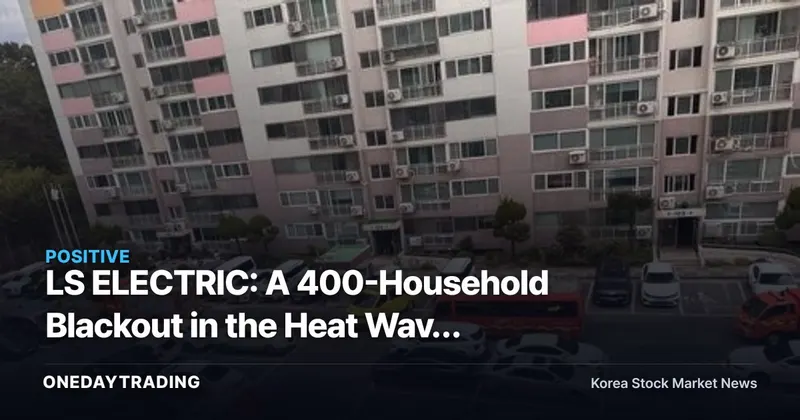
According to Yonhap News, a power outage hit a 400-household apartment complex in Daejeon, leaving residents without electricity for more than four hours during the heat wave. The same report noted that outages also continued in Dangjin. The confirmed figures are 400 households and more than four hours — and both numbers matter to investors.
A 400-household complex isn't a small multi-family building; it's an apartment community that requires a management body and equipment investment. More than four hours isn't a momentary blip — it's long enough to disrupt cooling, elevators, refrigeration and storage, and even device charging. During a heat wave, electricity stops being a convenience and becomes core infrastructure for residential safety.
That said, this report alone can't pin down the cause of the outage. Whether it originated in KEPCO's grid, in the apartment's internal receiving equipment, or in a specific equipment failure requires separate confirmation. So the read-through to stock prices shouldn't be treated as settled either. The direction points toward demand for power-equipment upgrades, but revenue recognition only shows up in the numbers once construction orders and delivery contracts are signed.
Structural Backdrop
The power-equipment cycle doesn't end with order backlogs. Stock prices actually strengthen most in the phase where a growing backlog lifts utilization, and that utilization holds up margins. A heat-wave blackout sits at the front end of this chain — it's the kind of event that builds the case for new orders.
Apartment-complex outages more often expose bottlenecks in terminal equipment than in the power grid as a whole. When cooling loads across households rise simultaneously, the spare capacity of transformers, circuit breakers, switchboards, and cables gets put to the test. In that moment, the beneficiaries are equipment and maintenance providers that reduce failure risk — not simply companies that sell more electricity.
Impact on Stocks and Sectors
- LS ELECTRIC: Its core business is low- and high-voltage distribution, circuit breakers, and power automation equipment. As discussion of replacing receiving equipment in apartments and commercial facilities grows, it's grouped as the most direct domestic power-equipment (industry sector) candidate.
- HD Hyundai Electric: Demand for transformers and power equipment is riding a global capacity-expansion cycle. Domestic residential-equipment issues alone can't explain its earnings, but they reinforce the broader power-infrastructure investment narrative.
- Hyosung Heavy Industries: It holds a heavy-electrical-equipment portfolio that includes transformers and circuit breakers. Order visibility becomes important as investment in replacing aging equipment and stabilizing power supply expands.
- Korea Electric Power Corporation (KEPCO): If the outage's cause is confirmed to lie in the grid, cost and regulatory burdens could come into focus. Conversely, if the fault lies in the complex's own equipment, the direct earnings impact would be limited.
- Construction and property-management firms: For new developments, power capacity and backup equipment are becoming part of what makes a project competitive at pre-sale. For existing complexes, long-term repair reserve funds and resident approval determine how fast replacements happen.
Bullish vs. Bearish Scenarios
The bullish scenario is straightforward. If the heat wave persists and outages keep recurring, local governments, resident representative councils, and management bodies could move up inspection and replacement budgets for receiving equipment. That would add demand for terminal distribution equipment on top of large-scale transmission-grid investment, benefiting power-equipment makers.
There's a bearish scenario too. Equipment-replacement decisions at the apartment-complex level are slow. Once resident cost-sharing, long-term repair plans, insurance claims, and liability questions get tangled together, it takes time to reach an actual order. Power-equipment stocks (tickers) have already priced in a substantial amount of expectation around data centers, renewable energy, and aging-grid investment, so it's risky to read a single incident as a direct trigger for an earnings upgrade.
Investor Action Points
- The next heat-wave stretch: Watch whether outage reports stay isolated or start recurring. If the number of affected regions and households, along with recovery times, keeps climbing, the case for equipment investment strengthens.
- Corporate disclosures: Track changes in distribution/transformer orders and delivery schedules at LS ELECTRIC, HD Hyundai Electric, and Hyosung Heavy Industries — this is the first point where the news converts into revenue.
- Where liability lands: Determine whether the cause traces back to KEPCO's grid or to equipment inside the complex itself, since that distinguishes which stocks (tickers) stand to benefit versus suffer.
- Policy timeline: Check whether the government or local authorities roll out inspections of residential electrical equipment, subsidies for aging equipment, or heat-wave response budgets.
LS ELECTRIC by the Numbers
LS ELECTRIC's most recent closing price was 201,000 won (-0.74% versus the prior session), and the composite signal combining foreign-investor and institutional-investor supply-demand (order flow) with news and momentum reads 🟡 Neutral — Watch. With positive and negative signals mixed, this is a wait-and-see zone.
- ▼ 52-Week Range Position — Near the bottom 7% of its 52-week range
Recent related news skews favorable, with 1 positive catalyst and 0 negative catalysts.
※ Price and foreign-investor/institutional-investor supply-demand (order flow) data are provided by Korea Investment & Securities (KIS) and are current as of publication time.
This article was automatically summarized and analyzed based on the original news report. View original (Yonhap News, Industry)