
Key Takeaways
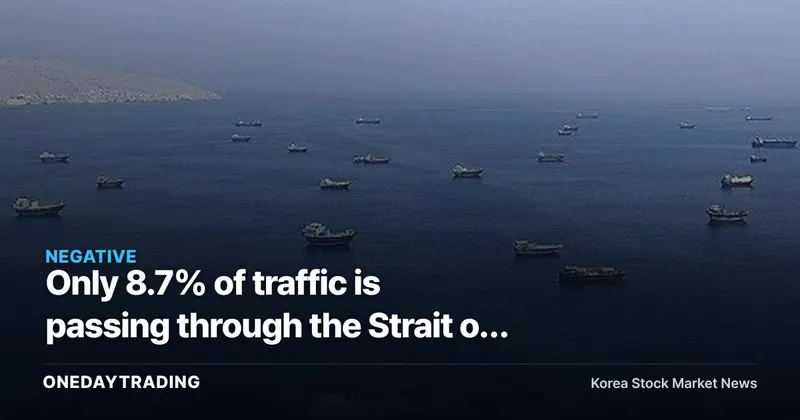
The fact that traffic through the Strait of Hormuz has fallen to 8.7% of prewar levels means that marine insurance and freight rates could spill into the Korean stock market before crude oil prices do. Refiners may have room for inventory valuation gains, while airlines and chemicals face cost pressure first.
In this setup, the market looks at the numbers before the political headlines. If cargo volumes do not recover, the duration of the risk premium matters more than the direction of oil prices.
What Happened
As of August 29, based on Yonhap News reporting, the 24-hour cargo volume passing through the Strait of Hormuz was just 8.7% of prewar levels, with only three vessels transiting the passage. Another 500 vessels were waiting, and war-risk insurance rates jumped to 3%, 20 times normal. When logistics are blocked, prices react first through insurance and transport costs rather than spot prices.
Iran condemned U.S. sanctions as a violation of international law and economic violence targeting civilians, and said that reopening Hormuz would require conditions. By contrast, Pakistan, Oman, Qatar and the United Nations continue to step in as mediators. The market has to price in both scenarios at once: a prolonged blockade and a diplomatic reopening.
What matters here is Iran's domestic situation. Last month's inflation rate surged to 66%, while external trade fell 35%, which could increase pressure to negotiate. At the same time, it could also intensify the regime's instinct to defend itself. That is why this is not just a diplomatic story, but a macro variable affecting the energy supply chain and the inflation path.
Background and Context
Hormuz is a critical bottleneck for crude oil and liquefied petroleum gas. When this route is disrupted, oil prices no longer move on supply and demand alone, but on a composite price that also includes insurance, detour costs and inventory holding costs. That is also why Brent crude moves first.
The Korean market absorbs this shock together with the exchange rate. If the won-dollar exchange rate moves above 1,400 won, import costs rise faster, and if oil prices stay elevated, margins in airlines and chemicals come under pressure. On the other hand, refiners may benefit from refining spreads and inventory valuation, but if a sharp gain (surge) in oil prices leads to weaker demand, that effect fades quickly.
Impact on the Market and Stocks
- S-Oil, SK Innovation : Higher oil prices and wider refining spreads could translate into inventory valuation gains. However, if oil prices rise too far, weaker demand and procurement costs also increase.
- Korean Air : Jet fuel costs rise directly, weighing on profitability. If the won-dollar exchange rate moves above 1,400 won, pressure from fuel and lease costs accelerates further.
- HMM, Pan Ocean : If route uncertainty lasts, detours and higher insurance costs may be passed through into freight rates. However, if the industry sector is weak, cost pass-through will not fully remain as profit.
- Lotte Chemical : Higher naphtha and energy costs shake spreads. If product price pass-through is delayed, margins are squeezed first.
- Banks and domestic demand stocks : When oil prices and the exchange rate rise together, inflation expectations climb, putting pressure on the rate path and consumer sentiment. In that case, the market is more likely to rotate toward defensive names.
Investor Checklist
- If cargo volume through Hormuz falls below 10% of prewar levels, insurance and freight rates are repriced before oil prices.
- Watch the spread between Brent crude and Dubai crude. As Middle East risk rises, the spot premium widens first.
- If the won-dollar exchange rate moves above around 1,400 won, cost sensitivity rises for airlines and chemicals.
- The next catalyst is the outcome of mediation by the United Nations, Qatar, Oman and Pakistan. If talks continue, the risk premium fades; if they fail, volatility in refiners and shipping increases.
Outlook
The longer a full blockade lasts, the more strongly the Korean market is likely to reflect industry sector differentiation. If oil prices and freight rates stay high, refiners and some shipping companies may hold up relatively well, but airlines, chemicals and domestic consumption stocks will have a hard time avoiding cost pressure.
Conversely, if mediation advances and traffic recovers, the market can quickly strip out the risk premium. That said, as long as Iran continues to demand sanctions relief and compensation, a conditional easing looks more likely than a quick settlement. So the first thing to watch, ahead of next quarter's earnings, is the pace of actual traffic recovery and the insurance rate.
Frequently Asked Questions
Why do refiners and airlines diverge if the Strait of Hormuz is blocked?
Refiners buy crude and sell refined products, so higher oil prices can lead to inventory valuation gains and improved refining margins. Airlines, by contrast, have jet fuel as a direct cost, so when oil and the dollar rise together, profits are quickly eroded.
What indicators should Korean investors watch first?
Brent crude, the won-dollar exchange rate, and traffic through Hormuz. If all three move at once, the chance that cost pressure will show up in actual earnings is high.
If mediation continues, will the market stabilize immediately?
Not necessarily. The market watches vessel transit numbers and insurance rates, not just the wording of an agreement. Only when actual cargo traffic recovers does the oil premium fade, and only then do the burdens on airlines, chemicals and transport stocks ease.
Brent Crude IndicatorAs of 2026-08-29
| Period move | 1 week -6.06% 1 month -2.91% |
|---|
Indices, commodities and exchange rates are based on global markets and reflect values at the time of publication.
This article is automatically summarized and analyzed based on the original news report. View original article (Yonhap News Securities)