
Three-Line Briefing
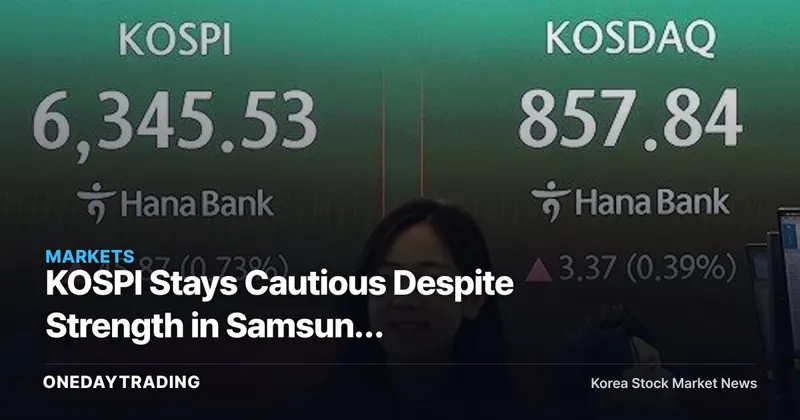
- On the 12th, the domestic stock market opened in a cautious, wait-and-see mode, unable to settle on a direction amid conflicting signals — geopolitical uncertainty surrounding the Strait of Hormuz on one hand, and strength in U.S. semiconductor stocks on the other.
- Oil-price risk translates directly into cost burdens for Korea's economy as a crude oil importer, while strength in U.S. chip stocks is fueling hopes of a valuation re-rating for the semiconductor heavyweights that dominate KOSPI market capitalization.
- Whether the index can actually sustain a rebound hinges on how much — and how long — oil prices rise, and how much of that tailwind the semiconductor sector's leading stocks can absorb.
What's Changing
The KOSPI losing momentum matters less for the index figure itself than for the signals embedded within it. It means the forces that pushed the index up through yesterday and the forces holding it back today are coming from different issues. Strength in U.S. semiconductor stocks is a factor the market has already priced in to some degree. The problem is Strait of Hormuz risk — a variable whose degree of pricing-in is still hard to gauge, which makes it all the more unsettling.
The Strait of Hormuz is a chokepoint through which a substantial share of the world's seaborne crude oil traffic passes. If uncertainty over this passage persists, the transmission path is straightforward: concerns over rising oil prices feed into import prices and inflation pressure, which then complicate monetary authorities' interest-rate calculus, ultimately weighing on valuation multiples for growth stocks. Semiconductors are the industry sector leaders with the highest valuation sensitivity on the KOSPI. Assuming that domestic semiconductor heavyweights will simply follow U.S. chip stocks higher overlooks the fact that the market has not yet fully scored the oil-price variable.
This is precisely why "cautious, wait-and-see trade" is the accurate description. When a bullish catalyst — semiconductors — and bearish catalysts — oil prices and geopolitical risk — are both alive at the same time, the index refrains from betting on either side and instead stays on the sidelines. In this phase, sector rotation moves ahead of the broader index.
Numbers in Context
Given that Samsung Electronics and SK Hynix together account for a substantial share of KOSPI market capitalization, strength in U.S. chip stocks carries enough weight to steer the direction of the entire index. On the other hand, Korea is a country that relies entirely on imports for its crude oil. Any disruption to oil shipments through the Strait of Hormuz would burden refiners and chemical makers with higher input costs, while airlines and shippers would take a direct hit from fuel expenses. Right now is the phase where these two forces are offsetting each other within the same index.
Stocks to Watch — Winners and Losers
- Samsung Electronics, SK Hynix: If strength in U.S. chip stocks persists, these are the industry sector leaders among KOSPI large caps most likely to be first in line for a valuation re-rating.
- S-Oil, SK Innovation: As direct crude oil refiners, rising global oil prices raise their cost burden, though short-term earnings direction may vary depending on inventory valuation gains and refining margin conditions.
- Korean Air, HMM: Fuel costs make up a large share of their cost base, so a prolonged rise in oil prices would translate directly into earnings pressure.
- KB Financial Group, Shinhan Financial Group: If oil-driven inflation complicates the interest-rate calculus, it would also shake up the net interest margin math for the banking sector.
Risk Check
- Whether Strait of Hormuz uncertainty actually translates into disrupted crude oil shipments — or ends up being just a concern — remains unconfirmed.
- Whether strength in U.S. semiconductor stocks carries through directly to domestic semiconductor heavyweights may hinge on exchange-rate and supply-demand (order flow) variables.
- If the cautious, wait-and-see trade drags on, trading volume could shrink, potentially amplifying volatility instead.
- The impact of rising oil prices on the domestic monetary authority's rate-decision calculus remains only an estimate until the next set of indicators is released.
Bottom Line
Semiconductors clearly have the power to lift the index, but the fact that oil-price risk has not yet been fully priced in could hold back this upside scenario. The direction will only become clear once we see the next level for oil prices alongside the actual response from domestic semiconductor heavyweights.
This article was automatically summarized and analyzed based on the original news report. View original (Yonhap News Agency, Securities)