
Summary
The KOSPI’s close at 6,820.02 was not confirmation of a bull market, but a session in which semiconductor share buyback-related supply-demand (order flow) held off the rate shock for one day. According to Yonhap News as of August 31, other corporations posted net buying of 1.5773 trillion won on the main board, and that money drove intraday reversals in Samsung Electronics and SK hynix.
What this really says is that earnings matter more than rates. Even as the probability of a September U.S. benchmark interest rate hike jumped from 35.4% to 57.5%, the KOSPI managed to turn its closing price positive, meaning the market had already priced in part of the rate-related negative catalyst and was shifting the next question to the resilience of corporate earnings.
What Happened
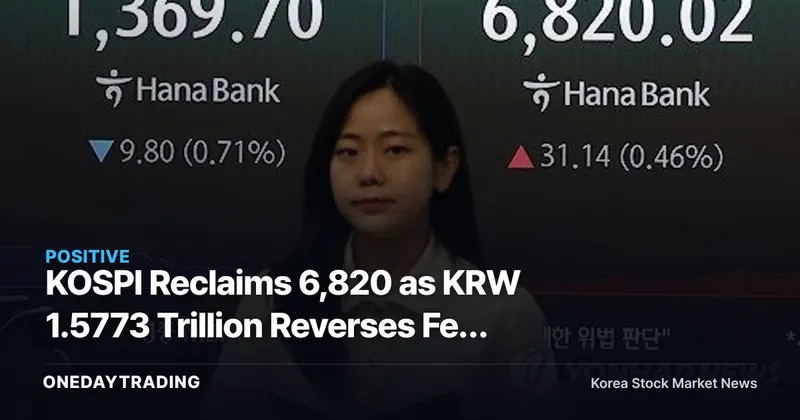
On the 31st, the KOSPI opened at 6,613.58, down 175.30 points, or 2.58%, from the previous session. Its intraday low was 6,547.76. The decline widened to as much as 3.55% at one point. But the closing price was 6,820.02, up 31.14 points, or 0.46%, from the previous session.
The starting point was the U.S. Jackson Hole meeting. On August 28, Federal Reserve Chair Kevin Warsh said, in effect, that the Fed would need to respond if inflation did not move sufficiently toward its target. Fed funds futures markets pushed the probability of a 0.25 percentage-point hike at the September FOMC back up to 57.5%.
U.S. equities reacted first. On August 28, the Dow Jones fell 0.02%, the S&P 500 lost 0.25%, and the Nasdaq declined 0.52%. The Philadelphia Semiconductor Index dropped 3.47%, while Nvidia fell 4.57%. That is why Korean stocks came under pressure immediately after the open, led by large-cap semiconductor names.
Structural Backdrop
Concerns over a benchmark interest rate hike hit valuation multiples first. When the discount rate rises, it becomes harder to assign high valuations to profits far in the future. That is why industry sectors such as AI, semiconductors, and growth stocks, where earnings expectations have already been priced in, tend to wobble first. The 3.47% drop in the Philadelphia Semiconductor Index flowed directly into a higher risk premium for Samsung Electronics and SK hynix in the Korean market.
But the day’s closing price sent a different message. Retail investors sold a net 143.6 billion won, foreign investors sold 640.2 billion won, and institutional investors sold 793.8 billion won. Under a typical supply-demand (order flow) setup, the index should have ended near its lows. Instead, other corporations bought 1.5773 trillion won, changing the index’s lower bound. The key point is that Samsung Electronics’ treasury share purchases for employee stock compensation and SK hynix’s treasury share purchases for cancellation were counted as other-corporation buying for the ninth consecutive trading day.
Impact by Stock and Industry Sector
- Samsung Electronics: Overcame early weakness and closed up 1.17%. A rate shock weighs on multiples, but share buybacks reduce free float and support short-term supply-demand (order flow).
- SK hynix: Rose 1.27%. Even after the sharp drop (plunge) in the U.S. semiconductor index, if expectations remain for tight memory supply and stronger pricing power, earnings momentum can act as a shield even in a high-rate environment.
- Samsung Electro-Mechanics: Gained 2.60%. With the electrical and electronics industry sector up 1.22%, the recovery in supply-demand (order flow) for the two semiconductor bellwethers also created a downside cushion for component-stock valuations.
- LG Energy Solution: Advanced 2.16%. Rate pressure remains across growth stocks broadly, but on this day only large-cap growth names with resilient supply-demand (order flow) staged selective rebounds.
- Securities: The industry sector fell 1.66%. Although the index rose, 489 stocks declined versus 366 gainers, making it hard to view the move as a recovery in trading sentiment.
Bullish vs. Bearish Scenarios
The bullish scenario is clear. If the perception holds through the September FOMC that the pace of rate hikes will be moderate, the market will again favor industry sectors with earnings growth over those hit by the discount-rate shock. In that case, semiconductors remain the center of gravity for the KOSPI. If Samsung Electronics and SK hynix move beyond the share buyback effect and see actual upward revisions to earnings estimates, the 6,800 level could harden into short-term support for the index.
The bearish scenario comes from the same axis. If U.S. inflation data overshoots again, a 0.25 percentage-point hike will not stop at being priced in and will spread into uncertainty over the next policy path. In that case, share buybacks may be enough to defend one day’s supply-demand (order flow), but they will struggle to reverse falling multiples. The fact that declining stocks outnumbered advancing stocks is evidence that the market’s internal strength is still thin.
Investor Action Points
- Rate probabilities before the September FOMC: Investors should check whether the Fed funds futures-implied probability of a 0.25 percentage-point hike rises further from 57.5%. If the probability expands, pressure on growth-stock multiples will increase.
- Won-dollar exchange rate in the 1,360 won range: As of 3:30 p.m. on August 31, the won-dollar exchange rate was 1,368.6 won. If the exchange rate holds in the 1,360 won range, foreign investors’ selling pressure could ease somewhat.
- Persistence of other-corporation net buying: Other-corporation buying continued for a ninth trading day. If share buyback-driven supply-demand (order flow) weakens, the downside protection for Samsung Electronics and SK hynix will diminish.
- Market breadth: Even if the KOSPI rises, if declining stocks continue to outnumber advancers, the index rebound will remain limited to large caps. Investors should also watch whether small- and mid-cap growth stocks fail to keep pace, as reflected in the KOSDAQ’s close at 834.29.
Frequently Asked Questions
Why did the KOSPI plunge intraday and then reclaim the 6,800 level?
On August 31, the KOSPI fell as low as 6,547.76 intraday on concerns over U.S. rate hikes, but closed higher at 6,820.02 as other corporations recorded net buying of 1.5773 trillion won. Samsung Electronics and SK hynix rose 1.17% and 1.27%, respectively, leading the index reversal.
Why do Fed rate-hike concerns matter for Korean semiconductor stocks?
A Fed benchmark interest rate hike raises the discount rate, lowering valuations for growth stocks and semiconductor stocks. After the Philadelphia Semiconductor Index fell 3.47% on August 28 and Nvidia dropped 4.57%, Korean semiconductor stocks also faced selling pressure right after the open.
When will the effect of Samsung Electronics and SK hynix share buybacks become clear?
The share buyback effect first shows up in daily other-corporation net buying and closing-price resilience. However, the next stage for their share prices will depend on the rate path after the September FOMC and whether memory prices, shipments, and margins recover in the next earnings releases.
KOSPI Index MetricsAs of 2026-08-31
| Period Trend | 1 Week -1.34% 1 Month +20.43% |
|---|
Index, commodity, and exchange rate figures are based on global market standards and reflect values at the time of publication.
Samsung Electronics Key MetricsAs of 2026-08-31
| Period Return | 1 Week +1.17% 1 Month +25.60% |
|---|---|
| Trading Value · Trading Volume | 4.3192 trillion won · 17,009,810 shares |
| Supply-Demand (Order Flow) | Foreign Investors +4 billion won net buying Institutional Investors −594.5 billion won net selling |
| Recent News Tone | Positive Catalyst 6 · Negative Catalyst 8 |
Price and supply-demand (order flow) data are real-time values from Korea Investment & Securities (KIS), while supply-demand (order flow) and news-tone aggregates are calculated by OneDayTrading.
Upcoming Events to Watch
- 09.10Futures and Options Triple ExpirationMediumQuadruple witching — watch for volatility and supply-demand (order flow) disruptions
- 09.16FOMC Policy Rate DecisionHighU.S. Fed monetary policy announcement — direction of rates and the dollar
- 10.08Index Options ExpirationLowKOSPI200 options expiration
- 10.22Bank of Korea Monetary Policy BoardHighBenchmark interest rate decision meeting
This article is automatically summarized and analyzed content based on the original news report. View original article (Yonhap News Securities)