
Three-Line Briefing
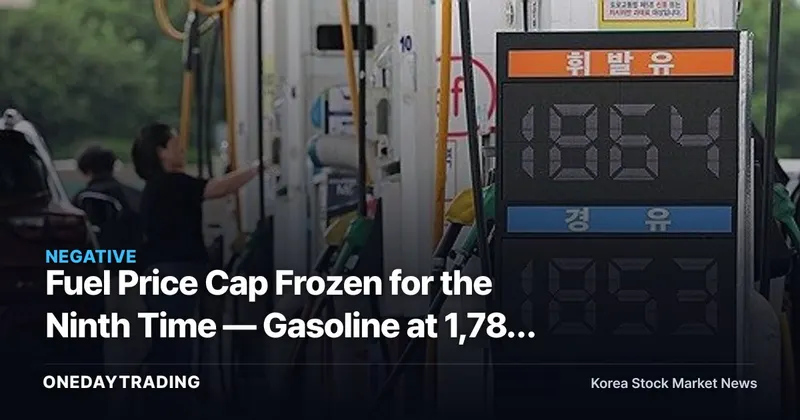
- Amid ongoing uncertainty over the Middle East situation, the government has frozen the fuel price cap for the ninth round, keeping gasoline at 1,784 won per liter and diesel at 1,773 won per liter.
- Since the fuel price cap fixes an upper limit on consumer prices, pressure on refiners and distribution networks to absorb margin compression grows whenever global oil prices and the exchange rate rise.
- Investors should watch cost sensitivity in sectors where fuel expenses hit earnings directly — aviation, logistics, and chemicals — even ahead of refining stocks themselves.
What's Changing
Freezing the fuel price cap is a policy signal aimed at holding down consumer inflation during a period of rising oil prices. What the numbers 1,784 won for gasoline and 1,773 won for diesel really reflect isn't price stability — it's a reshuffling of who absorbs the margin. When crude import costs rise, someone has to absorb the difference.
Refining stocks aren't simple beneficiaries of higher global oil prices alone. While rising crude prices can generate inventory valuation gains, a price cap that limits pass-through to selling prices narrows the room for improvement in refining margins and domestic distribution margins. For companies with refining exposure such as SK Innovation, S-Oil, and GS, product spreads and the ability to pass costs through to domestic selling prices matter more than the direction of oil prices itself.
Conversely, aviation, logistics, and chemicals get a short-term cost buffer. At Korean Air, jet fuel prices sway operating costs, while at logistics firms like CJ Logistics, diesel prices are tied to shipping rates and driver cost structures. However, if the price freeze is absorbed purely at the distribution stage without subsidies or tax adjustments, the effect will mostly be felt by consumers and show up only marginally in corporate earnings.
Numbers in Context
According to a Yonhap News report, the government's ninth freeze of the fuel price cap keeps gasoline at 1,784 won per liter and diesel at 1,773 won per liter. The gap between diesel and gasoline prices is just 11 won. For diesel-dependent sectors like freight, construction, and logistics, this narrow spread is a key indicator for assessing cost structure.
What the market has already priced in is the Middle East risk itself. What hasn't been fully priced in yet is the failure of cost pass-through when a weaker won and rising oil prices hit at the same time. Crude oil is purchased in dollars, while domestic sales are settled in won. When the KRW/USD exchange rate rises, won-denominated costs increase even at the same level of global oil prices.
Winners and Losers
- S-Oil: With a large weighting in core refining operations, it's highly sensitive to global oil prices and refining margins. The price cap freeze limits pass-through power on domestic selling prices, which could weigh on near-term margin improvement.
- SK Innovation: Its refining and battery businesses move together. Rising oil prices may favor inventory valuation gains in refining, but with the price ceiling held in place, any expansion in domestic sales margin remains conditional.
- GS: Affected by the refining cycle through GS Caltex's earnings. During a phase of government price control, how the policy burden is shared matters more than product spreads.
- Korean Air: Fuel costs make up a major share of expenses. Stable domestic petroleum product prices ease cost sentiment, but jet fuel is more directly exposed to global oil prices and the exchange rate.
- CJ Logistics: Diesel prices are linked to ground logistics costs. The diesel freeze at 1,773 won improves near-term cost visibility, but earnings improvement will be limited if freight-rate pass-through power is weak.
Risk Check
- If the Middle East situation worsens and global oil prices rise further, the price cap freeze shifts from a consumer-protection measure to a burden variable for refiners and distributors.
- A rising KRW/USD exchange rate increases the cost of importing crude. Even if oil prices stay flat, a weaker won raises won-denominated costs for domestic refiners.
- If the government prolongs the price freeze, both the inflation-stabilizing effect and the margin pressure on companies grow simultaneously. The key question for share prices is which side gets priced in first.
- Earnings at aviation and logistics stocks aren't determined by fuel-cost stability alone. Passenger demand, freight rates, labor costs, and maintenance costs all move together.
Bottom Line
The fuel price cap freeze acts as a buffer for consumer inflation, but under conditions where oil prices and the exchange rate rise at the same time, it becomes a policy variable that shakes both refiners' margins and transportation companies' costs.
Frequently Asked Questions
Is the fuel price cap freeze a positive catalyst for refining stocks?
The fuel price cap freeze is not a simple positive catalyst for refining stocks. Even if rising global oil prices generate inventory valuation gains, keeping the ceiling at 1,784 won for gasoline and 1,773 won for diesel could weaken pass-through power on domestic selling prices.
What does gasoline at 1,784 won and diesel at 1,773 won mean?
It means the government has held the consumer price ceiling steady by freezing the fuel price cap for the ninth round. With the gap between gasoline and diesel prices at just 11 won, cost pressure remains highly sensitive for logistics and freight sectors that rely heavily on diesel.
What should investors watch among stocks (tickers) tied to the fuel price cap?
Stocks (tickers) tied to the fuel price cap fall into two groups: companies with large refining exposure such as S-Oil, SK Innovation, and GS, and companies highly sensitive to fuel costs such as Korean Air and CJ Logistics. Key indicators to track next are global oil prices, the KRW/USD exchange rate, and whether the government adjusts the price cap again.
S-Oil in Real-Time Data
S-Oil's most recent closing price was 141,100 won (-1.05% from the previous day), and the signal combining foreign/institutional investor order flow with news and momentum reads 🟢 Net Buy Bias. Foreign investors, institutional investors, and news sentiment are all positive, making it worth watching.
- ▲ Double Net Buying — foreign investors +600 million won · institutional investors +300 million won, buying in tandem
Recent related news is favorable, with 1 positive catalyst and 0 negative catalysts.
※ Price and foreign/institutional order-flow data are provided by Korea Investment & Securities (KIS), as of publication time.
This article was automatically summarized and analyzed based on the original news report. View original (Yonhap News Securities)