
Summary
SK Hynix's decision to scrap degree requirements is not simply an HR policy tweak — it reflects an industry structure in which, amid the AI memory boom, securing core talent translates directly into production capacity and technology gaps. From an investor's standpoint, this can be read less as a cost line item and more as a leading indicator of future competitiveness.
That said, the hiring policy itself is not a direct catalyst for near-term earnings or the stock price, and since the success or failure of a talent strategy only shows up over several years in the form of yields and order intake, the directional impact is best classified as neutral.
What Happened
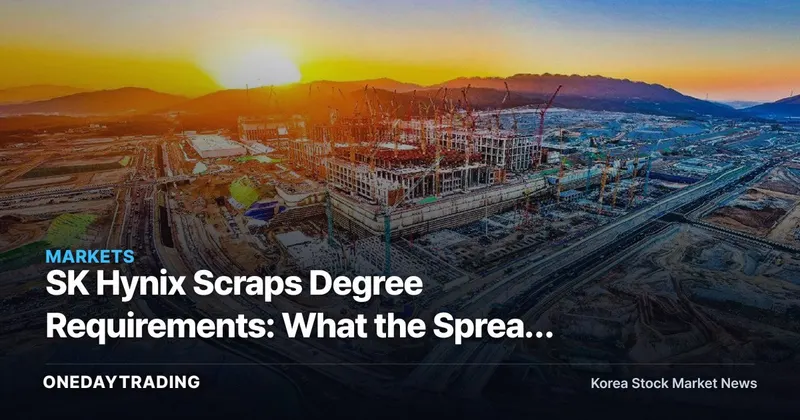
SK Hynix recently eliminated educational background restrictions from its rolling recruitment of new graduates. By dropping the practice of limiting eligibility to applicants above a certain academic credential, the company sent a signal to both the market and job seekers that it will prioritize job fit and potential over prestige of school or major. Given that SK Hynix (000660) stock has become something of a meme among retail investors online, the fact that such a closely watched company is lowering its hiring bar has drawn even more attention to blind hiring.
This trend is not unique to SK Hynix. Samsung Group has run an open hiring policy — disregarding academic background and pedigree — for some 30 years already, and other conglomerates such as Lotte and POSCO are revamping their systems in a similar direction. The key point is that this is not an isolated HR experiment at one company, but a shift in the hiring standard across large Korean conglomerates as a whole.
Structural Background
Behind this lies a shift in demand structure within the semiconductor industry. As the spread of generative AI has driven explosive demand for high-bandwidth memory (HBM) and advanced packaging, demand for cross-disciplinary talent spanning design, process, and software has outgrown what a diploma alone can certify. A limited pool of graduates from elite science and engineering programs can no longer meet surging workforce needs, while global Big Tech firms and foundries compete for the very same talent pool.
Scrapping degree requirements can be seen as a rational response to this environment — widening the applicant pool to surface hidden job-relevant capabilities. Since talent-acquisition cost, retention, and flexibility in job reassignment ultimately affect yields and the pace of new-product ramp-up, HR strategy functions as a downstream variable of manufacturing competitiveness.
Impact on Stocks (Tickers) and Industry Sector
- SK Hynix (000660): The company at the center of the issue. With SK Hynix holding HBM leadership, expanding its talent pool works to ease workforce bottlenecks tied to capacity expansion and new-process ramp-up, and talent competitiveness is directly linked to mid-to-long-term yields.
- Samsung Electronics (005930): Having run open hiring for 30 years as a precedent-setter, the company is highlighted as a direct competitor to SK Hynix in the race to secure memory and foundry talent.
- POSCO Holdings (005490): As the company expands from steel into battery materials, demand for specialized talent in new business lines has grown, making it a prime beneficiary of expanded blind hiring.
- Lotte Corporation (004990): The move aligns with the company's push to restructure its workforce around job-based hiring as it digitally transforms legacy businesses such as retail and chemicals.
- Semiconductor equipment/materials/parts industry sector: As large IDMs continue expanding capacity and headcount, order flow and staffing demand at front-end and back-end process suppliers are affected as well.
Bull vs. Bear Scenarios
From a bullish perspective, scrapping degree requirements is read as a sign of confidence in the talent-acquisition race and of intent to expand the business. As long as HBM demand stays firm and capacity expansion continues, a broader talent pool reduces the risk of production disruptions and acts as a buffer against the loss of technical staff.
The bearish view is equally clear. A change in hiring policy alone does not immediately show up in earnings, and workforce expansion can lead to higher fixed costs. If the memory cycle turns down, the added labor costs become a burden, and the elevated valuations on semiconductor stocks (tickers) can react sensitively to a slowdown in the industry sector or to swings in the exchange rate and demand. An HR policy change alone is a weak basis for a buy decision on the stock (ticker).
Investor Action Points
- Check whether SK Hynix's and Samsung Electronics' upcoming quarterly earnings — specifically HBM revenue share and shipment guidance — support the narrative behind workforce expansion.
- Track fixed-cost trends via labor and R&D expense lines in quarterly reports to see whether headcount growth is eroding profitability.
- Monitor memory spot and fixed-contract prices alongside the won-dollar exchange rate to gauge industry direction and export margins.
- Keep capacity-expansion and order-related disclosures, as well as capex announcement schedules, on your calendar to verify whether the talent strategy is translating into actual capacity growth.
SK Hynix by the Numbers (Real-Time Data)
SK Hynix (000660)'s most recent closing price is 2,685,000 won (unchanged from the previous session, 0.00%), and the composite signal combining foreign investor/institutional investor order flow (supply-demand) with news and momentum reads 🟢 net buying bias. With news flow skewing positive, the stock (ticker) may be worth watching.
- ▲ 52-week range position — 100% of the 52-week range — trading in new-high territory
- ▲ News flow — 27 positive catalysts vs. 5 negative catalysts — positive catalysts dominate
Recent related news skews favorable, with 27 positive-catalyst stories versus 5 negative-catalyst stories.
※ Price and foreign/institutional investor order-flow data are provided by Korea Investment & Securities (KIS) and reflect figures as of the time of publication.
This article was automatically summarized and analyzed based on the original news source. View original article (Maeil Business Newspaper, Corporate)