
Summary
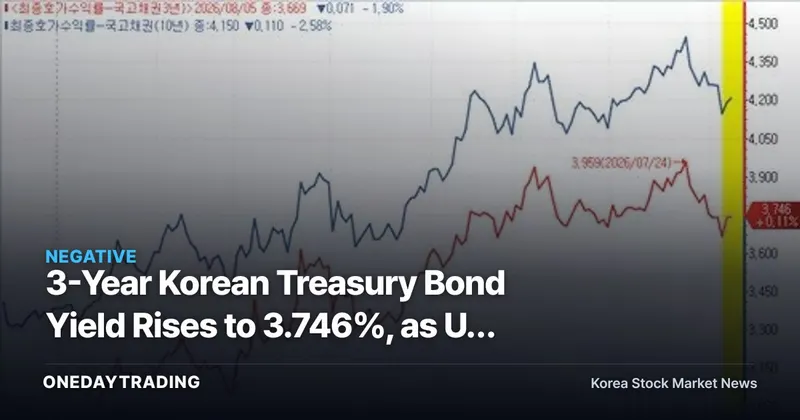
Korean government bond yields mostly rose on the 7th, with the benchmark 3-year note climbing to 3.746%. The catalyst behind the move wasn't Bank of Korea policy but US economic data — reaffirming that Korea's bond market has recently been driven more by external variables than domestic ones. A higher discount rate means heavier valuation pressure on sectors weighted toward future earnings, while it works as a favorable catalyst for sectors that live off net interest margin.
What Happened
Government bond yields trended higher across most maturities on the day, with the benchmark 3-year note settling at 3.746%. Market participants kept a close eye on US releases as they timed their buying and selling of domestic bonds. The reason Korean government bond yields react so sensitively to a single US data point is simple: the Bank of Korea's benchmark interest rate path is effectively tethered to the US Federal Reserve's policy rate trajectory and the level of the KRW/USD exchange rate.
None of this is new. Korea's bond market has repeatedly shown heightened volatility around US employment and inflation data releases for several quarters now. What's different this time is that expectations for a domestic rate cut are colliding head-on with forecasts that the US will hold — or delay cutting — its policy rate. Until that gap narrows, the direction of Korean government bond yields will keep being whipsawed by individual US releases rather than domestic indicators.
Structural Backdrop
Tracing the chain from rates to valuation to sector leadership reveals a spot the market hasn't fully priced in yet. When government bond yields rise, discount rates climb, and that lowers the fair valuation of growth stocks and high-P/E sectors that price in future earnings. Banks and insurers, by contrast, benefit when funding costs lag behind the faster rise in earning-asset yields. The issue is that the broader KOSPI's valuation doesn't appear to have fully absorbed this rate level yet. Compared to how quickly the 3-year yield has climbed into the mid-3.7% range, the multiple compression in growth stocks has been comparatively slow.
Stock (Ticker) and Sector Impact
- KB Financial Group / Shinhan Financial Group — Rising market rates translate directly into wider net interest margins, a tailwind for bank earnings power. That said, if concerns over loan defaults grow in tandem, the benefit could be offset by rising funding costs.
- Samsung Life Insurance / Samsung Fire & Marine Insurance — For insurers, a rise in long-term government bond yields lifts the discount rate applied to policy reserves, easing liability burdens while also improving investment yields.
- GS E&C / Hyundai Engineering & Construction — Rising rates simultaneously push up project-financing costs and the loan-interest burden on homebuyers, making them a headwind for the construction and real estate development industry sector.
- High-P/E growth stocks / biotech industry sector — As the discount rate rises, valuation pressure intensifies most for sectors with a heavier weighting toward future earnings. Stock (tickers) without earnings to back them up are most exposed to selling pressure.
Bullish vs. Bearish Scenarios
In the bullish scenario, this rate increase proves to be a temporary adjustment reflecting the resilience of the US economy. If US data cools and expectations for a domestic rate cut revive, government bond yields would reverse lower, easing the valuation pressure that has weighed on growth and construction stocks in the meantime.
In the bearish scenario, delays to a US policy rate cut persist for longer. In that case, government bond yields could settle into a range in the mid-3.7% area or push even higher, and most sectors outside banks and insurers would have to carry the discount-rate burden for an extended period. Companies with high debt ratios or that rely on long-maturity funding would feel the pinch of rising funding costs most acutely.
Investor Action Points
- Track the schedule for the next US employment and inflation data releases and how the results compare with market consensus — this is the variable most likely to move government bond yields first.
- Monitor the Bank of Korea's Monetary Policy Committee schedule and whether it holds or cuts the benchmark interest rate.
- Track the KRW/USD exchange rate level alongside this — foreign investors' bond and equity fund flows and government bond yields are linked through the exchange rate.
- Review the debt ratios and earnings-realization timelines of your holdings to adjust exposure to rate-sensitive stock (tickers).
This article was automatically summarized and analyzed based on the original news report. View original (Yonhap News Agency, Securities)