
Summary
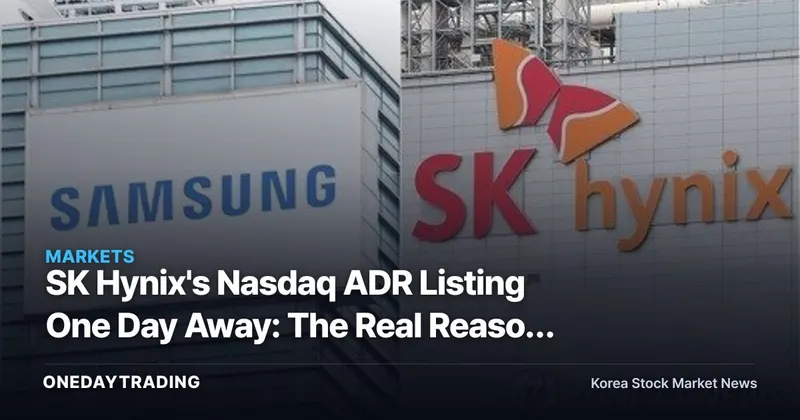
SK Hynix closed down 0.27% during the KOSPI regular session on the 10th, one day ahead of its Nasdaq American Depositary Receipt (ADR) listing. On the day, foreign investors were the heaviest net sellers of SK Hynix on the main bourse. The fact that foreign investors offloaded shares just before a positive-catalyst event like a listing suggests the move reflects arbitrage-driven supply-demand (order flow) between the two markets rather than any deterioration in fundamentals.
What Happened
An ADR is a structure in which a depositary bank takes custody of domestic common stock and issues a corresponding certificate that trades on Nasdaq. In the early stages of a listing, a price spread between the domestic KOSPI price and the Nasdaq ADR price tends to emerge, and hedge funds and arbitrage desks that target this gap typically sell the domestic shares while buying the ADR. SK Hynix ranking among the top foreign net-selling stocks (tickers) on the 10th can largely be viewed as part of this day-one supply-demand rebalancing around the listing.
That said, it cannot be concluded that all of this selling was purely arbitrage-driven. Since SK Hynix has been a stock (ticker) at the center of market attention recently on the back of improving HBM (High Bandwidth Memory) earnings, the possibility that some profit-taking coincided with the listing event cannot be ruled out either.
Structural Background
The memory supply chain runs from materials → equipment → production → finished sets (GPUs and AI accelerators), and SK Hynix serves as the intermediate hub responsible for HBM production itself within this chain. The Nasdaq ADR listing simply opens an additional channel for direct access by US institutional investors and passive funds to this hub — it does not change production capacity or yield. In other words, this listing is a procedural step that broadens valuation accessibility, while the direction of earnings still hinges on next-generation HBM mass-production yields and customers' order schedules.
Impact on Stocks (Tickers) and Industry Sector
- SK Hynix: The ADR listing opens a direct buying channel for overseas institutional investors and ETFs, but in the early going, arbitrage-driven supply-demand (order flow) targeting the price gap between the domestic and ADR listings could add to volatility.
- Samsung Electronics: As an HBM competitor, it may also see a valuation re-rating as SK Hynix's accessibility to overseas investors expands.
- Hanmi Semiconductor: As a supplier of HBM back-end process equipment to SK Hynix, its earnings are directly tied to changes in SK Hynix's capacity expansion and utilization rates.
- Memory materials and components suppliers: These are likely to be more sensitive to the pace of HBM production expansion than to the ADR listing event itself.
Bullish vs. Bearish Scenarios
In the bullish scenario, the ADR listing settles in smoothly, broadening the buying base among large US institutional investors and passive funds. If HBM supply remains tight, foreign supply-demand (order flow) could turn back to net buying once the early listing-related noise clears.
In the bearish scenario, this net selling marks the start of profit-taking after the recent sharp gain (surge). If Samsung Electronics and Micron close the gap on next-generation HBM yields faster than expected, the competitive landscape itself — separate from the positive-catalyst listing event — could erode the valuation premium.
Action Points for Investors
- Check the price spread and trading volume between the domestic listing and Nasdaq during the ADR's first week to gauge how long the arbitrage-driven supply-demand (order flow) persists.
- Watch the next earnings release for commentary on the HBM revenue mix and next-generation HBM yields.
- Track news on HBM customer qualification progress at Samsung Electronics and Micron to assess shifts in the competitive landscape.
- Monitor KOSPI supply-demand data for the timing of any shift between foreign net buying and foreign net selling.
SK Hynix by the Numbers: Real-Time Data
SK Hynix's most recent closing price was 2,180,000 won (-0.27% versus the previous session), and the composite signal combining foreign/institutional investor supply-demand (order flow) with news and momentum reads 🟡 neutral / wait-and-see. With positive and negative signals mixed, this is a stock (ticker) to watch closely.
- ▲ News flow — 2 positive catalysts vs. 1 negative catalyst — positive catalysts lead
Recent related news skews favorable, with 2 positive-catalyst items versus 1 negative-catalyst item.
※ Price and foreign/institutional investor supply-demand (order flow) data are provided by Korea Investment & Securities (KIS) as of the time of publication.
This article was automatically summarized and analyzed based on the original news report. View Original (Yonhap Infomax)