
Three-Line Briefing
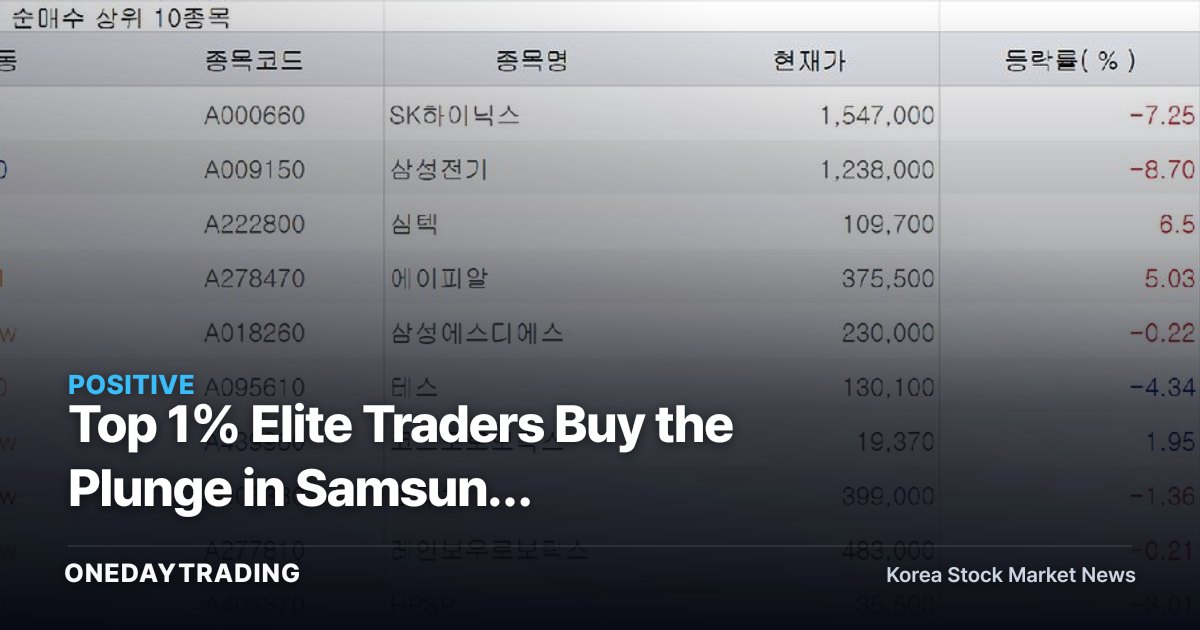
- According to Maeil Business Newspaper's "Stock Elite Traders Right Now" 9:30 a.m. trading trends, Samsung Electro-Mechanics and SK Hynix — both of which plunged early in the session — ranked among the top buys concentrated by the top 1% of investors by returns
- At the same time, Samsung Electronics, which fell by a relatively smaller margin, was instead spotted among this elite group's top sell picks
- The divergence in bargain-buying targets is being interpreted as reflecting differences in business exposure to demand for AI server memory and substrates
What's Different
SK Hynix, Samsung Electro-Mechanics, and Samsung Electronics are all grouped under the same semiconductor and electronics sector, but they generate revenue through different channels. SK Hynix has a single-focus memory business built around DRAM and HBM, so any warmth in a memory upturn flows straight through to earnings. HBM is a high-value-added product supplied to AI accelerator makers including Nvidia, and it commands higher prices and margins than commodity DRAM, meaning that simply holding on to a leading supplier position is itself a basis for valuation. Samsung Electro-Mechanics makes MLCCs and semiconductor package substrates, and both product lines benefit from the push toward higher-performance servers and smartphones. Because a single AI server requires more MLCCs and substrates than a conventional server, earnings leverage grows larger as server investment increases.
Samsung Electronics, by contrast, has a diversified business structure that stacks Mobile (MX), Consumer Electronics (VD), and Harman on top of a Device Solutions (DS) division spanning both memory and foundry. Even when the memory market improves, the gain is offset within DS by the burden of foundry utilization rates, and the relatively lower margins of the mobile and consumer electronics businesses dilute overall earnings. In this sharp sell-off, the fact that elite traders sold Samsung Electronics — which had fallen by a smaller margin — while buying Samsung Electro-Mechanics and SK Hynix, which had fallen further, suggests they were not simply scooping up cheaper stocks but narrowing their positions toward purer exposure to memory and AI components.
Numbers in Context
The key to this data is the filter of the top 1% by returns. Trading by a group of investors screened by cumulative returns rather than single-day profit and loss is more likely to reflect an information edge or trading discipline than the average retail investor. What matters here is that this group treated the early-session plunge as a buy signal rather than a sell signal, and that their buying concentrated not in the stock that fell the most, but in the two stocks with the clearest exposure to the AI value chain. The fact that Samsung Electronics landed among the top sells despite falling by a relatively smaller margin can be read as a signal that the priority in this rebound buying was business purity rather than the size of the decline.
Winners and Losers
- SK Hynix: Its position secured within the HBM supply chain translates directly into margin leverage from a memory upturn, making it the biggest beneficiary of this dip-buying
- Samsung Electro-Mechanics: Its MLCCs and semiconductor package substrates are tied to demand from higher-performance AI servers and flagship smartphones, drawing accompanying buying interest
- Samsung Electronics: Its mixed structure spanning DS, MX, VD, and Harman dilutes the leverage from a memory upturn, putting it relatively higher on the sell priority list
- HBM back-end process and substrate-related materials and equipment makers are also emerging as a secondary beneficiary line from expanding server investment
Risk Check
- If the early-session plunge stemmed from a broad, short-term market correction rather than stock-specific issues, then the elite traders' moves could simply be short-term trades betting on a rebound
- Because the top 1% trading data is only a single-day snapshot, it needs to be confirmed whether these positions are maintained in subsequent trading sessions
- The dilution argument for Samsung Electronics could also weaken if an improvement in foundry utilization or a hit new mobile product is confirmed
- If expectations for HBM and substrate demand are already largely priced in, a pullback could deepen if actual order and utilization figures fall short of those expectations
Bottom Line
This round of trading by elite investors carries a dual meaning: bargain-buying that treated the plunge as an opportunity, and selective buying of stocks with the purest exposure to memory and AI components. SK Hynix's HBM supply contracts, Samsung Electro-Mechanics' server substrate orders, and Samsung Electronics' foundry utilization figures next quarter will be the confirmation points that determine whether this selective bet was correct.
SK Hynix in Real-Time Data
SK Hynix's most recent closing price is 1,526,000 won (-8.51% versus the previous day), and the signal light combining foreign investors and institutional investors supply-demand (order flow) with news and momentum reads 🟡 Neutral / Wait-and-see. With positive and negative signals mixed, this is a stock to watch closely.
Recent related news is mixed, with 4 positive catalysts and 4 negative catalysts.
※ Price and foreign/institutional investor supply-demand (order flow) data are provided by Korea Investment & Securities (KIS) and are as of the time of publication.
This article is automatically summarized and analyzed content based on the original news report. View original (Maeil Business Newspaper - Securities)