
At a Glance
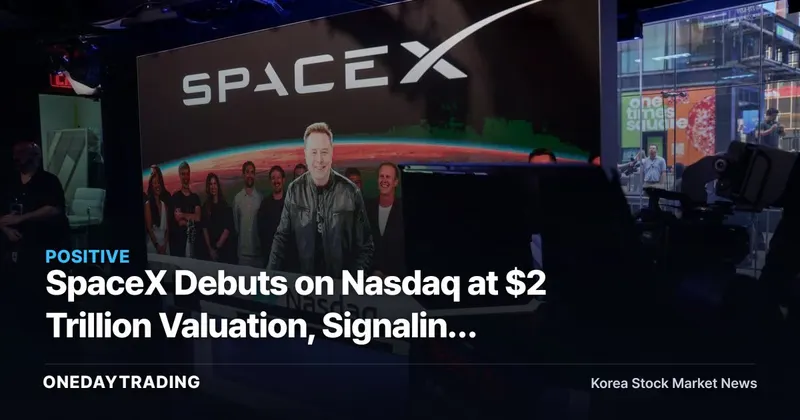
SpaceX, led by Elon Musk, made its Nasdaq debut and closed its first trading day with a market capitalization of roughly $2 trillion, ranking as the sixth most valuable company in the United States. Compared with the mega-cap tech giants, SpaceX's revenue is only a fraction of theirs, but expectations for the future growth of its reusable launch vehicle business and satellite communications operations are strongly reflected in its valuation.
This goes beyond a single company's listing event — it is a symbolic milestone showing that the private space industry has now been fully absorbed into mainstream capital markets as a core asset class.
Why It Matters Now
SpaceX's value rests on two pillars. The first is its innovation in launch costs through reusable rockets, which has secured it a near-monopoly position in the global satellite launch market. The second is Starlink, its low-Earth-orbit satellite communications network, which is rapidly expanding its subscriber base into regions lacking telecom infrastructure as well as into aviation, maritime, and defense sectors.
The reason the market has assigned such a high market capitalization relative to revenue is that it represents a bet on the long-term cash flows that space internet, Mars exploration, and government and military launch contracts could generate in the future. At the same time, this makes it a double-edged asset — a high-valuation name where expectations have already been priced in well ahead of results.
This also carries significant implications for Korea. As global capital reshuffles around the space industry theme, Korean companies with competitive strengths in satellites, launch vehicles, and defense components could see upward pressure on their own valuations as well.
Frequently Asked Questions
- Why is the market capitalization so large when revenue is small? The price reflects expectations for future growth — driven by Starlink's expanding subscriber base and SpaceX's dominance of the launch market — far more than current earnings.
- Can Korean investors buy the stock (ticker) directly? Yes, Nasdaq-listed shares can be traded through an overseas brokerage account, but investors should weigh both the early volatility typical of a fresh listing and exchange rate risk.
- Is this a positive catalyst for Korea's space industry? Improved market sentiment around the space theme broadly, combined with an upward re-rating of valuations globally, is expected to have a positive spillover effect on related Korean stocks (tickers).
- Are there bubble concerns? The market capitalization-to-revenue multiple is extremely high, leaving room for a sharp correction if growth slows or policy conditions shift.
Related Stocks (Tickers) and Sector Impact
- Hanwha Aerospace As Korea's leading space aerospace stock (ticker), holding launch vehicle engine technology and the Nuri rocket program, it stands to directly benefit from a re-rating of the space theme.
- Hanwha Systems With satellite communications and low-Earth-orbit satellite projects underway, it is closely tied to the Starlink momentum.
- Contec As a satellite ground station data services company, it could see structural benefits from the increase in satellite launches.
- Intellian Technologies As a supplier of satellite antenna solutions, it is expected to see rising demand as satellite communications spread.
- AP Satellite Given its business in satellite terminals and components, it falls within the reach of capital flowing into the space theme.
Points to Watch When Investing
- Share prices in the early days after listing tend to run hot on expectations and supply-demand (order flow), leading to significant short-term volatility.
- SpaceX's core businesses are heavily dependent on government and military contracts, making them sensitive to policy and budget variables.
- Related Korean stocks (tickers) that rally on theme momentum alone can quickly reverse if earnings fail to keep pace.
- For investments in overseas stocks (tickers), exchange rate fluctuations directly affect returns.
Overall Outlook
In an optimistic scenario, growth in Starlink subscribers and continued dominance of the launch market would translate into real cash flow, reinforcing the long-term growth story for the space industry as a whole and potentially spreading a structural re-rating to Korean space and satellite stocks (tickers) as well. On the other hand, an excessive valuation relative to revenue, a slowdown in growth expectations, and intensifying regulation and competition all represent clear downside risks. While the thematic momentum is undeniable, a measured, staged approach — one that soberly weighs the gap between actual earnings and market expectations — is the more prudent strategy.
This article was automatically summarized and analyzed based on original news reporting. Read the original article (CNBC)