
Summary
The key signal from September correction warnings is order, not direction. The first thing to wobble is the index multiple, and only then does stock-by-stock differentiation begin. If oil turns lower and the market's perception of a peak in U.S. manufacturing has not yet hardened, the KOSPI is more likely in a pause-and-reselect phase than in a trend decline.
This message does not mean investors should turn bearish on the entire KOSPI. It means the pace at which foreign investor supply-demand (order flow) returns speeds up when exchange rates, oil, and U.S. rate expectations shift together. That is why the second half of the year is more about selection within industries than about index forecasts.
What Happened
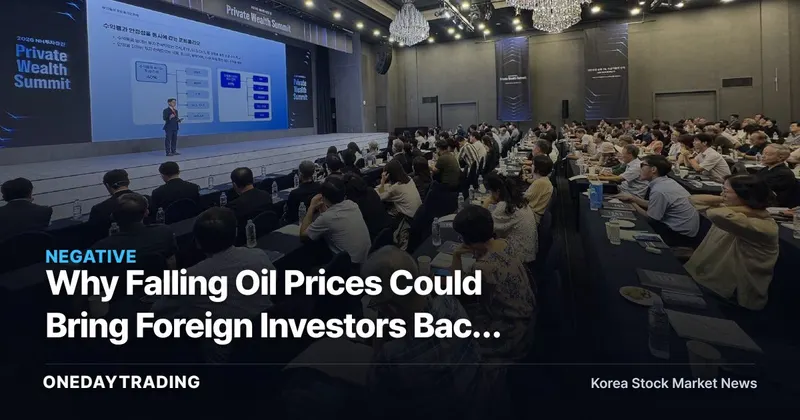
The assessment from Money Today Securities and NH Investment & Securities' Daegu wealth seminar was clear. In the period ahead of the U.S. presidential election, volatility can rise, and September should be treated as a month where a short-term correction remains possible. But the view is that this correction should be seen as a process of confirming a rebound, not as a breakdown in trend.
The evidence comes from U.S. manufacturing conditions. If the manufacturing index cannot yet be said to have entered a peak zone, it is difficult to conclude that economic slowing will immediately translate into a sharp drop (plunge) in earnings. The market may already have priced in some of the correction, but if the combination of the economy and rates stabilizes once more, large caps are likely to react first, ahead of the broader index.
That is where the direction of oil matters. If oil falls, inflation pressure eases, and foreign investors face less of the rate burden and exchange-rate burden they weigh first when buying Korean stocks. In other words, foreign investor return is driven by cost calculations, not sentiment.
Structural Background
What moves stocks is not a single headline, but the discount rate created by rates, oil, and exchange rates. When rates stay high, multiples compress even if earnings are unchanged; conversely, when inflation stabilizes, share prices react before earnings do. In that environment, large caps with visible cash flow, such as semiconductors, autos, and financials, become the market's face first.
The interpretation that the U.S. manufacturing index has not yet peaked also fits the same logic. If fear of the late stage of expansion is weak, the market responds through industry rotation rather than a trend decline. So the second-half tape is not a game of calling the index top; it is a contest to see which industry sector gets its earnings estimates revised up first.
Stock and Industry Impact
- Samsung Electronics, SK hynix: these are the flagship liquidity names that tend to respond first when foreign money returns to the KOSPI. When large-cap semiconductors attract supply-demand (order flow), their contribution to the index is large, so the short-term rebound feels fast.
- Hyundai Motor: this is a stock where exchange rates and export expectations are reflected before costs. If foreign investors' risk appetite recovers, large export stocks become the center of index resilience.
- Korean Air: falling oil prices lower jet fuel costs and help protect margins. Transportation stocks may read the easing in fuel costs as a bigger positive catalyst than concerns about slowing growth.
- S-Oil, SK Innovation: weaker oil prices are not automatically a positive catalyst for refiners. Inventory valuation and refining margin dynamics have to line up as well, so buying purely on crude prices is risky.
- KB Financial, Shinhan Financial Group: when expectations for a rate peak-out regain traction, valuation moves first. But the trend only takes hold once asset quality and net interest margin, not just loan growth, are confirmed.
Bull vs Bear Scenarios
The bullish scenario is one in which falling oil prices, a moderate pace of manufacturing activity, and a return of foreign net buying all line up at the same time. In that case, the market recovers first in large caps such as Samsung Electronics, Hyundai Motor, and financial stocks rather than in the index as a whole. Even if a correction occurs, it is likely to be short-lived, and the market may quickly shift into a stock-picking phase.
The bearish scenario is the opposite. If oil rises again, U.S. rates do not come down, and the won-dollar exchange rate becomes unstable, foreign investors will trim large-cap exposure first. In that case, the September correction could develop from a simple pause into valuation compression.
Investor Action Points
- Watch the next U.S. manufacturing index together with inflation data. Inflation reacceleration will be priced more heavily than economic slowing.
- Check whether international oil prices remain on a downtrend. If oil turns lower, foreign investor supply-demand (order flow) and the reaction in airlines and transportation stocks will show up first.
- Watch for a turn in foreign net buying in the KOSPI. Net buying is stronger than words, and market leadership always appears in supply-demand (order flow) first.
- After September, focus on earnings visibility within industries rather than the index itself. Semiconductors, exporters, and financials are the names where the numbers can be confirmed first.
Frequently Asked Questions
Why does talk of a September correction come up?
September is seasonally prone to higher volatility, and if it falls ahead of the U.S. presidential election, policy, rate, and exchange rate variables all pile on. The market prices in that uncertainty early, so market sentiment wobbles faster than the index itself.
That said, a correction does not necessarily mean a trend decline. If earnings support the market and oil remains stable, the correction can become the starting point for the next rebound.
Why do foreign investors come back when oil falls?
Falling oil prices ease inflation pressure and thereby reduce the burden of rates. When foreign investors look at Korean stocks, they do not just look at growth; they also calculate the carrying cost that combines exchange rates and rates.
So when oil falls and rate expectations stabilize, foreign buying often comes in through large caps first. The KOSPI reacts first, and only then do differences by industry begin to widen.
Which stocks tend to move first in the second half?
Generally, large caps with liquidity and earnings visibility, such as semiconductors, autos, and financials, move first. That is because these stocks have the biggest index impact when foreign money comes in.
By contrast, oil-sensitive industry sectors can diverge. Airlines benefit from lower oil through margins, but refiners are harder to call a positive catalyst for on oil alone.
Samsung Electronics through real-time data
Samsung Electronics' latest closing price is 266,000 won (0.00% from the previous day), and the traffic-light signal that combines foreign investors, institutional investors, news, and momentum is 🟢 Buy bias. Foreign investors and news are positive, so it is worth watching.
- ▲ News flow — positive catalyst 10 vs negative catalyst 4 — positive catalyst dominates
Recent related news is favorable, with 10 positive catalyst items and 4 negative catalyst items.
※ Price and foreign investor/institutional investor supply-demand (order flow) data are provided by Korea Investment & Securities (KIS) and are based on the time of publication.
This article is automatically summarized and analyzed based on the original news report. View original article (Money Today Securities)