
At a Glance
News that waste plastic is being converted into naphtha-grade recycled feedstock for global markets is more than just an environmental headline. Across the refining and chemical value chain, three variables are moving in tandem: feedstock procurement, carbon regulation compliance, and customer certification.
The crux of this issue isn't price, but adoption potential. How much of conventional naphtha the recycled feedstock can displace — and whether overseas customers translate that into actual purchase contracts — is what will differentiate petrochemical stocks' valuation multiples.
Why It Matters Now
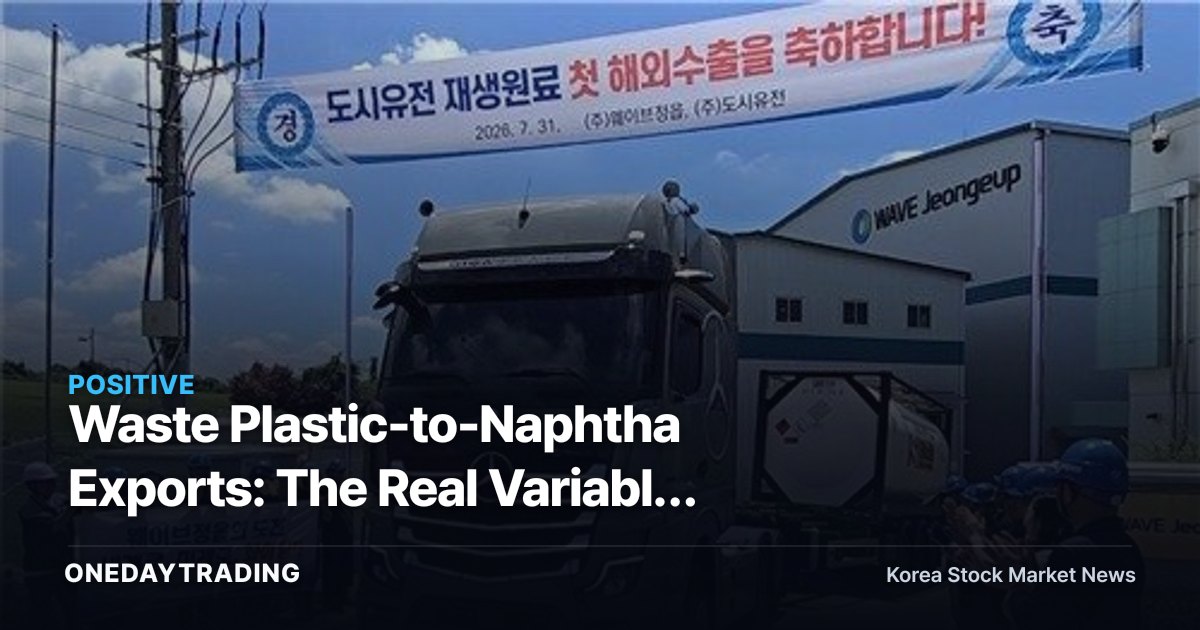
Domestic company Dosi Yujeon announced that it is converting discarded waste plastic into naphtha-grade recycled feedstock — a petrochemical raw material — for supply to overseas markets. The words investors should focus on here are recycled feedstock and export. It means the waste-processing technology hasn't stayed confined to the factory floor; it has made it onto overseas customers' feedstock procurement tables.
The petrochemical industry has long been weighed down by Chinese capacity expansion and oversupply of commodity products. Conventional naphtha cracking facilities are sensitive to oil prices and spreads, and their pricing power has weakened. Recycled naphtha, however, is being evaluated through a different lens. As customers increasingly demand carbon reduction and higher recycled-material content, certification, traceability, and stable supply capability — rather than the feedstock's physical properties — are what create the premium.
That said, the market isn't yet at the stage of pricing this in as a direct earnings improvement for existing chemical stocks. Recycled feedstock volumes are still limited in the early going, and production costs and quality consistency still need to be verified. What this news signals isn't an immediate spread rebound, but the possibility that the valuation axis is partially shifting — from commodity petrochemicals toward competition over circular feedstock sourcing.
Frequently Asked Questions
- What's different about waste plastic-derived naphtha? Unlike conventional crude-oil-based naphtha, it is recycled feedstock converted back from waste plastic. Chemical companies can use it to lower the carbon footprint of recycled plastics, packaging, and material products.
- Why does the export matter? Because it can be seen as a step beyond domestic pilot-scale validation, toward confirming actual purchase demand from overseas customers. The more global brands and chemical companies demand recycled feedstock, the more an export track record strengthens negotiating leverage.
- Does this matter for refining stocks too? The direct effect is limited. But if a portion of the naphtha and chemical feedstock market shifts toward recycled feedstock, it could change the long-term investment priorities of integrated refining-and-chemical companies.
- What's the biggest uncertainty? Mass-production scale, quality consistency, and certification systems. The green narrative attaches quickly, but customers' actual switch to this feedstock still has to pass verification.
Related Stocks and Sector Impact
- LG Chem. A major chemical company with both battery materials and petrochemical operations. If recycled-feedstock adoption expands, the market's evaluation of its eco-friendly materials portfolio — rather than commodity products — could become more important.
- Lotte Chemical. Given its heavy reliance on naphtha-based petrochemicals, its execution on feedstock diversification and circular-economy strategy could be a variable that helps unwind its stock's valuation discount.
- SK Innovation. A company where refining, chemicals, and green-transition investment are intertwined. An expanding recycled-feedstock market raises the explanatory weight of its materials-transition strategy relative to conventional refining margins.
- Waste plastic recycling and chemical materials sector. Overseas references matter for companies that hold the underlying technology. However, thematic rallies gain staying power only once volume contracts, certification, and repeat deliveries are confirmed.
Investment Considerations
- News related to recycled naphtha tends to draw a green premium, but its actual earnings contribution depends on confirming the sales price and production cost.
- If crude-oil-based naphtha prices fall, the economics of recycled feedstock could weaken. The key question is how much carbon regulation and mandatory customer usage requirements can offset that price disadvantage.
- An export announcement alone shouldn't be taken to mean a long-term supply contract is locked in. Repeat deliveries, expansion of the customer base, and whether certification standards are passed need to be verified separately.
- Chemical stocks move on a mix of cycle-recovery hopes and green-transition expectations. If spread deterioration persists, recycled-feedstock news alone won't be enough to ease pressure on share prices.
Overall Outlook
This news looks like a scene of waste-plastic recycling moving from an environmental campaign into a feedstock industry. The bullish scenario is clear: if overseas customers stably accept naphtha-grade recycled feedstock, the domestic chemical value chain gains both a tool for carbon-regulation compliance and a new feedstock option, at the same time.
The bearish scenario also remains open. If recycled feedstock stays confined to small-volume supply and remains less price-competitive than conventional naphtha, the expectations already priced into the stock could cool. From Kang Si-hyeon's perspective, the next checkpoints are clear. What the market has already bought into is the green narrative; what's still underpriced is repeat export volume and customer certification. Going forward, watch whether supply contract size, refiners' and chemical makers' recycled-feedstock adoption plans, and oil prices and naphtha spreads all move in the same direction.
LG Chem in Real-Time Data
LG Chem's most recent closing price was 263,500 won (+2.73% versus the prior day), and the signal combining foreign investor/institutional investor supply-demand (order flow) with news and momentum reads 🟢 Net Buying Bias. With foreign investors, institutional investors, and momentum all positive, this stock (ticker) is worth watching.
- ▲ Dual Buying — foreign investors +2.2 billion won and institutional investors +1.8 billion won, buying in tandem
※ Price and foreign/institutional supply-demand (order flow) data are provided by Korea Investment & Securities (KIS) and are as of the time of publication.
This article is automatically summarized and analyzed content based on the original news report. View original (Yonhap News Agency, Securities)