
Summary
While this announcement may appear to be a one-off promotion, from an investment perspective it reads as one scene in a broader channel restructuring effort by TV home shopping operators to shift transaction volume toward their own online platforms. Hyundai Home Shopping is using Samsung Electronics appliances as a loss-leader to draw customers into its proprietary platform, Hyundai H Mall, while its fashion subsidiary Handsome is stimulating demand through discounts at the premium curated shop EQL. The key question is not the rewards promotion itself, but rather what channel mix home shopping operators — burdened by transmission fees — are assembling to defend their margins.
What Happened
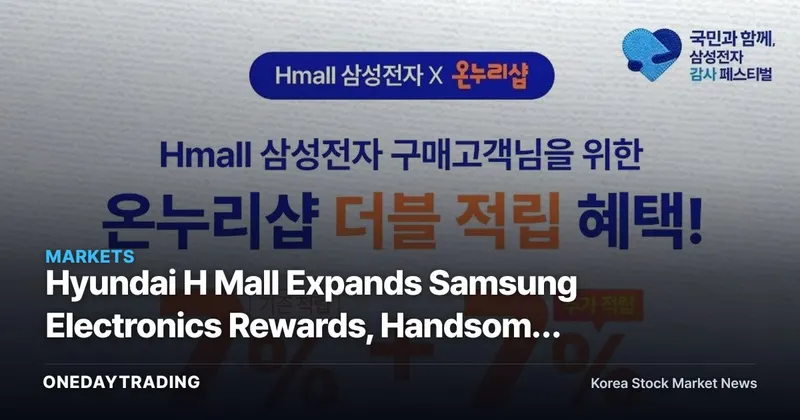
Hyundai Home Shopping will offer additional rewards points to customers who purchase Samsung Electronics products through its official online store, Hyundai H Mall, through July 31. Consumer electronics and IT products carry high average transaction values, making rewards incentives a powerful driver of purchase conversion. As such, raising the rewards rate is not merely a marketing expense — the underlying intent is to steer payments away from external open marketplaces and onto the company's own platform, accumulating transaction volume and customer data in-house.
Simultaneously, the group's fashion affiliate Handsome is running a first-half sale on its online curated platform, EQL. EQL is a premium channel featuring emerging and imported designer brands, which Handsome has been cultivating as a vehicle to reduce its dependence on traditional department stores and grow its proprietary digital transaction share. The discount event is interpreted as targeting both inventory clearance and new customer acquisition.
Structural Background
The TV home shopping industry faces a double squeeze: a declining viewership base and rising broadcast transmission fees paid to platform operators. With broadcast revenue stagnating while fees climb year after year, operating profit margins are being structurally compressed. In response, Hyundai Home Shopping and its peers are intensifying efforts to grow their share of non-broadcast digital and mobile transaction volume, while leveraging proprietary brand and manufacturing capabilities — such as those found in Handsome — to defend margins. The current rewards and discount promotions are an extension of that strategy.
Stock (Ticker) and Industry Sector Implications
- Hyundai Home Shopping — As the organizer, the company's primary focus is expanding online store transaction volume and locking in customers. However, rewards and discounts are a near-term driver of promotional cost increases, so the critical question is whether higher transaction volume can offset margin erosion.
- Handsome — EQL discounts are expected to drive digital channel revenue growth, but wider discount ranges may act as a margin dilution factor in the apparel segment.
- Samsung Electronics (005930) — While this adds another appliance sales channel, the impact of a single home shopping operator's rewards promotion on total revenue is negligible, limiting the stock price relevance.
- Retail/Home Shopping Industry Sector — Competitors such as GS and CJ face the same online migration and transmission fee pressures, meaning channel efficiency gains will serve as key differentiators within the industry sector.
Bull vs. Bear Scenarios
On the bull side, promotions anchored in premium appliances and high-end fashion could grow the company's own-platform transaction volume and new membership base, leading to a structural improvement that raises the share of revenue less dependent on transmission fees. A structural expansion in digital transaction volume would be positive for long-term profitability.
Conversely, on the bear side, rewards and discounts may ultimately translate into higher promotional costs and margin dilution, leaving profits flat even as headline revenue grows. In a consumer spending slowdown, rising dependence on discounting could intensify profitability pressure — another variable to watch.
Investor Action Points
- In Hyundai Home Shopping's next-quarter earnings, track both the growth rate of digital and mobile gross merchandise value and the direction of operating profit margins to assess the quality of the promotional impact.
- Compare Handsome's online revenue mix and apparel segment margin rate on a quarterly basis to gauge the profitability impact of the discounting.
- Monitor policy schedules and industry announcements related to home shopping transmission fee negotiations and regulation to track changes in cost structure.
- Use consumer sentiment and home appliance demand indicators to assess the sustainability of promotions in high-ticket categories.
Hyundai Home Shopping: Real-Time Data Snapshot
Hyundai Home Shopping's most recent closing price was ₩87,300 (0.00% vs. prior day). The composite signal — incorporating foreign investors and institutional investors supply-demand (order flow), news, and momentum — shows 🟢 Buy Bias. Foreign investors and institutional investors are positive, making this stock (ticker) worth watching.
- ▲ Supply-Demand (Order Flow) Continuity — Foreign investors net buyers for 4 consecutive sessions (+400 million won)
- ▲ Dual-Pillar Buying — Foreign investors +400 million won · Institutional investors +1.5 billion won, buying in tandem
※ Price and foreign investors/institutional investors supply-demand (order flow) data are provided by Korea Investment & Securities (KIS) and reflect values at the time of publication.
This content is an automatically summarized and analyzed piece based on the original news article. View original article (Yonhap News Industry)