
Summary
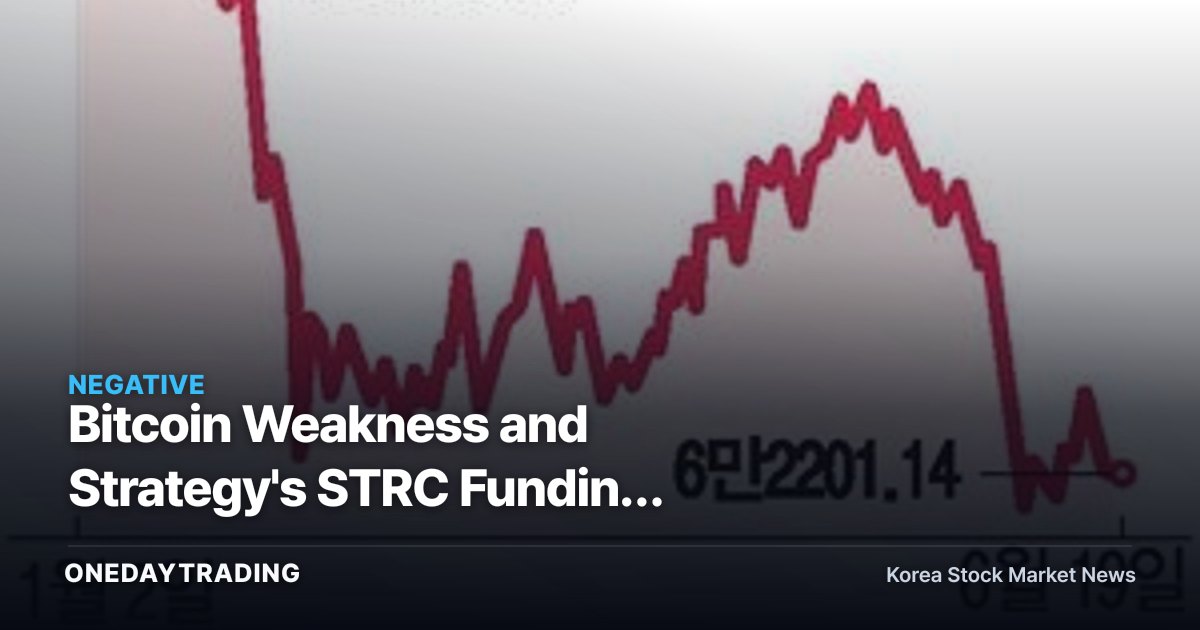
The price of STRC—a perpetual preferred stock issued by Strategy (MSTR), the company led by chairman Michael Saylor, to raise capital for bitcoin purchases—is wavering, putting pressure on bitcoin prices across the board. The fact that bitcoin's market capitalization was at one point overtaken by SK Hynix is a signal that the coin's price is no longer driven by pure supply-demand (order flow), but rather by the soundness of a leveraged funding structure. For investors, this is a phase in which checking for cracks in the funding channel should come before taking direct exposure to the coin.
What Happened
Strategy is a company that, instead of focusing on its core software business, has chosen a strategy of filling most of its corporate assets with bitcoin. To increase its coin holdings, it has mobilized common stock offerings, then convertible bonds, and now even perpetual preferred stock—and among these, STRC is a vehicle that raises funds by promising a set dividend in exchange for having no maturity.
The problem is that when the market price of this preferred stock weakens, the company has to pay a higher cost to raise the same amount of capital. Once the expectation forms that its capacity for additional coin purchases is shrinking, it leads to concern that institutional buying—one of the pillars that has propped up bitcoin's price—could weaken.
Amid this trend came the scene of bitcoin's market capitalization being temporarily overtaken by that of SK Hynix. The very fact that bitcoin, long classified as a global asset, found its size placed on a comparable footing with a single nation's memory-semiconductor company starkly reveals the intensity of the recent contraction in the coin market.
Structural Background
The core of the Strategy model is that the virtuous cycle only turns when its own share price and the prices of its bonds and preferred stock are kept high. That is because rising coin prices lift the share price and the value of the assets it raises, and those assets are then used to buy more coins. Conversely, when the price of its funding vehicles wobbles, the same loop can operate in reverse, with slowing purchases and price weakness reinforcing each other.
Thus STRC's price weakness is interpreted not as a single-stock issue, but as a sign that one of bitcoin's support pillars is shaking. It means the coin's price has entered a phase where it is tied not only to its own supply-demand (order flow) but also to the funding costs of a specific company.
Stock and Sector Ripple Effects
- Strategy (MSTR): The epicenter of the issue. Because its bitcoin holdings' valuation is directly linked to the funding costs of its preferred stock and convertible bonds, when coin weakness and funding strain overlap, its share-price volatility tends to exceed that of the coin itself.
- Crypto trading and payment infrastructure firms: Their trading value and fee revenue are proportional to coin prices and trading activity. In a phase of price weakness, shrinking trading volume can dampen earnings momentum.
- Domestic crypto-related stocks (listed companies holding stakes in coin exchanges or running blockchain businesses): They react sensitively to bitcoin investor sentiment, showing theme-driven swings. By structure, they track coin-price headlines in the short term rather than fundamentals.
- SK Hynix: It has no direct beneficiary or victim relationship, but as it was highlighted as a market-cap comparison target, it is worth distinguishing that it moves on a separate driver—AI memory demand.
Bullish vs. Bearish Scenarios
The bullish logic is that STRC's price weakness is a temporary fluctuation, and that if interest rates and risk appetite improve, funding costs will normalize and the institutional buying loop can resume. The view holds that the longer-term trend of bitcoin establishing itself as an institutional asset remains intact.
The bearish logic is that once a leverage-based buying structure reverses, a vicious cycle is possible in which price declines trigger worsening funding, which in turn comes back as selling pressure. In particular, a structure that makes the coin's price dependent on a company's funding costs carries the risk of being vulnerable to external shocks.
Investor Action Points
- Monitor the price trends and dividend burden of Strategy's preferred stock and convertible bonds, including STRC, together as leading indicators of the coin's price.
- Check whether the frequency and scale of Strategy's additional bitcoin purchase disclosures are declining, to gauge changes in institutional buying capacity.
- Because domestic crypto theme stocks carry large coin-price-linked volatility unrelated to fundamentals, separate out the risk of short-term sharp swings driven by trading value and price headlines.
- Do not compare bitcoin and SK Hynix by the same yardstick; manage positions by distinguishing the different drivers of memory demand and coin supply-demand (order flow).
This article is content automatically summarized and analyzed based on the original news report. View original (Maeil Business Newspaper, Securities)