
Three-Line Briefing
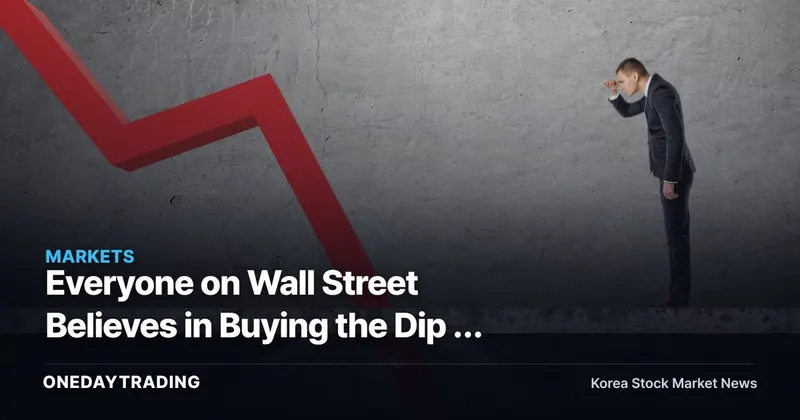
- Buying the dip on every decline has hardened into a near-universal consensus on Wall Street, according to the analysis.
- The key point: this strategy, which feels like free money, actually lags buy-and-hold returns over the long term.
- The real warning sign isn't the strategy itself but the crowding — everyone doing the same thing — which reflects overconfidence in market sentiment.
What's Changing
For investors, the significance of this issue lies not in a positive catalyst or negative catalyst for any specific stock, but in the fact that market-wide behavior has aligned in a single direction. Because the pattern of buying quickly after every pullback has been repeatedly rewarded, the belief that declines represent opportunity rather than risk has become widespread. The problem is that when every participant shares the same assumption, the shock is far greater the moment that assumption breaks.
The structural reason buying the dip looks so appealing is clear. Because stock prices have trended upward over the long run, buying after a decline appears, in hindsight, to have almost always been the right call. But the strategy presumes holding cash while waiting for a pullback, and if the market keeps rising during that wait, an opportunity cost accrues. The core finding of this analysis is that, as a result, investing all capital upfront and simply holding it outperforms in long-term returns.
This diagnosis is directly relevant to Korean investors as well. When U.S. market sentiment enters an overconfident phase, the KOSPI and KOSDAQ tend to move in tandem through risk-asset appetite and foreign investor supply-demand (order flow). If the same dip-buying behavior becomes just as widespread among domestic retail investors, an external shock could trigger simultaneous, mass sell-offs.
Numbers in Context
The key evidence is the long-term performance gap between buying the dip and simple buy-and-hold. As long as the market trends upward, the longer the periods spent holding cash, the more disadvantaged cumulative returns become — a gap that doesn't show up over short stretches but widens as the cycle lengthens. That said, the original report focuses on pointing out the strategy's structural disadvantage rather than presenting specific annualized return figures. It is therefore more accurate to read this analysis in the context of behavioral crowding and opportunity cost rather than absolute figures.
Stocks to Watch: Winners and Losers
- Broad indices and large-cap index ETFs: Dip-buying crowding produces quick rebounds during corrections, but also becomes the epicenter of expanding volatility once the consensus breaks.
- Large domestic exporters (Samsung Electronics (005930), Hyundai Motor, etc.): Heavily influenced by foreign investor supply-demand (order flow) that tracks U.S. risk appetite, leaving them exposed to volatility whenever global sentiment shifts.
- Brokerage and asset management sector: Benefits from increased trading activity and retail investor inflows, but carries the risk of slowing trading value once the crowding unwinds.
- High-valuation growth and theme stocks: The stronger the dip-buying sentiment, the faster the recovery — but this is also where declines are steepest once the overconfidence breaks.
Risk Check
- Paradox of consensus: When everyone uses the same strategy, the cash waiting to buy the dip can actually weaken the rebound.
- Opportunity cost: The longer the cash-holding period, the more missed gains accumulate during a rising market.
- Potential regime shift: In prolonged sideways or bearish phases where the historical uptrend assumption no longer holds, the strategy's core premise itself is undermined.
- Sentiment contagion: A pullback in U.S. sentiment can quickly transmit to the domestic market through the exchange rate and foreign investor supply-demand (order flow).
Bottom Line
It's not that buying the dip is a flawed strategy — the real variable to examine is the fact that it has become everyone's default. Investors should weigh the opportunity cost against buy-and-hold alongside crowding risk, while confirming — through trading value and foreign investor supply-demand (order flow) — whether sidelined cash actually drives a rebound during the next correction before acting accordingly.
This article is automatically summarized and analyzed content based on the original news report. View Original (MarketWatch)