
At a Glance
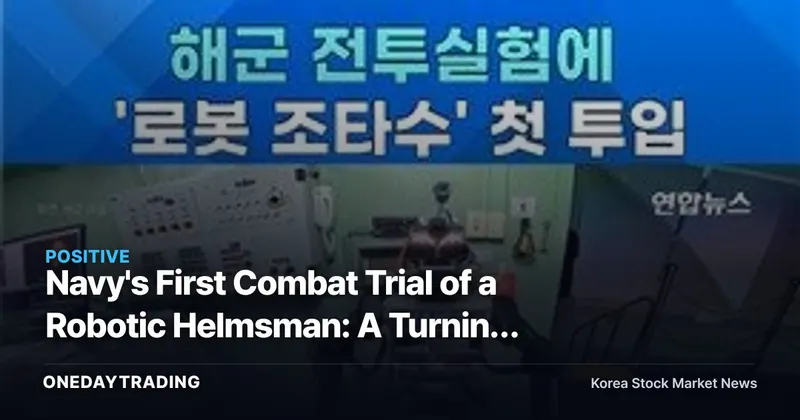
The Navy has deployed its robotic crew member, Phybot, in a combat trial and publicly unveiled the exercise for the first time. The real story here isn't the image of a robot steering a ship — it's that naval force operations are shifting from manpower-supplementing automation toward combat-environment validation.
Defense investors should view shipbuilders, sensor makers, communications firms, and systems-integration companies as a single group, while still distinguishing the time lag before actual orders materialize. The trial marks the start of the narrative; revenue comes only after mass-production requirements are finalized.
Why It Matters Now
The defense cycle doesn't end with the order backlog. Equipment destined for the battlefield must pass through testing and evaluation, concept-of-operations development, budget allocation, and mass-production contracts before it turns into earnings. The Navy's first public combat trial of Phybot matters precisely because it sits at the front end of this long process. The fact that a robotic crew member is now being validated in an actual warship operating environment is a policy signal that could lead to broader warship automation, unmanned surface vessels, and AI-assisted systems for naval vessels.
The helmsman role may look like simple, repetitive work, but aboard a warship it's anything but. It requires maintaining course, executing emergency evasive maneuvers, integrating with the crew's command structure, and tolerating error within strict margins under combat conditions. That's why the beneficiary chain doesn't stop at a single finished robot. Shipbuilders that build the hull, defense contractors that integrate combat systems, and companies supplying surveillance, communications, and navigation sensors all move together.
Still, it's too early for share prices to fully reflect mass-production volume. The public combat trial points to a direction, but order size, which vessels will carry the system, and the mass-production timeline all still need separate confirmation. In defense stocks, expectations tend to rise first while earnings catch up later. The wider that gap grows, the greater the valuation burden becomes.
Frequently Asked Questions
- Why is the Phybot story a defense-stock issue? The fact that the Navy deployed a robotic crew member in a combat trial means warship-operation automation has moved beyond the lab into military operational validation. Over the long term, this connects to demand for warship retrofits, combat-system integration, and unmanned equipment.
- Does this generate revenue right away? Not yet. A combat trial is a validation procedure, not a mass-production contract. Investment decisions should be sized only after confirming follow-on test results, budget allocation, and formal program approval.
- Should investors only look at the robotics maker? No. Naval platforms require shipbuilding, navigation, communications, sensor, and combat-system integration capabilities all at once. A company's ability to integrate into the warship system matters more than a standalone robot product.
- What's the biggest risk? Military equipment is held to high safety and reliability standards. An error in a combat situation isn't just a performance shortfall — it can delay the entire concept of operations.
Related Stocks and Sector Impact
- HD Hyundai Heavy Industries. A shipbuilder with naval vessel construction and special-purpose ship capabilities. If robotic crew members and warship automation expand into a full-fledged program, there is read-through demand for new warship design and existing-vessel upgrades.
- LIG Nex1. Its strengths lie in guided weapons, surveillance and reconnaissance, and communications/electronic systems. For a robotic crew member like Phybot to link into combat systems, sensor and command-and-control integration is required.
- Hanwha Aerospace. Known mainly for land-based defense systems, but its unmanned-systems and integrated defense portfolio give it scalability into the naval automation theme. Direct order wins, however, still need to be confirmed.
- Hyundai Rotem. Has experience in robotics/unmanned technology and defense platforms. Its direct link to naval equipment is limited, but it could benefit alongside an expanding military unmanned-systems budget.
Points to Watch When Investing
- A first public trial is not the same as first mass production. Follow-on combat trial results should be viewed separately from the Navy's official program announcements.
- For beneficiary stocks, the path to being installed on a platform matters more than simply holding the technology. Companies with a track record in warship programs, combat systems, and military procurement can convert to revenue faster.
- Defense stocks tend to price in expectations even before order announcements are disclosed. If share prices overheat on trial news alone, volatility increases during the gap before an actual contract materializes.
- Policy budgets are the key variable. Watch how concretely unmanned combat power and naval automation line items are reflected in the defense budget.
Overall Outlook
The first public combat trial of Phybot signals that South Korea's Navy has begun addressing crew shortages and battlefield automation as a single, connected problem. The optimistic scenario is clear: if warship automation grows into a formal program, shipbuilding, defense electronics, sensors, and robotics makers will be tied together into one supply chain.
But the downside scenario also needs attention. Even if trials continue, if mass-production requirements are finalized late, the shift to revenue will be delayed. What matters right now isn't the stock price reaction, but follow-on order announcements, the Navy's concept-of-operations disclosures, and unmanned-combat-power line items within the defense budget. When these three align, the defense robotics theme moves from headlines to an earnings cycle.
HD Hyundai Heavy Industries: Real-Time Data
HD Hyundai Heavy Industries' most recent closing price is 485,500 won (-2.51% versus the previous day), and the signal combining foreign investor/institutional investor supply-demand (order flow) with news and momentum reads 🟡 neutral / wait-and-see. With positive and negative signals mixed, this is a stock to watch rather than act on.
- ▲ News flow — positive catalyst 3 vs. negative catalyst 0 — positive catalyst dominant
Recent related news skews favorable, with 3 positive-catalyst items versus 0 negative-catalyst items.
※ Price and foreign/institutional investor supply-demand data are provided by Korea Investment & Securities (KIS) and reflect the time of publication.
This article is automatically summarized and analyzed content based on the original news report. Read the original (Yonhap News Industry)