
Key Takeaway
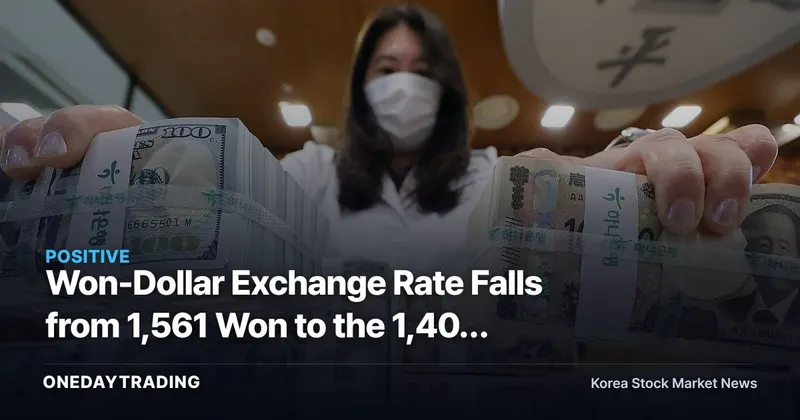
The fact that the won-dollar exchange rate fell from 1,561 won on June 1, 2026, to the 1,400 won range in August means conditions for a resumption of foreign buying in the Korean stock market have opened up.
Kang Si-hyun’s view is clear. The drop in the exchange rate is not just a foreign-exchange market headline, but a signal that simultaneously reprices interest-rate expectations, stock valuations, and industry sector leadership.
What Happened
Based on Yonhap News Securities’ Market Note report, the won-dollar exchange rate rose to as high as 1,561 won per dollar on June 1 this year before easing into the 1,400 won range in August. A stronger won means the Korean currency is gaining value against the dollar, creating an environment in which overseas investors can add foreign exchange gains to returns on Korean stocks.
What this really means is that the price tag on the KOSPI is changing. Foreign investors do not look only at share-price gains. Even if they buy Samsung Electronics and SK hynix, further weakness in the won would erode returns in dollar terms. Conversely, in a period of won strength, the same share-price gain translates into a larger dollar-denominated return.
The fact that the exchange rate has fallen from 1,561 won to the 1,400 won range reflects the market’s view that the peak of the strong dollar has at least partly passed. The issue from here is that the direction of won strength has already been priced in, while how far foreign buying will spread across industry sectors has not.
Background and Context
The exchange rate is the shadow of interest rates. When dollar strength eases, the burden from discount-rate pressure on Korean stocks declines, and when the discount rate falls, multiples move first. In that sequence, stocks can react before earnings improve. In particular, industry sectors with high foreign investor participation and heavy index influence, such as semiconductors, internet, and financials, are the first to be tested.
That said, a stronger won does not mean the same thing for every industry sector. For airlines, food and beverage, and retail, which pay import costs in dollars, it reads as cost relief. By contrast, automakers and some IT hardware names with large export exposure face pressure on won-denominated revenue. The market prices not the exchange-rate decline itself, but how each industry sector’s profit and loss statement changes.
Impact on the Market and Stocks
- SK hynix: A large-cap semiconductor name that is highly sensitive to foreign supply-demand (order flow). If won strength continues, dollar-based investment returns improve, making it easier for both index funds and active funds to move in.
- Samsung Electronics: A flagship KOSPI large-cap stock and an early beneficiary of exchange-rate stability. However, because it is an exporter, excessive won strength can weigh on won-denominated revenue.
- KB Financial Group: If the drop in the exchange rate leads to a recovery in foreign investors’ risk appetite, banks’ dividend appeal comes back into focus. If expectations for rate cuts move too quickly, net interest margin pressure becomes the countervailing factor.
- Korean Air: An industry sector where dollar-linked costs such as jet fuel and aircraft leases become less burdensome. If the won-dollar exchange rate falls further from the 1,400 won range, the cost line improvement will show up in earnings first.
- Hyundai Motor: A stronger won is a burden on export profitability. Even if U.S. sales remain solid, weakening exchange-rate effects can dampen earnings momentum in won terms.
Investor Checklist
- Check whether the won-dollar exchange rate holds in the low 1,400 won range or returns to the 1,500 won range. The durability of foreign buying depends on this level.
- Watch whether KOSPI foreign net buying stays confined to semiconductors or spreads to financials, internet, and consumer names. Without broader expansion, the exchange-rate effect remains limited to part of the index.
- Watch the next Bank of Korea policy meeting and U.S. inflation data together. If the basis for dollar weakness is rate-cut expectations, a hotter-than-expected CPI can reverse supply-demand (order flow) in a single day.
- In third-quarter earnings releases, separate industry sectors where won strength shows up as lower import costs from those where it shows up as weaker export translation gains.
Outlook
The optimistic scenario is simple. If the won-dollar exchange rate stabilizes further in the 1,400 won range and U.S. rate expectations ease, foreign investors buy both foreign exchange gains and KOSPI multiple recovery in Korean stocks at the same time. In that case, leadership is likely to narrow to semiconductors with visible earnings and financials with credible dividends.
The trigger for the bearish scenario is also clear. If the dollar strengthens again and the won-dollar exchange rate re-enters the 1,500 won range, the foreign buying thesis weakens. Then stocks that rose on strong supply-demand (order flow) would be the first to correct. The next number to watch is not the stock price, but the exchange rate.
Frequently Asked Questions
Why is a fall in the won-dollar exchange rate positive catalyst for KOSPI?
A decline in the won-dollar exchange rate raises foreign investors’ returns in dollar terms. If the exchange rate falls from 1,561 won on June 1, 2026, to the 1,400 won range in August, the effect of a stronger won adds to gains in Korean stocks.
However, a lower exchange rate alone does not lift every stock (ticker). Large-cap names with high foreign ownership and clear earnings visibility tend to react first.
Which stocks benefit from a stronger won?
Beneficiaries of a stronger won are industry sectors with large dollar costs or high sensitivity to foreign supply-demand (order flow). Airlines such as Korean Air see their dollar cost burden ease, while SK hynix and Samsung Electronics are heavily influenced by inflows of foreign index funds.
By contrast, automakers and some IT hardware names with high export exposure need to monitor the burden of lower won-denominated revenue.
When can foreign buying weaken?
Foreign buying can weaken if the won-dollar exchange rate approaches the 1,500 won range again or if U.S. inflation data pushes back expectations for rate cuts. Once hopes for foreign exchange gains fade, the relative appeal of Korean stocks also declines.
Investors should view the next Bank of Korea policy meeting, the U.S. CPI release, and the spread of KOSPI foreign net buying across industry sectors on the same chart.
This article is automatically summarized and analyzed based on the original news report. View original (Yonhap News Securities)