
At a Glance
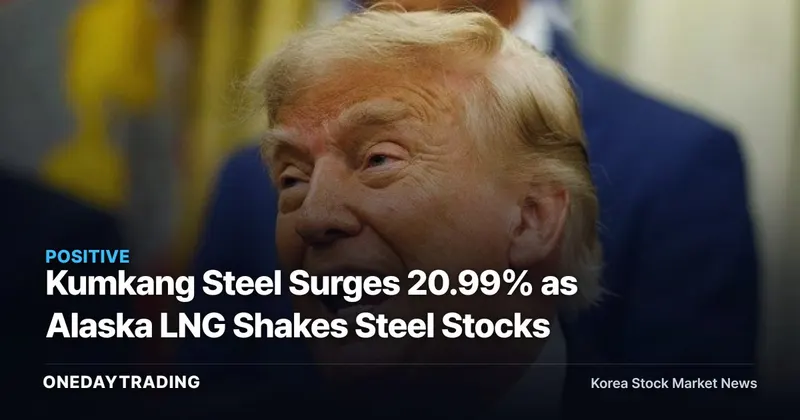
Kumkang Steel’s share price rose 1,140 won, or 20.99%, from the previous day as of 9:46 a.m. on the 3rd. The move came just after U.S. President Donald Trump mentioned the Alaska liquefied natural gas project. Investor funds reacted to a political remark rather than a contract, but if steel demand translates into actual orders, it could lift shipments and utilization rates at related companies.
Alaska LNG is a large-scale energy development plan combining natural-gas production, liquefaction and transport infrastructure. From a steel perspective, the key demand is for heavy plate and steel pipe used in pipelines, storage tanks and plant structures. However, a long lag separates the project announcement from steelmakers’ revenue recognition, covering design, financing, ordering and production.
Why It Matters Now
What this sharp gain really signals is not an immediate rebound in steel prices. The market has first priced in the possibility that expanded U.S. energy-infrastructure investment could create export opportunities for Korean steelmakers. Kumkang Steel’s 20.99% rise looks more like a typical theme-driven reaction in which expectations run ahead of earnings announcements.
The link between interest rates and multiples also matters. Large projects are sensitive to financing costs, so if orders are delayed while U.S. rates remain high, expected multiples can fall quickly. Conversely, if financial conditions ease and the project reaches a final investment decision, supply-demand (order flow) is likely to narrow toward steel stocks with U.S. standards certification and a track record of supplying the market.
Benefits for Korean steelmakers do not simply rise in proportion to steel usage. Product specifications, delivery schedules, local-sourcing requirements and U.S. trade regulations determine the volume that can actually be won. While the project remains at the announcement stage, smaller stocks (tickers) such as Kumkang Steel, with relatively fewer freely tradable shares and lower market capitalization, may show greater price elasticity than large blast-furnace operators, but earnings stability must be assessed separately.
Key Issues
- Distance Between Remarks and Orders: Trump’s comment indicates policy direction but does not finalize a steel supply contract or construction schedule. Official orders from the designer, EPC contractor or gas operator would be the first confirmation signal.
- What Steel Is Needed: LNG facilities require a high proportion of steel with low-temperature toughness and weld quality. A rise in commodity rebar prices does not mean demand for project-grade heavy plate and steel pipe will increase by the same amount.
- Interest-Rate Headwind: If U.S. long-term yields rise again, the economics of large energy projects could weaken and financial close could be delayed. In that case, the theme premium could contract first.
- Priced In Versus Still Unconfirmed: Policy expectations and supply-demand (order flow) in related stocks are partly reflected. Actual order backlogs, shipments and improvement in margin per ton have not yet been confirmed in numbers.
Impact on Related Stocks and Sectors
- Kumkang Steel: The key stock (ticker) that received the direct share-price reaction to this news. To sustain the 20.99% gain, the market must confirm potential supply of steel pipe or heavy plate linked to the Alaska project, or orders from customers.
- POSCO Holdings: Its supply capacity for high-grade heavy plate and energy-use steel is the potential benefit channel. Procurement standards and production-location requirements for the U.S. project will determine actual volumes.
- Hyundai Steel: Higher shipments of heavy plate and structural steel could reduce fixed-cost pressure. However, if domestic and overseas steel prices are weak, increased volume will not immediately translate into higher profit.
- Dongkuk Steel: Expectations for stronger heavy-plate demand may be reflected, but certification for high-grade project materials and whether it wins orders matter more than generic theme inclusion.
- Gas and Plant Value Chain: Expectations could spread beyond steel to EPC, piping and storage-equipment companies. When the buyer and rules of origin are disclosed, the order of beneficiaries may be reshuffled substantially.
Investment Considerations
- Check the official schedules and final investment decision status from the U.S. Department of Energy, the State of Alaska and the project developer.
- At the next earnings releases, review U.S.-bound export share, heavy-plate and steel-pipe order backlogs, utilization rates and per-ton spreads together.
- If U.S. long-term yields rise and financial close is delayed, supply-demand (order flow) in the steel-stock theme could weaken. If orders proceed instead, expectations will convert into shipments and revenue.
- During a small-cap surge, prioritize the substance of additional disclosures over trading value and short selling or securities-borrowing balances. Also determine whether an intermediary contractor sits between the project and the company.
Overall Outlook
The bullish scenario is one in which the U.S. government’s policy push leads to developer selection and financing, while Korean steelmakers pass specifications certification and secure supply contracts. Steel demand would then move from mere expectations into order backlogs and shipments, and recovering utilization could improve margins through fixed-cost leverage.
At the other extreme, political remarks may be repeated while costs, interest rates and environmental permitting delay the project. If steel prices remain weak and companies simply wait for project volume, revenue recognition will be pushed back, making current multiples difficult to justify. This sharp gain is therefore a test of whether policy remarks become actual orders, rather than a buy signal.
The next macro triggers are U.S. long-term yields and the won-dollar exchange rate. Lower rates and a high won-dollar level would support export profitability, but a sharp currency decline would reduce won-translated revenue expectations. Until official project orders and order disclosures from Korean steelmakers emerge, differentiation among stocks (tickers) is likely to continue.
Frequently Asked Questions
Why would the Alaska LNG project benefit steel stocks?
LNG plants and storage and transport facilities require heavy plate, steel pipe and structural steel. Actual benefits arise only when the project is ordered and Korean companies meet certification and procurement requirements.
Does Kumkang Steel’s 20.99% share-price gain mean earnings are improving?
The rise on the morning of the 3rd was a market reaction formed immediately after Trump mentioned the project. That figure alone cannot confirm an improvement in revenue or operating profit; follow-up order disclosures and next quarter’s shipments are the validation metrics.
Which indicators should investors check first when evaluating steel-related stocks?
Review the project’s final investment decision, each company’s order backlog, U.S.-bound shipment share, utilization rate and per-ton margin in that order. If orders are delayed or rates rise again, the theme premium may shrink before earnings do.
Kumkang Steel Key MetricsAs of 2026-09-03
| Period Returns | 1 Week +22.59% 1 Month +39.37% |
|---|---|
| Trading Value · Trading Volume | 32.9 billion won · 4,913,432 shares |
| Supply-Demand (Order Flow) | Foreign Investors −60 million net selling Institutional Investors No notable trading |
Price and supply-demand data are real-time values from Korea Investment & Securities (KIS); supply-demand and news-tone aggregates are calculated by One Day Trading.
Supply-Demand & Momentum Assessment🟡 Neutral · Watch
Positive and negative signals are mixed, making this a period to watch.
- ▲Trend AlignmentShort- and medium-term upward alignment (today +21.9% · 1 week +22.6% · 1 month +39.4%)
Upcoming Dates to Watch
- 09.10Simultaneous Futures and Options ExpirationModerateQuadruple witching — watch for volatility and supply-demand disruptions
- 09.16FOMC Policy Rate DecisionHighFederal Reserve monetary-policy announcement — direction of rates and the dollar
- 10.08Index Options ExpirationLowKOSPI200 options expiration
- 10.22Bank of Korea Monetary Policy BoardHighBenchmark interest rate decision meeting
This article is automatically summarized and analyzed based on the original news report. View Original (Maeil Business Newspaper Securities)