
Key Takeaway
Busan City’s maritime-sector town hall meeting on September 14 is not news that will immediately change shipping stocks’ earnings. But the market tends to read events like this first as a sign that policy could eventually turn into money. So the key issue here is not the event itself, but how much policy premium remains in the shipping, port, and shipbuilding value chain.
If the maritime capital concept is backed by budgets and projects, the valuations of shipping stocks such as HMM, Pan Ocean, and Korea Line Corp., as well as shipbuilders such as Samsung Heavy Industries, Hanwha Ocean, and HD Korea Shipbuilding & Offshore Engineering, could be reassessed. On the other hand, if it stops at gathering opinions, expectations are likely to be used up first and the stock reaction could be short-lived.
What Happened
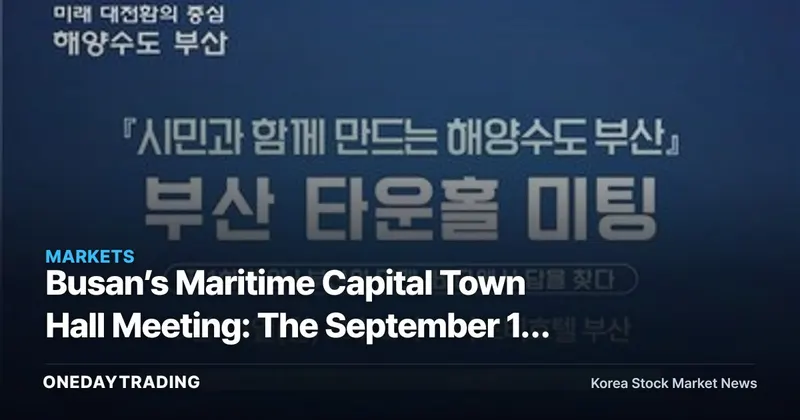
Busan City will hold a town hall meeting on the maritime sector at Asti Hotel Busan at 2 p.m. on the 14th of next month. The aim is to gather views from citizens and experts and refine the vision for Busan as a maritime capital.
What matters to investors is not the format, but the stage. A town hall meeting is neither a bill nor a budget item, but it is a starting point for laying out the policy direction. The market is quickest to attach expectations at this early stage, and quickest to unwind them if no numbers follow.
Background and Context
The term maritime capital is broadly about growing ports, shipping, shipbuilding, hinterland logistics, and maritime finance as one package. Busan is already home to these industries, so the symbolism is strong, but symbolism alone does not keep a stock moving for long.
In a high-interest-rate environment, these themes tend to move on valuation multiples before earnings. A higher discount rate reduces the value of future cash flows. So the stronger the policy expectation, the more quickly the market can rally first, but if interest rates and freight rates weaken, the story can lose steam fast.
In the end, the stock market looks at the transmission channel, not the policy label. Port expansion and hinterland development affect cargo volumes and rental income; support for shipping affects freight-rate volatility and vessel utilization; and shipbuilding plus eco-friendly vessel policy affect order backlog and ship prices. What actually gets tied to the budget is the key.
Impact on the Market and Stocks
- HMM, Pan Ocean, and Korea Line Corp. may see policy expectations reflected in supply-demand (order flow) before freight rates do. But shipping stocks are ultimately driven by container freight rates and the exchange rate, so policy headlines alone will not change the trend.
- Samsung Heavy Industries, Hanwha Ocean, and HD Korea Shipbuilding & Offshore Engineering are connected when Busan’s maritime cluster leads to discussions on eco-friendly ships and offshore plants. Still, for this industry sector, orders and profitability matter more than the event itself.
- CJ Logistics and Dongbang and other logistics stocks may get indirect benefits when linked to port-side logistics. Cargo growth has to translate into actual contracts and utilization rates before the numbers change.
- Busan-based construction and infrastructure stocks only become meaningful if port, road, and hinterland projects take shape. At this stage, confirming the timeline matters more than the theme.
Investor Checklist
- Watch whether the September 14 event includes project names, funding, and timelines. If there are only words and no numbers, the market reaction will also be short.
- For shipping stocks, watch SCFI and the won-dollar exchange rate together. Even with policy expectations, earnings will not follow if freight rates and the exchange rate turn lower.
- For shipbuilders, the next order announcements and ship-price trends are the key. The Busan story is only a secondary catalyst; new orders are the real substance.
- Check Busan City’s follow-up budget plan and the schedule for talks with the central government. Once the budget is attached, the story becomes numbers, not policy.
Outlook
The positive scenario is clear. If, after September 14, Busan City breaks the maritime capital vision into project units and backs ports, logistics, and shipbuilding with budgets and institutional support, the policy premium on related stocks can come back to life. In that case, the market may start to view Busan not as a local issue, but as a medium-term momentum story for shipping and shipbuilding.
The risk is the same. If this meeting ends with opinion gathering and no concrete funding, the stock price may reflect only pre-event expectations and then pull back. Shipping and shipbuilding are already cyclical industry sectors, so policy news cannot overpower freight rates, orders, and the exchange rate.
Frequently Asked Questions
Is Busan’s maritime capital town hall meeting a positive catalyst for shipping stocks?
Conditionally, yes. It becomes a positive catalyst only when policy leads to actual projects and budgets, allowing shipping and port-related stocks to command higher valuations. The event itself does not change earnings.
Can the stock price keep rising just on the September 14 event?
It is hard for that to last. The market usually prices in expectations immediately after the announcement, then cools quickly if there is no project plan or funding. For shipping stocks in particular, freight rates and the exchange rate are the core drivers of the stock price.
What should investors check first?
After the event, investors should look at what project names, timelines, and budget items Busan City announces. Then they should also check SCFI, the won-dollar exchange rate, and shipbuilding order announcements together to judge whether the policy story is translating into earnings.
HMM, viewed with real-time data
HMM’s latest closing price is KRW 21,450 (0.00% from the previous day), and the traffic-light signal combining foreign investors and institutional investors supply-demand (order flow) with news and momentum is 🟡 neutral/wait-and-see. Positive and negative signals are mixed, so this is a watchful phase.
※ Price data and foreign investors/institutional investors supply-demand (order flow) data are provided by Korea Investment & Securities (KIS) and are based on the publication time.
This article is automatically summarized and analyzed based on the original news report. View original (Yonhap News Industry)
<