
3-Line Briefing
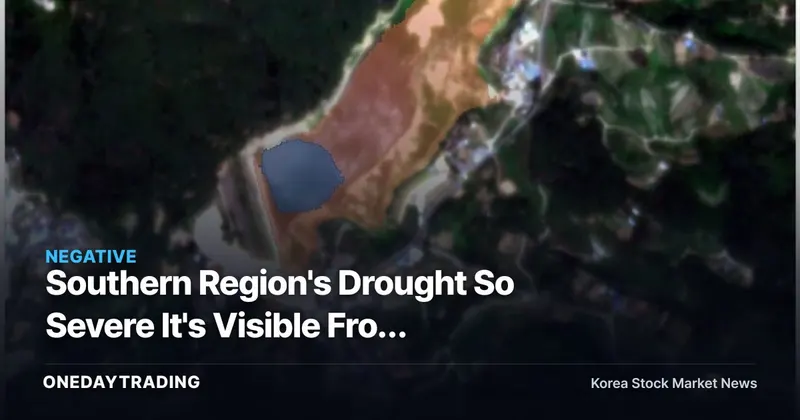
- As the heat wave and drought continue in the southern region, satellite imagery has clearly captured a sharp decline in water storage at major dams and reservoirs.
- This is a case where satellite data revealed the true severity of the drought before local government announcements or on-the-ground reporting did, raising concerns over disruptions to agricultural and residential water supplies.
- If the drought drags on, weak crop yields and rising feed and fertilizer costs could combine to push up cost burdens for food and beverage and distribution companies.
What's Changing
Local government drought-response announcements typically focus on measures such as developing new wells or dispatching water tanker trucks. Satellite imagery, by contrast, leaves little room for interpretation. A reservoir with an exposed bed is a physical fact that no figures can adjust, and when it's identifiable to the naked eye even from satellite images, as in this case, it should be read as a signal that the situation has exceeded what regional-level responses can handle.
From an investment standpoint, what matters is not the drought itself but which cost line it touches. Reservoir water is broadly used in two ways: agricultural water and residential/industrial water. If agricultural water dries up, rice paddies and other field crops are affected, and this feeds through to grain and vegetable prices with a time lag. A shortage of residential and industrial water could also weigh on operating rates at regional industrial complexes, but for now the risk on the agricultural-water side is the more pronounced one.
The point that determines the outcome here is whether this drought is a temporary seasonal deviation or a recurring structural pattern. If drought news out of the southern region has repeated every summer for the past several years, the market may gradually start pricing this in not as a one-off event but as a factor that raises cost volatility every summer.
Numbers and Context
The key evidence behind this report is satellite observation. Ground-level surveys or local government reservoir-level announcements can diverge from actual conditions depending on sampling points and release timing, but satellite images show the real reduction in water surface area at a given moment as is. In other words, this is a case where observational data signaled the severity before any official statement did. That said, the original report does not provide specific reservoir-level figures or the extent of the affected area, and that information needs to be confirmed at the next stage.
Stocks to Watch: Beneficiaries and Losers
- Fertilizer makers (Joby, Namhae Chemical) — If drought makes managing soil moisture and nutrients more difficult, farmers' demand for foliar feeding and specialty fertilizers could rise, but there is also a risk that poor crop conditions shrink overall cultivation scale.
- Seed and agricultural materials companies (Asia Seed) — Rising demand for reseeding and drought-tolerant varieties could serve as a short-term revenue-defense factor.
- Feed and livestock-related companies (EG Bio, Woorison F&G) — This is the loss-side scenario, where weak feed-crop yields push up grain procurement costs and worsen the cost ratio.
- Water-treatment and water infrastructure companies (Webs) — Demand for groundwater development, well drilling, and water-reuse facilities could grow alongside local government budget execution.
- Food and beverage and restaurant franchises — If purchase prices for raw agricultural produce rise, the resulting cost-ratio pressure could lead to discussions of price increases in the second half.
Risk Check
- Rainfall is a variable that can shift sharply in a short period. If a typhoon or heavy downpour arrives, drought concerns could ease quickly, potentially canceling out the cost-increase scenario altogether.
- The geographic scope and duration of the drought have not yet been specifically confirmed in the original report, so it is premature to extend this into a nationwide inflation impact.
- How strongly individual stocks (tickers) benefit could vary significantly depending on the scale and timing of government and local government fiscal spending.
- Agricultural prices are also driven by factors beyond drought, including international grain prices, the exchange rate, and distribution margins.
Bottom Line
The exposed reservoir bed that satellites revealed first is a warning sign that arrived ahead of any local government response announcement, but whether this actually feeds through into prices and corporate earnings will depend on future rainfall and the pace of response-budget execution.
This article is content automatically summarized and analyzed based on the original news report. View Original (Yonhap News, Industry)