
Key Takeaways
More than 1,600 households lost power for about seven hours. What this figure signals isn't just everyday inconvenience — it shows that aging electrical equipment in older apartment complexes has become a bottleneck in residential infrastructure.
For investors, it's a small signal confirming demand in the electrical equipment and building maintenance industries. That said, this isn't a corporate order-win or earnings disclosure, so it shouldn't be over-interpreted as a short-term stock (ticker) catalyst.
What Happened
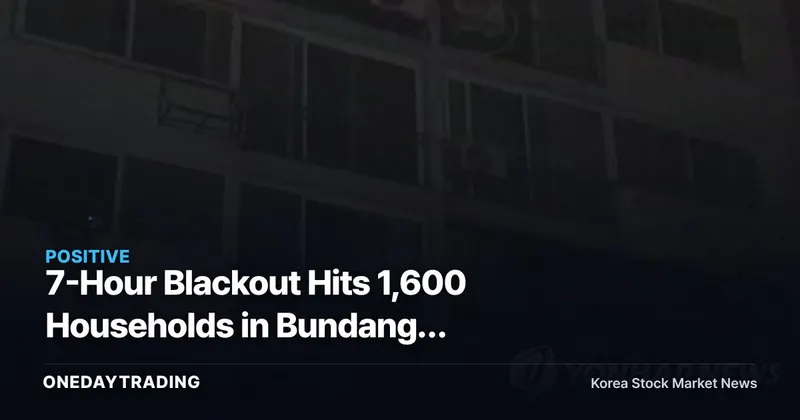
Around 5:46 a.m. on the 8th, a blackout occurred at an apartment complex of roughly 1,600 households in Bundang-gu, Seongnam, Gyeonggi Province. Restoration took about seven hours, and the cause was presumed to be a faulty circuit breaker. Since the timing overlapped with the morning commute and a weekend, resident inconvenience was significant.
The key point here is that the cause is presumed to be internal power equipment within the complex, not a shortage of generation capacity or a wide-area transmission grid issue. The power cycle doesn't end at the power plant — it runs through transformers, switchboards, circuit breakers, and receiving equipment before reaching individual households. When a single component fails in that final stretch, daily life stops for all 1,600 households at once.
A circuit breaker is a device that cuts the circuit when current abnormalities occur, preventing fires and equipment damage. A defective breaker can either cut power unnecessarily for safety, or conversely fail to perform a needed cutoff in time. This is why inspecting circuit breakers and distribution equipment in apartment complexes is increasingly reclassified from a cost item to a safety investment.
Background and Context
Bundang is a flagship "first-generation new town" district. Many apartment complexes there have been occupied for a long time, and electricity usage patterns have changed. Demand from air conditioners, induction cooktops, dryers, and EV charging has grown well beyond past levels. The buildings haven't changed, but the load curve has.
Viewed the way Lee Do-yoon would frame it, the problem shows up in utilization rates before it ever shows up in order backlogs. Power equipment stays invisible in normal times, but failures surface when peak-hour demand meets aging components. This blackout isn't news that changes electrical equipment makers' earnings today — it's a case study in how costs grow the longer replacement and inspection needs are deferred.
Market and Stock (Ticker) Impact
- LS ELECTRIC: A company with low- and high-voltage power equipment and distribution solutions. If demand for circuit breaker and switchboard replacement in apartment complexes becomes institutionalized, it could underpin structural demand in this market.
- HD Hyundai Electric: Primarily focused on large-scale power equipment, but sits on the same axis as the broader trend of expanding power infrastructure investment. The key question is whether aging-equipment replacement demand spreads from industrial to residential use.
- Hyosung Heavy Industries: A company with transformer and power equipment businesses. Its valuation case strengthens not only from data center and transmission/distribution investment, but also when the logic of reinforcing aging urban infrastructure gets attached.
- Construction and property management firms: In reconstruction and remodeling discussions, the importance of electrical equipment capacity and safety inspection items could rise. That said, decisions at the individual complex level are bound by long-term repair reserve funds, resident council decisions, and local government inspection standards.
- KEPCO (Korea Electric Power Corporation): Since the cause is presumed to be a faulty breaker inside the complex, KEPCO is unlikely to be seen as directly responsible. Still, as social sensitivity around distribution-grid reliability grows, pressure for grid investment tends to rise.
Investor Checkpoints
- Cause confirmation: Watch whether the presumed circuit breaker fault is confirmed as an internal complex-equipment issue by the actual investigation. A KEPCO grid problem and an internal receiving-equipment problem carry different investment implications.
- Stronger local government inspections: Watch whether Seongnam City and other first-generation new town areas expand inspections of aging apartment electrical equipment. Administrative inspections can act as a catalyst that pulls forward replacement demand.
- Power equipment orders: Check whether LS ELECTRIC, Hyosung Heavy Industries, and HD Hyundai Electric mention building- and distribution-related demand in their next-quarter order intake.
- Summer peak load: It matters whether similar blackout cases recur during periods when heat waves overlap with cooling demand. Repetition is what moves policy and budgets.
Outlook
The optimistic scenario is clear: inspections of aging apartment power equipment get strengthened, and circuit breaker, switchboard, and receiving-equipment replacement shifts from deferred cost to essential investment. In that case, power equipment makers gain an additional demand narrative — residential infrastructure — on top of data centers and transmission grids.
There's also a downside scenario. If this incident is written off as an isolated, one-off component failure at a single complex, the market impact will be limited. Power equipment stocks (tickers) have already priced in a fair amount of expectation around grid investment, so directly translating a small residential incident into earnings improvement could instead expose valuation risk first. The next things to watch are the results of the cause investigation, whether local governments expand safety inspections, and third-quarter commentary from power equipment makers on distribution and building-equipment orders.
LS ELECTRIC by the Numbers
LS ELECTRIC's most recent closing price is 201,000 won (-0.74% vs. the previous day), and the composite signal combining foreign investor/institutional investor supply-demand (order flow) with news and momentum reads 🟡 neutral, wait-and-see. Positive and negative signals are mixed, making this a stretch to watch closely.
- ▼ 52-week range position — 7% from the 52-week low
Recent related news shows 2 positive catalysts vs. 0 negative catalysts, a favorable mix.
※ Price and foreign/institutional investor supply-demand data are provided by Korea Investment & Securities (KIS), as of the time of publication.
This article was automatically summarized and analyzed based on the original news source. View original (Yonhap News Industry)