
Three-Line Briefing
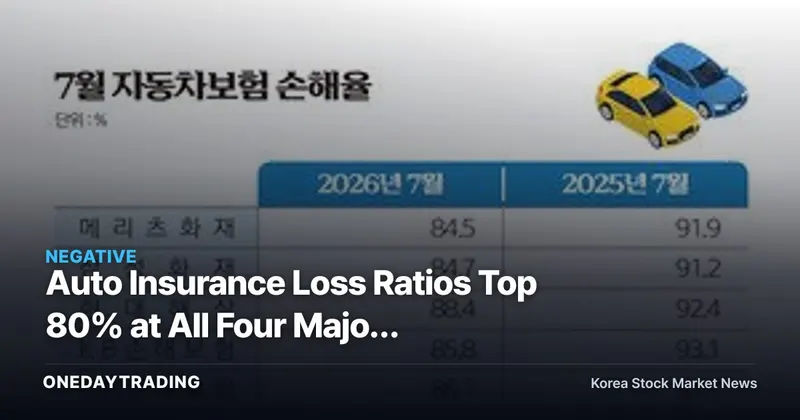
- Auto insurance loss ratios in July 2026 were 88.4% for Hyundai Marine & Fire Insurance, 86.1% for DB Insurance, 85.8% for KB Insurance, and 84.7% for Samsung Fire & Marine Insurance. All four exceeded the 80% level commonly viewed as breakeven.
- When loss ratios rise, underwriting operating profit is the first to decline, and insurers' multiples depend on how much interest rates and investment income can offset that pressure.
- These figures point to an industry-wide issue. This is not a one-off deviation by a single company, but a sign that the auto insurance earnings structure is being compressed across the board.
What Changes
The fact that all four major auto insurers exceeded an 80% loss ratio at the same time puts both downward earnings pressure and valuation pressure on insurance stocks. The loss ratio is the ratio of claims paid to premiums collected. After factoring in operating expenses, the breakeven point is around 80%, so crossing that line means underwriting operating profit has narrowed.
The reason this matters to investors is simple. Insurers can support volatile underwriting results with interest rates and bond gains, but as auto insurance losses widen, it becomes increasingly difficult to defend earnings with investment income alone. That is why the market looks at the loss-ratio figure before the reported earnings number. If loss ratios do not fall below 80%, recovery in insurance profits is likely to remain slow in the third quarter as well.
Share prices may already reflect part of this. However, when all major insurers exceed 80% at the same time, as they did in July, investors need to check whether this is not just an individual stock (ticker) issue but a step down in margin levels for the entire industry sector.
Viewing the Numbers in Context
As of July, Hyundai Marine & Fire Insurance had the highest loss ratio at 88.4%, followed by DB Insurance at 86.1%, KB Insurance at 85.8%, and Samsung Fire & Marine Insurance at 84.7%. On a cumulative January-to-July basis, all were also above 80%: DB Insurance at 85.2%, Hyundai Marine & Fire Insurance at 84.8%, KB Insurance at 84.8%, and Samsung Fire & Marine Insurance at 84.3%. More important than monthly fluctuations is the fact that the cumulative figures are already sitting in an elevated range.
Insurance stocks are also interest-rate-sensitive stocks. As loss ratios rise, the market assigns a lower profit contribution to underwriting and looks more closely at the investment income and interest-rate levels needed to fill the gap. In other words, a rising loss ratio cuts earnings estimates, and lower earnings estimates weigh on multiples. If interest rates are not stable or begin to fall, this pressure becomes even greater.
Beneficiaries and Losers
- Samsung Fire & Marine Insurance: Even its industry-low 84.7% loss ratio is a burden because it is still above breakeven. Its defensive profile is relatively better, but that does not mean industry conditions have improved.
- DB Insurance: Its cumulative loss ratio is the highest at 85.2%. The pressure auto insurance is placing on earnings capacity is showing up in its numbers first.
- Hyundai Marine & Fire Insurance: Its July loss ratio of 88.4% signals the greatest short-term earnings volatility. Its share price may also become more sensitive to changes in earnings estimates.
- KB Financial Group: Slower earnings at KB Insurance could weigh on non-bank profits. Direct exposure is lower than for property-and-casualty insurers, but it affects the quality of group earnings.
- Overall insurance industry sector: For non-life insurers with heavy auto insurance exposure, defending insurance profits is the key issue across the board. Until loss-ratio improvement is confirmed, an industry-level rerating will be difficult.
Risk Check
- If loss ratios continue to exceed 80% in August and September, the third-quarter earnings outlook could be revised down further.
- If interest-rate momentum weakens, investment income will struggle to cover the deterioration in loss ratios.
- These figures are preliminary estimates. If the final figures from the Financial Supervisory Service differ, the short-term share-price reaction could also change.
- Even if some negative catalyst has already been reflected in the market, insurance stocks are likely to see limited upside unless there is evidence that loss ratios are falling again.
Bottom Line
The simultaneous move above 80% in auto insurance loss ratios across all four major insurers puts both earnings downgrades and multiple pressure on insurance stocks. However, if third-quarter loss ratios fall back below 80% and interest rates hold up, the current pressure could become a starting point for a defensive-stock revaluation.
Frequently Asked Questions
Why is an 80% auto insurance loss ratio important?
The loss ratio is the share of premiums received that is paid out as claims. Once operating expenses are included, around 80% is effectively the breakeven point, so crossing that line quickly thins underwriting operating profit.
That is why investors view the loss ratio not as a simple statistic but as a leading indicator for earnings. If the loss ratio stays high, next-quarter earnings estimates are usually cut first.
Which insurance stocks are more sensitive?
Based only on these figures, Hyundai Marine & Fire Insurance and DB Insurance face the larger burden. Hyundai Marine & Fire Insurance had the highest July loss ratio at 88.4%, while DB Insurance had the highest cumulative ratio at 85.2%.
Samsung Fire & Marine Insurance has a relatively stronger defensive profile, but if the entire industry moves in the same direction, it will be difficult for the company alone to protect its multiple.
What should investors watch next?
Investors should first watch next month's loss ratio and the cumulative third-quarter trend. If the figure starts to fall below 80%, expectations for a recovery in insurance profits can revive.
Until then, the key issues are how much support comes from interest rates and investment income, and how much the final Financial Supervisory Service figures differ from the preliminary estimates.
Samsung Fire & Marine Insurance Key MetricsAs of 2026-08-31
| Period Return | 1 Week +3.93% 1 Month +17.04% |
|---|---|
| trading value · trading volume | 94.4 billion won · 139,193 shares |
| supply-demand (order flow) | foreign investors −8.5 billion won net selling institutional investors +9.9 billion won net buying |
| Recent News Tone | positive catalyst 1 · negative catalyst 0 |
Price and supply-demand (order flow) data are real-time values from Korea Investment & Securities (KIS), while supply-demand (order flow) and news-tone calculations are produced by OnedayTrading.
supply-demand (order flow) · Momentum Assessment🟡 neutral · Watchful
Positive and negative signals are mixed, making this a watch-and-wait zone.
- ▲Trend AlignmentShort- and medium-term upside alignment: intraday +0.7% · 1 week +3.9% · 1 month +17.0%
Upcoming Events to Watch
- 09.10Futures and Options Simultaneous ExpirationMediumQuadruple witching — watch for volatility and supply-demand (order flow) disruption
- 09.16FOMC Policy Rate DecisionHighU.S. Federal Reserve monetary-policy announcement — direction of rates and the dollar
- 10.08Index Options Expiration DateLowKOSPI200 options expiration
- 10.22Bank of Korea Monetary Policy BoardHighbenchmark interest rate decision meeting
Auto Insurance Loss RatiosAs of July 2026
| Insurer | Loss Ratio | Month-on-Month | Versus Breakeven |
|---|---|---|---|
| Hyundai Marine & Fire Insurance | 88.4% | — | +8.4%p |
| DB Insurance | 86.1% | — | +6.1%p |
| KB Insurance | 85.8% | — | +5.8%p |
| Samsung Fire & Marine Insurance | 84.7% | — | +4.7%p |
The breakeven line is generally viewed as around 80%. All four of the four companies included in the tally exceeded this level. These are preliminary industry estimates and may differ from the final figures released by the Financial Supervisory Service. Monthly trends can be viewed on the auto insurance loss ratio page.
This article is automatically summarized and analyzed based on the original news report. View original article (Korea Financial News)