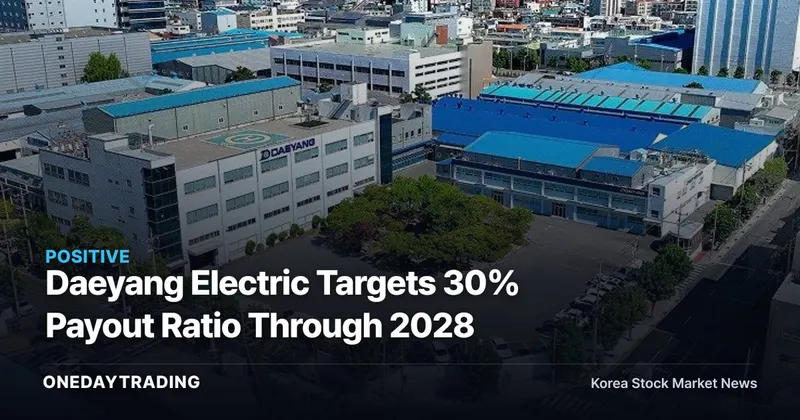

Daeyang Electric has set a target consolidated dividend payout ratio of at least 30% from 2026 through 2028. As reported by Maeil Business Newspaper Securities, the investment significance lies not merely in the higher dividend, but in the shift from a payout ratio previously capped at 10% to a medium- to long-term policy spanning three fiscal years.
What Has Changed in Daeyang Electric’s Dividend Policy?
- Daeyang Electric has announced a target consolidated dividend payout ratio of at least 30% for the three fiscal years from 2026 through 2028.
- While Daeyang Electric previously kept its dividend payout ratio at or below 10%, it will now strengthen shareholder returns primarily by increasing cash dividends.
- The company plans to prioritize strategic cash reserves over share buybacks and cancellations while preserving funding for investment and financial flexibility.
The consolidated dividend payout ratio measures the proportion of profit distributed to shareholders based on consolidated earnings. The new policy is not a commitment fixing a specific dividend amount in advance, but a disclosed target benchmark for future dividend decisions. The key point for investors is not the dividend amount itself, but the change in the company’s profit-allocation policy.
From 10% or Less to at Least 30%: What the Numbers Show
Daeyang Electric’s previous policy was to keep its dividend payout ratio at or below 10% to prepare for volatility in the business environment and secure funding for growth investments. Under the new policy, the company will target at least 30% from 2026 through 2028. Rather than drawing down its cash holdings all at once, the company is raising the benchmark for the share of earned profit returned through cash dividends.
The key implication for investment decisions is greater predictability. By disclosing both the policy period and target payout ratio, the company is enabling investors to assess its dividend principles in advance. Maintaining a payout ratio of at least 30% would demonstrate consistency in the policy of increasing cash dividends, but investors will need separate disclosures to determine the specific dividend per share and total dividend payment.
Balancing Higher Cash Dividends With Strategic Cash Reserves
The company will maintain its policy of holding strategic cash even as it increases shareholder returns. It says it must preserve funding for investment in new businesses and M&A, as well as financial flexibility. This principle also explains why the company is focusing its shareholder-return policy on higher cash dividends rather than share buybacks and cancellations.
The announcement should therefore not be interpreted as a simultaneous expansion of every shareholder-return measure. The company did not provide a specific scale or timetable for share buybacks or cancellations, nor did it disclose targets or schedules for new-business investment and M&A. At this stage, what is confirmed is that the dividend target and cash-retention policy have been established together.
What Daeyang Electric Investors Should Monitor Next
- Actual cash dividend: Investors should check the dividend per share and total dividend payment in the company’s next dividend-related disclosure.
- Policy implementation: The central question is whether the consolidated dividend payout ratio remains at or above 30% in each fiscal year from 2026 through 2028.
- Treasury-share policy: If the company considers share buybacks or cancellations, investors should watch for a separately disclosed scale and timetable.
- Use of cash: If strategic cash is deployed for new-business investment or M&A, the key issue will be how the balance between higher dividends and financial flexibility changes.
Daeyang Electric said, “We will actively align with the government’s policy direction of expanding shareholder returns and develop into a company that grows alongside its shareholders by continuously strengthening business competitiveness and generating stable profits.” The policy announcement is a positive starting point. The decisive factor will not be the strength of the declaration, but how consistently actual dividend disclosures deliver on the target over the three fiscal years.
Daeyang Electric Key MetricsAs of 2026-11-04
| Period Returns | 1 Week -1.31% 1 Month -19.52% |
|---|---|
| Trading Value · Trading Volume | 49,804 shares |
| Supply-Demand (Order Flow) | Foreign Investors Net selling of 200 million won Institutional Investors No notable trading |
Price and supply-demand (order flow) data are real-time figures from Korea Investment & Securities (KIS), while supply-demand (order flow) and news-tone assessments are calculated independently by One Day Trading.
Supply-Demand (Order Flow) and Momentum Assessment🟡 Neutral · Wait-and-See
Mixed positive and negative signals suggest this is a period to watch.
- ▼52-Week PositionWithin 5% of the 52-week low
Upcoming Events to Watch
- 11.12Index Options ExpirationLowKOSPI 200 options expiration
- 11.26Bank of Korea Monetary Policy BoardHighBenchmark interest rate decision meeting
- 12.09FOMC Policy Rate DecisionHighU.S. Federal Reserve monetary policy announcement — direction of interest rates and the dollar
- 12.10Futures and Options ExpirationMediumQuadruple witching — watch for volatility and supply-demand (order flow) disruptions
This article was automatically summarized and analyzed from the original news report. View original article (Maeil Business Newspaper Securities)