
Summary
It isn't so much that the KOSPI rose — the signal that it's safe to buy risk assets again arrived first through the large-cap semiconductor names. The KOSPI's 4%-plus surge and the triggering of a buy-side sidecar on the 12th, along with the 7%-plus gains in Samsung Electronics and SK Hynix, amount to a stronger supply-demand (order flow) event than a simple rebound.
The core of this story isn't the index level. It's that buying pressure in both futures and the cash market grew simultaneously enough to trigger a temporary suspension of program buy orders.
What Happened
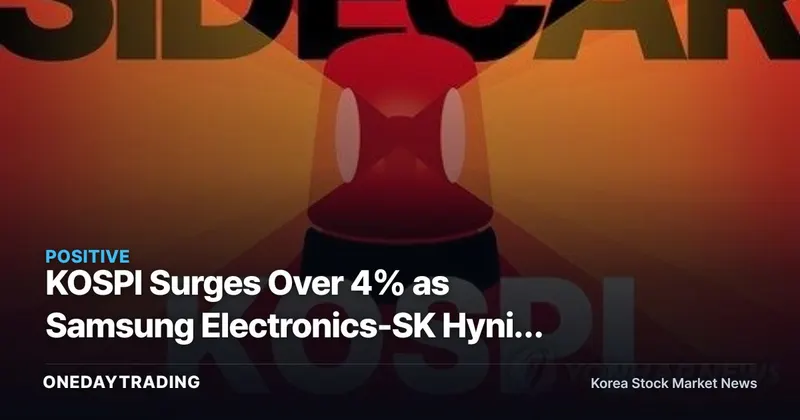
The KOSPI surged more than 4% on the 12th. During the session, a buy-side sidecar — a temporary suspension of program buy orders — was triggered, meaning price movement was large enough for the market to halt the effect of program buy orders for a set period.
The rally felt hottest in the large-cap semiconductor stocks (tickers). Samsung Electronics and SK Hynix each gained more than 7%. Given how much weight these two stocks (tickers) carry in the KOSPI index, the day's rebound looks less like a broad-based rotation and more like a concentrated rally led by large-cap chipmakers.
What investors should focus on is not the sidecar itself but what lies behind it. A strong influx of program buying suggests that it wasn't just cash-market stock purchases — futures prices, arbitrage trading, and passive tracking funds likely moved in the same direction. This flow is powerful, but it can also reverse just as quickly.
Structural Background
A strong index rebound typically unfolds in three stages. First, expectations build that pressure from interest rates and the exchange rate could ease. Second, as the discount-rate burden lightens, multiples expand first for growth stocks and high-beta sectors. Third, capital flows into the market leaders that carry the greatest index weight. In today's market, that final channel was Samsung Electronics and SK Hynix.
That said, a 4%-plus index gain alongside 7%-plus gains in semiconductor stocks (tickers) is hard to explain by an immediate upgrade in earnings outlook alone. It needs to be determined whether this is already fully priced in, or whether it is a short-term overheating driven by short covering and program-driven supply-demand (order flow). Even if expectations for an improving semiconductor cycle hold up, the prices set on a day when a buy-side sidecar was triggered could come back as a valuation burden the next day.
Stock (Ticker) and Sector Ripple Effects
- Samsung Electronics: The KOSPI's flagship stock (ticker) by market capitalization. Its 7%-plus gain is the central pillar of the index's rise, reflecting both expectations for an improving memory cycle and a recovery in foreign investors' risk appetite at the same time.
- SK Hynix: More sensitive to expectations around high-bandwidth memory and server demand. Even with the same 7%-plus gain, whether upward revisions to earnings estimates hold up will determine how sustainable the share price move is.
- Semiconductor equipment and materials stocks (tickers): If the large-cap rally continues, the momentum could spread through the back-end, materials, and equipment value chain. That said, actual order intake requires confirmation of capital spending execution by major customers.
- Brokerage stocks (tickers): When KOSPI trading value rises, expectations for brokerage commission income follow. What matters more than a short-term rally is whether elevated turnover holds for several days.
- Large-cap exporters: High-beta names in autos and IT components could rally in tandem. However, without the same level of earnings visibility as semiconductors, the quality of any chasing rally is weaker.
Bullish vs. Bearish Scenarios
The bullish scenario is straightforward: trading value in Samsung Electronics and SK Hynix stays elevated even after the KOSPI's 4%-plus surge, foreign net buying continues, and the exchange rate stabilizes. In that case, the market could move beyond a simple technical rebound into a valuation re-rating phase.
The bearish scenario starts from the same point. A buy-side sidecar is evidence of strong buying, but it is also a sign of overheating. If program buying and short covering fade without a follow-through upgrade in earnings outlook, part of the 7%-plus surge will remain a burden. In particular, if the exchange rate becomes volatile again or interest-rate expectations reverse, foreign investor supply-demand (order flow) could change direction within a single day.
Action Points for Investors
- Foreign investor supply-demand (order flow): Investors should check whether foreign net buying in Samsung Electronics and SK Hynix continues past the 12th. The cumulative direction matters more than a single day's buying.
- Program trading: Watch whether arbitrage and non-arbitrage buying persists after the sidecar. If program-driven money exits, the index's momentum could fade sharply.
- Exchange rate level: A stable won favors multiple expansion for large-cap semiconductor stocks (tickers). Conversely, if the won-dollar exchange rate rises again, the day's rally could wobble the moment expectations for currency gains fade.
- Next earnings guidance: Watch whether memory prices, server demand, and inventory trends improve enough in Samsung Electronics' and SK Hynix's next earnings releases to justify the share price gains.
Samsung Electronics: Real-Time Data Snapshot
Samsung Electronics (005930)'s most recent closing price was 257,000 won (+7.31% from the previous day), and the composite signal combining foreign/institutional investor supply-demand (order flow) with news and momentum reads 🟢 Buy-leaning. Foreign investors, institutional investors, news flow, and momentum are all positive, making this stock (ticker) worth watching.
- ▲ Dual buying — Foreign investors +584.3 billion won · institutional investors +76.3 billion won, buying in tandem
- ▲ Trend alignment — Short- and medium-term trends aligned to the upside (+7.3% today · +4.5% over 1 week · +1.0% over 1 month)
- ▲ News flow — 12 positive catalysts vs. 2 negative catalysts — positive catalysts dominate
Recent related news skews favorable, with 12 positive catalysts versus 2 negative catalysts.
※ Price and foreign/institutional investor supply-demand (order flow) data are provided by Korea Investment & Securities (KIS), as of the time of publication.
This article was automatically summarized and analyzed based on the original news report. View original (Yonhap News Agency, Securities)