
At a Glance
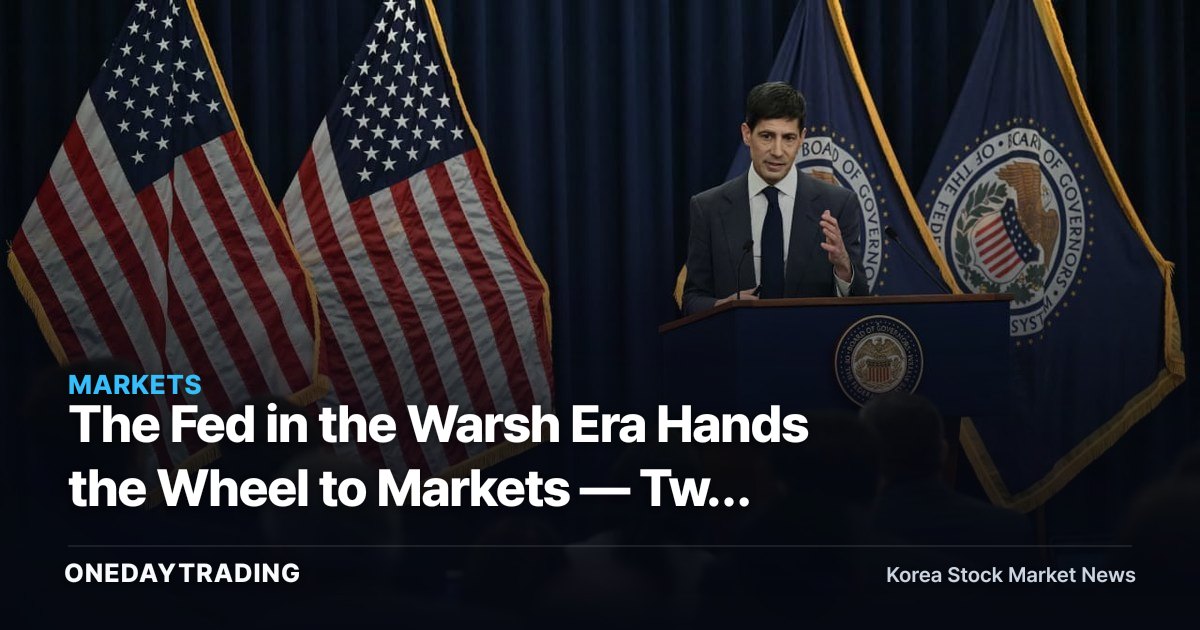
The assessment is that the Fed is moving away from its past habit of conveniently mapping out its policy path in advance, toward a phase in which markets are left to gauge the direction of rates on their own. In this so-called Warsh regime, the prices set by the bond and equity markets themselves — rather than any single remark from a Fed official — become the policy signal. For Korean investors, with U.S.-driven volatility transmitted directly through the exchange rate and foreign investor order flow, this is a moment to re-establish the benchmarks they use to make decisions.
Why It Matters Now
Until now, global capital moved along clear signposts — the Fed's dot plot and the chair's remarks. But as explicit guidance fades and the structure shifts to one where markets pre-price policy expectations, the authority to interpret the signals effectively passes to Wall Street. That means investors must directly use bond yields and risk-asset prices as their benchmarks for reading the Fed's intentions.
The reason this change is so sensitive for the Korean stock market is clear. The KOSPI is heavily swayed by foreign investor order flow and the won-dollar exchange rate, and when U.S. rate expectations move faster and more erratically through market prices, the swings in the exchange rate and in foreign investors' buying and selling grow accordingly. The murkier the policy path, the more the risk-asset premium wobbles — and that shock tends to show up first in the valuations of large-cap exporters such as semiconductors and autos.
Conversely, if a structure in which the market calibrates policy on its own takes hold, the one-off shocks that recurred at every Fed meeting may ease, and rate expectations can be absorbed into prices gradually. In other words, the same change carries two sides at once: greater short-term volatility and improved medium-term predictability.
Frequently Asked Questions
- What does the Warsh regime mean? It refers to a way of conducting monetary policy in which the Fed reduces specific guidance on its path and instead encourages market prices to form policy expectations on their own.
- What are the key indicators Korean investors should watch? Long-dated U.S. government bond yields and the strength of risk appetite in U.S. equities. These two serve as a de facto signal board in place of Fed commentary.
- Why does the exchange rate matter? When U.S. rate expectations waver, the dollar's strength or weakness shifts, and this directly affects the won-dollar exchange rate and foreign investors' KOSPI trading.
- Can the direction be pinned down right now? Because this is a transition in which the authority to interpret policy is shifting to the market, the weight falls on the likelihood of greater volatility itself, rather than on direction.
Impact on Related Stocks and Sectors
- Large-cap semiconductors Samsung Electronics and SK hynix are the most sensitive to foreign investor order flow and global risk appetite, so shifts in U.S. rate expectations feed directly into their valuations.
- Auto exporters For Hyundai Motor, moves in the won-dollar exchange rate directly affect operating profit, making it a key axis of benefit or harm tied to the Fed signals that drive the dollar's strength.
- Banks and financials For KB Financial and Shinhan Financial Group, rate levels are linked to net interest margins, so changes in long-term rate expectations bear on earnings visibility.
- Brokerages and asset management In phases of expanding market volatility, the amplitude of trading value and trading profit and loss widens.
- High-dividend and defensive stocks When uncertainty over the rate path increases, there can be stretches where relative preferences diverge.
Points to Watch When Investing
- Prioritize checking the actual price moves of U.S. government bond yields and equity-market risk appetite over Fed commentary.
- Watch the won-dollar exchange rate level together with the trend in net foreign buying to gauge the direction of supply-demand (order flow).
- A reduction in policy guidance can amplify short-term volatility, so view the risks of leverage and short-term bets conservatively.
- Keep the next FOMC schedule and U.S. employment and inflation data releases on your calendar, and verify the market's reaction after the fact.
Overall Outlook
On the optimistic side, as the market absorbs policy expectations in a more distributed way, the abrupt shocks at each meeting could ease, and the rate path could be reflected into prices gradually, improving medium-term predictability. During the transition, however, the standards of interpretation are ambiguous, and there is a risk of frequent stretches in which rates and the exchange rate overreact even to minor data points. Ultimately, training oneself to read the benchmark of bond and equity prices directly — rather than the Fed's words — is likely to be the variable that separates winners from losers for Korean investors.
This article is content automatically summarized and analyzed based on the original news report. View original (MarketWatch)