
Summary
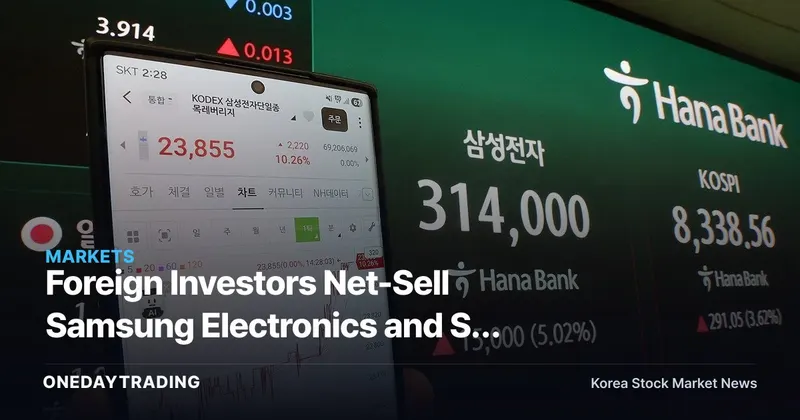
While foreign investors have recently net-sold Samsung Electronics and SK Hynix—the two large-cap semiconductor stocks—for several consecutive sessions, they have taken a two-track approach to single-stock leveraged products, buying and selling at the same time. It is a dual flow in which they trim their cash (spot) holdings while betting on short-term direction through derivatives and leveraged instruments. It is a phase in which supply-demand (order flow) volatility in the semiconductor industry sector could grow even greater.
What Happened
Foreign investors sold off Samsung Electronics and SK Hynix—the first- and second-largest stocks by KOSPI market capitalization—on a net-selling basis over a certain period. The two stocks account for an overwhelming share of total KOSPI market capitalization, so foreign net selling of the underlying shares acts as a direct drag on the direction of the index itself.
That said, over the same period foreign investors did not simply sell the single-stock leveraged products tied to these stocks; they bought and sold them simultaneously. In other words, this can be read as trimming long-term holdings while trading-oriented capital flows into leveraged instruments to take advantage of short-term price swings.
This two-track behavior shows that foreign capital does not move in only one direction. With money leaving the cash (spot) market coexisting with money returning on a short-term basis through leverage, an environment is created in which the intraday volatility and trading value of large-cap semiconductor stocks both rise at the same time.
Structural Background
Samsung Electronics and SK Hynix have a high foreign ownership ratio, making them sensitive to global fund flow, the exchange rate, and the memory semiconductor business outlook. In a phase of won weakness, pressure builds to reduce cash (spot) holdings on concerns over foreign-exchange losses, while at the same time capital seeking a short-term rebound tends to take a detour into leveraged products.
The expansion of single-stock leveraged products means that short-term betting tools at the individual-stock level have diversified. This is a structural factor that amplifies the swings in supply-demand (order flow): even the same foreign investors can now simultaneously run opposite trades in the cash and derivatives markets depending on their investment objective.
Impact on Stocks and Sectors
- Samsung Electronics: As a direct target of foreign net selling in the cash market, it faces heavy short-term supply-demand (order flow) pressure, though a swift reversal is also possible if hopes for a memory recovery emerge.
- SK Hynix: Momentum in high-value memory such as HBM may clash with foreign selling, potentially widening volatility.
- Semiconductor materials and equipment stocks: They tend to rise and fall in tandem with shifts in the bellwethers' order flow, placing them in the zone of indirect impact.
- KOSPI index and ETFs: Because the two stocks carry an overwhelming weighting, foreign selling exerts downward pressure across index-type products as a whole.
- Leveraged and derivatives product managers: Active trading is expected to benefit them on the trading-value front.
Bull vs. Bear Scenarios
In the bull scenario, foreign buying of leveraged products is read as a signal that a short-term bottom is being recognized. If a rebound in memory prices and expanding AI demand are confirmed, cash-market selling could halt, foreign investors could turn to net buying, and large-cap semiconductor stocks could rebound strongly.
In the bear scenario, net selling in the cash market may be the start of a trend-driven capital exodus. If exchange-rate pressure and global risk aversion overlap, leveraged buying may amount to nothing more than short-term profit-taking, with the risk that broad downward pressure on the index persists.
Investor Action Points
- Check foreign investors' shifts between net buying and net selling in the cash market on a daily basis, and use them as a signal of trend change.
- Recognize that leveraged products are short-term instruments with high volatility and cost, and approach them separately from long-term investing.
- Track the exchange rate, memory prices, and HBM demand indicators together to gauge the direction of the semiconductor business cycle.
- Rather than jumping to conclusions on any single signal, prepare for a phase of expanding volatility through staggered responses and risk management.
This article is content automatically summarized and analyzed based on the original news report. View the original (Yonhap News Securities)