
Summary
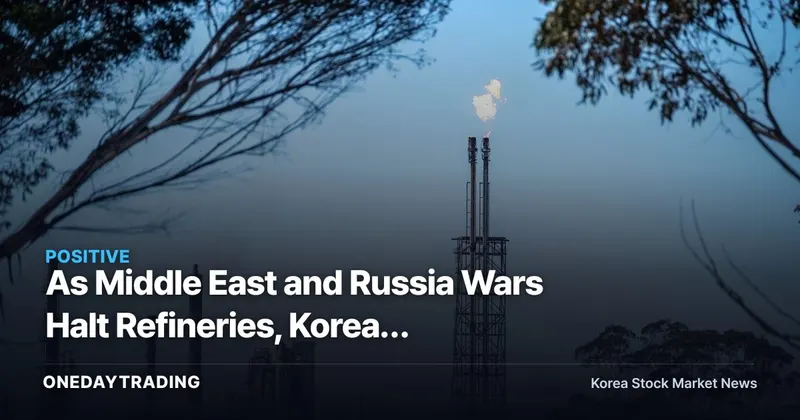
When war rattles the crude oil supply chain, refining stocks are typically squeezed by rising feedstock costs. This time, however, the opposite is happening. As the Middle East war and the Russia-Ukraine war drag on into another year, recurring disruptions at global refining facilities have prompted the market to reread domestic refiners' refining capacity itself as an energy security asset. What this tells us is that what's scarce right now isn't crude oil — it's refining capacity.
The Story So Far
Fears of escalation following the Middle East war, combined with the prolonged Russia-Ukraine conflict, hit the regional concentration of refining capacity before affecting crude oil supply-demand (order flow) itself. Ukrainian drone strikes on Russian refineries, layered on top of rising logistics and insurance costs stemming from Middle East instability, have shaken utilization rates at some European and Middle Eastern refineries — and the market's focus has shifted to the fact that only a limited number of facilities can fill that gap.
Korean refiners occupy a unique position in this landscape. The paradox is that a country without a single drop of domestic crude oil came to hold some of the world's top-tier refining capacity — precisely as part of a strategy to secure stable energy supply — and that capacity is now back in the spotlight as a strategic asset. In effect, the market's rationale for buying refining stocks has shifted: not a bet that oil prices will rise, but a bet that refining margins will improve structurally.
Structural Background
The key variable driving refiners' earnings isn't the price of oil itself but the spread between crude oil and refined product prices — the refining margin. When global refining capacity suffers regional disruptions, the supply of refined products tightens more than that of crude oil, widening this spread. As the wars drag on and this pattern keeps repeating, investors have begun re-rating refining stocks' valuations — not as oil-price cyclicals, but as plays on an oligopoly in refining capacity. In an environment where interest rates stay elevated, sectors backed by solid dividend yields and asset value hold relative appeal, and refiners check that box as well.
Impact on Stocks (Tickers) and the Industry Sector
- S-Oil — A pure-play refiner with a high concentration in refining and petrochemicals, making it the most sensitive to improving refining margins.
- SK Innovation — Holds both refining and battery businesses, so improved cash flow from the refining segment helps ease the group's overall financial burden.
- GS — Through its stake in GS Caltex, gains from improving refining margins flow through to the holding company's earnings.
- HD Hyundai — With HD Hyundai Oilbank as a subsidiary, improved earnings in the refining segment add to the holding company's valuation.
- The broader refining value chain — Shipping and tanker operators handling crude oil procurement and logistics also stand to benefit from shifts in cargo volumes driven by the regional concentration of refining capacity.
Bullish vs. Bearish Scenarios
The bullish scenario is one where war risk never fully resolves while refining disruptions keep recurring. In that case, refining margins stay structurally elevated, and refining stocks continue to command an energy security premium. The bearish scenario, conversely, is one where both wars are resolved faster than expected, or new refining capacity under construction in China and the Middle East comes online as scheduled. In that case, the refining-capacity-oligopoly narrative weakens, and refining stocks revert to their old role as cyclicals whose earnings swing with oil prices. It's also worth keeping in view, for balance, that if valuations have already priced in much of this premium, the pullback could be sharper if refining margins fail to rise as much as expected.
Investor Action Points
- Track weekly and monthly trends in refining margin indicators such as the Singapore complex refining margin to confirm that earnings improvement is showing up in the actual numbers.
- Check whether the refining segment's contribution to operating profit actually expands in the next quarterly earnings release.
- Each time a Middle East or Russia headline hits, distinguish whether both oil prices and refining margins move together or whether only oil prices spike.
- Keep an eye on the KRW/USD exchange rate level as well. Since crude oil import payments are settled in dollars, a further rise in the exchange rate could offset part of the benefit from improving refining margins.
S-Oil Through Real-Time Data
S-Oil's most recent closing price was 137,600 won (up +10.17% from the previous session), and the signal combining foreign investors/institutional investors order flow with news and momentum stands at 🟡 neutral / wait-and-see. Positive and negative signals are mixed, making this a range to watch.
- ▲ Trend alignment — Short- and medium-term uptrend alignment (today +10.2% · 1 week +8.1% · 1 month +4.6%)
Recent related news skews favorable, with 1 positive catalyst and 0 negative catalysts.
※ Price and foreign investors/institutional investors order flow data are provided by Korea Investment & Securities (KIS) and reflect the time of publication.
This article is automatically summarized and analyzed content based on the original news report. View original (Yonhap News Agency, Industry)