
Three-Line Briefing
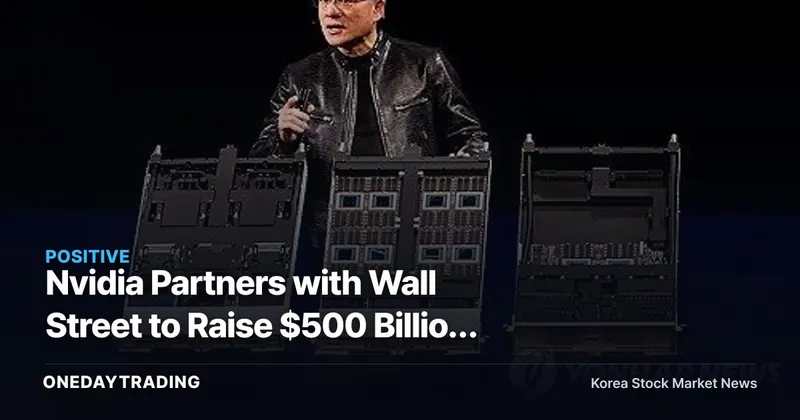
- Nvidia and major Wall Street investment firms are raising $500 billion, or roughly 710 trillion won, to expand AI infrastructure.
- This capital isn't spent directly by Nvidia—it's channeled to support investment by the customers buying its GPUs, namely data center and cloud operators.
- Because the supplier and financial sector are jointly building the customer's purchasing power, order visibility across the entire semiconductor supply chain—from HBM to foundry—gets an additional boost.
What's Changing
News that Nvidia is raising capital sounds odd at first. Nvidia is already a company with tens of trillions of won in quarterly net profit. The party short on cash isn't Nvidia—it's the customers looking to buy Nvidia's GPUs. What's really behind this $710 trillion won raise is vendor financing: the seller and the financial industry teaming up to fill the buyer's wallet. This should be read as a signal that the next bottleneck in the semiconductor supply chain isn't wafers or HBM, but the capital needed to build data centers.
Breaking the supply chain into stages puts the weight of this raise into perspective. Each Nvidia GPU incorporates HBM stacked by SK Hynix and Samsung Electronics, passes through TSMC's CoWoS packaging, and ends up in a customer's data center. Until now, the constraints in this chain have been HBM high-stack yield and CoWoS capacity. This capital is designed to create the purchasing power to actually buy up volume once it clears that bottleneck. Even if supply opens up, orders won't grow without money to pay for it. That's why Wall Street stepped in.
That said, this structure is less about truly increasing demand than about pulling it forward. When customers buy GPUs with borrowed capital rather than their own cash, Nvidia's revenue rises, but the reliability of that revenue becomes tied to the customers' repayment capacity. If the buyers can't pay it back, the cycle runs in reverse.
Numbers in Context
At $500 billion, or roughly 710 trillion won, this is a sum that would be hard to match even by combining the annual revenue of Korea's major semiconductor companies. Even accounting for the fact that this capital will be deployed sequentially across multiple projects rather than all at once, it signals that Nvidia is willing to shoulder some financial risk itself to grow the market. The key question is whether this money flows into new data center construction—that is, capex—or serves as a bridge to cover funding gaps in already-contracted projects. If it's the former, it becomes a leading indicator of genuinely rising HBM and foundry orders; if the latter, it merely secures orders that were already locked in.
Stocks to Watch
- Nvidia: The architect of a structure that directly builds its customers' purchasing power. Revenue growth continues, but the company also takes on a share of customer credit risk.
- SK Hynix: As an HBM supplier, if customer orders can be executed without funding constraints, the payback period on high-stack expansion investment shortens.
- Samsung Electronics: Exposed to Nvidia's supply chain through both HBM and foundry, so an expansion in customer capex would also boost its order opportunities.
- TSMC: CoWoS packaging capacity is the key factor determining whether this capital inflow actually resolves the real bottleneck.
- Data center and power-related stocks (tickers): Without the buildings and power to house the GPUs, even this capital can't be absorbed. The pace of securing power supply is the variable to watch next.
Risk Check
- Circular financing concerns: A structure where the supplier funds the customer's purchases isn't immune to criticism that it lowers the quality of reported revenue.
- Customer repayment capacity: If data centers built with this capital fail to hit expected utilization and profitability, the repayment burden turns directly into bad debt.
- Physical supply chain constraints: Even with capital in hand, if HBM yield, CoWoS capacity, and power supply remain unchanged, actual shipments could lag behind plan.
- Valuation concerns: AI-related stocks (tickers) have already priced in a substantial amount of future demand, making it hard to conclude that fundraising news alone guarantees further upside.
Bottom Line
The $710 trillion won raise is a positive catalyst that eases the capital constraints on the AI infrastructure cycle, but whether that money translates into actual utilization and repayment needs to be confirmed through next quarter's data center groundbreakings, HBM shipment volumes, and customer earnings reports.
This article is automatically summarized and analyzed based on the original news report. View original (Yonhap News Securities)