
Key Takeaways
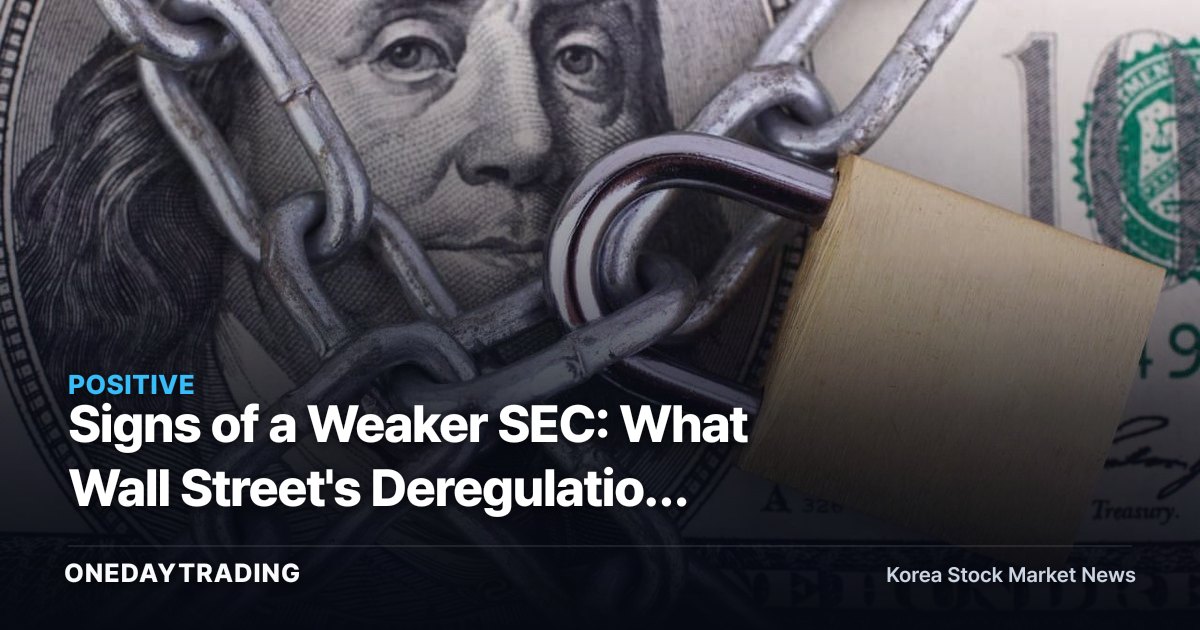
A shift is underway inside the U.S. Securities and Exchange Commission (SEC) — long regarded as the toughest watchdog in American capital markets — that is eroding its own enforcement leverage from within. In the short term, this easing of regulatory intensity could act as a positive catalyst by reducing litigation and penalty risk for the financial and crypto-asset sectors. At the same time, it carries a structural cost: weaker investor protection.
For Korean investors, the key is to watch both sides of the equation — whether the regulatory discount applied to U.S.-listed financial stocks and crypto-asset platforms shrinks, and whether that comes at the expense of governance trust.
What's Happening
The SEC has long wielded influence through its enforcement power — pressuring companies over accounting fraud, insider trading, and market manipulation, and extracting settlements in the process. According to reports, however, the internal mood at the Commission is shifting, with an emerging assessment that both the severity of sanctions and its negotiating leverage are weakening.
Enforcement leverage refers to the credibility of the threat that makes a company conclude a settlement is preferable to fighting the SEC. As that credibility erodes, companies have greater incentive to dig in or push disputes into litigation — which in turn weakens the effectiveness of any remedies or corrective actions the regulator can extract.
The crypto-asset sector in particular has been one of the SEC's main battlegrounds, where the agency has pressured exchanges and issuers by asserting securities classifications and registration requirements. As a result, it is considered the area most sensitive to any change in enforcement intensity.
Background and Context
In the United States, the intensity of regulatory oversight swings widely depending on the administration's leanings and the composition of the commission. When a pro-market, deregulatory stance strengthens, new rulemaking tends to slow and existing enforcement tends to be applied more conservatively. This raises the possibility that some of the investor-protection framework built up since the financial crisis could be rolled back.
Historically, the early stages of a deregulatory cycle tend to boost risk-asset appetite. But when accumulated laxity later surfaces as accounting fraud or inadequate disclosure, markets have shown a two-sided pattern in which the accumulated trust deficit is billed all at once.
Impact on Markets and Stocks (Tickers)
- Crypto-asset platforms (e.g., Coinbase): If SEC pressure over securities classification and registration requirements eases, the litigation-risk premium priced into these stocks could shrink, opening room for a valuation re-rating. Since regulatory uncertainty has been the primary discount factor, this sector stands to benefit most directly.
- Major investment banks and brokerages (e.g., Goldman Sachs, JPMorgan): Lighter enforcement around disclosure and business-conduct rules would reduce the burden of settlement costs and compliance spending, which is favorable for profit margins.
- Fintech firms and recently listed companies: Lower registration and disclosure hurdles could accelerate capital raising and new business initiatives.
- Corporate-governance and ESG-focused funds: Conversely, weaker investor protection is a negative variable for capital that prioritizes governance trust, and could trigger some fund outflow pressure.
Investor Checkpoints
- Track the SEC's new rulemaking calendar and enforcement statistics on a quarterly basis. A trending decline in the number of sanctions and settlement amounts would signal easing.
- Watch for changes in legal costs and provisions in the upcoming earnings reports of crypto-asset-related stocks (tickers) such as Coinbase.
- Gauge the durability of the policy direction through key commissioner turnover, chair statements, and congressional hearing schedules.
- Distinguish whether the deregulation is a one-off shift or becomes institutionalized through revisions to accounting and disclosure standards.
Outlook
On an optimistic view, lighter enforcement burdens could lower the risk premium for the financial and crypto-asset industry sectors, supporting favorable supply-demand (order flow) dynamics in the near term. However, if the erosion of oversight accumulates, accounting transparency and disclosure credibility could deteriorate — and when wrongdoing eventually comes to light, the affected stock (ticker) and the sector as a whole risk being hit all at once with a trust-cost reckoning. Since a regulatory vacuum brings together a near-term positive catalyst and a medium-to-long-term tail risk, investors should track the expected benefits and the governance risk as two separate threads.
This article was automatically summarized and analyzed based on the original news source. Read original (MarketWatch)