
Key Takeaways
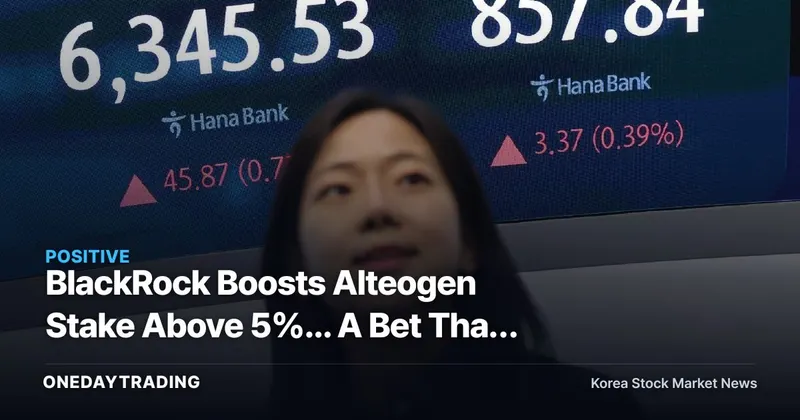
A regulatory filing revealed that BlackRock made large-scale purchases on the 31st, raising its stake in Alteogen, KOSDAQ's largest stock (ticker) by market cap, to over 5%. The same asset manager also expanded its holdings in NAVER, Kakao, and financial stocks. This move coincides precisely with the moment retail investors are pouring heavy money into semiconductor leveraged ETFs. Because the filing does not disclose the purpose of the purchase, two interpretations hold simultaneously: a "high-conviction bet" or "mechanical index inclusion."
What Happened
According to a large-holdings disclosure report, BlackRock made substantial purchases of Alteogen shares on the 31st, pushing its ownership stake above 5%. Under Korea's Financial Investment Services and Capital Markets Act, a 5% stake is the threshold that triggers mandatory disclosure, so the buying should be understood as the first visible surfacing of purchases that had already been accumulating below that line. Alteogen is KOSDAQ's largest stock (ticker) by market cap, and unlike large-cap semiconductor and battery stocks with high retail turnover, it is a stock (ticker) whose price is relatively more influenced by foreign investors and institutional investors supply-demand (order flow).
The same report showed that BlackRock also increased its holdings in NAVER, Kakao, and financial stocks. All three industry sectors share the common trait of having recently seen relatively diminished retail investor interest. In contrast, net retail buying has clearly been concentrated in semiconductor leveraged ETFs, which is the point of contrast with this disclosure.
Background and Context
Alteogen is a company that has licensed out its hyaluronidase platform technology—which converts intravenous (IV) biologic formulations into subcutaneous (SC) injections—to numerous global pharmaceutical companies. Because of the nature of these licensing deals, revenue is recognized through clinical and regulatory milestones, making it difficult to gauge a contract's actual progress from quarterly earnings alone. As a result, the share price tends to react to news of contract progress or expectations of expanded licensing before it reacts to earnings.
Still, it would be premature to immediately read BlackRock's stake increase as a high-conviction bet. Most of BlackRock's holdings in Korean-listed shares come through index-tracking products such as iShares, meaning a stake can rise mechanically simply from weight adjustments within benchmarks like the KOSDAQ 150 or MSCI, or from passive fund inflows. The filing's text alone does not make clear whether this disclosure reflects a high-conviction purchase by an active manager or merely the result of index-fund rebalancing.
Impact on the Market and Individual Stocks
- Alteogen: A disclosure that a major overseas asset manager has raised its stake is often taken as a favorable supply-demand (order flow) signal, which could spur short-term buying, but since the purpose of the purchase was not disclosed, whether the trend continues needs to be confirmed separately.
- NAVER/Kakao: This can be interpreted as a signal that foreign investors and institutional investors are re-entering large-cap platform stocks. It aligns with the view that these stocks have entered a relatively undervalued zone as a side effect of retail supply-demand (order flow) rushing into semiconductors.
- Financial stocks: This looks largely like bargain-hunting by foreign capital drawn to dividend and valuation appeal. Since no specific stock (ticker) names were identified, it should be read as a signal of improving supply-demand (order flow) across the industry sector as a whole.
- Semiconductor leveraged ETFs: Because volatility increases the more retail capital concentrates in a specific theme, this disclosure can also be read as a warning that retail and institutional positioning are diverging in opposite directions.
Investor Checkpoints
- Check whether BlackRock's stake rises further in the next large-holdings report or stalls in the low 5% range. Follow-on buying is needed before this can be called a trend.
- Watch for whether disclosures of clinical or regulatory milestone achievements are imminent under Alteogen's existing licensing agreements. The share-price trigger is more likely to be news of contract progress than news of the stake itself.
- Watch both the scale of retail net buying in semiconductor leveraged ETFs and whether the semiconductor index pulls back. The point at which this concentration unwinds will be the turning point for this contrasting setup.
- Check whether BlackRock stated the purpose of the purchase in its filing as "simple investment" or "involvement in management." If it is the former, as is typical, the grounds for over-interpreting this as a high-conviction active bet are weaker.
Outlook
In the optimistic scenario, this stake increase—paired with active managers' perception of undervaluation—becomes the starting signal for foreign supply-demand (order flow) to broaden into Alteogen, NAVER, Kakao, and financial stocks. If retail capital rotates partly out of its semiconductor concentration, the improvement in supply-demand (order flow) for these stocks could continue for a while, even independent of earnings.
Conversely, if this disclosure turns out to be nothing more than mechanical rebalancing by passive funds, a scenario in which the market over-interprets the news and the stake then stalls without follow-on buying cannot be ruled out. Alteogen's valuation already reflects a substantial degree of expectation around its licensing deals, so if contract milestones are delayed, there remains a risk that the expectations built up by the stake news collide with a gap in actual earnings.
Alteogen by the Numbers: Real-Time Data
Alteogen's most recent closing price was 327,500 won (0.00% versus the prior session), and the composite signal light—combining foreign investors and institutional investors supply-demand (order flow) with news and momentum—reads 🔴 Caution. Foreign investors and institutional investors are net negative, so caution is warranted right now.
- ▼ Dual Selling — Foreign investors −28.0 billion won and institutional investors −55.5 billion won sold in tandem
※ Price and foreign/institutional investor supply-demand (order flow) data are provided by Korea Investment & Securities (KIS) and are current as of publication time.
This article is content automatically summarized and analyzed based on the original news report. View original (Maeil Business Newspaper, Securities)