
Summary
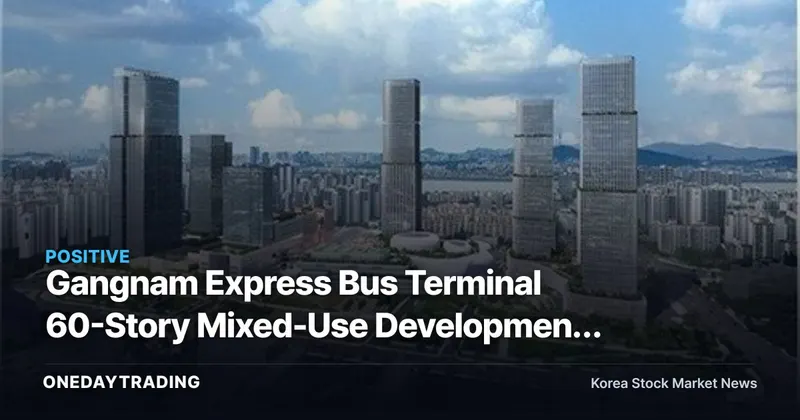
Preliminary work is accelerating on a development project that would move Seoul's Gangnam Express Bus Terminal underground and construct a mixed-use complex of offices, retail, and residences reaching up to 60 stories above ground on the site. The public contribution is estimated at around ₩2 trillion, positioning this as one of the largest urban mixed-use development projects in the Gangnam area. The project could serve as a mid-to-long-term catalyst for the construction, real estate, and developer industry sectors.
What Happened
At the core of this project is a plan to redevelop the aging express bus terminal site in three dimensions. The terminal functions currently occupying ground-level space would be relocated underground to improve efficiency, while the freed-up surface area would host a super-tall mixed-use complex combining office, commercial, and residential space. The tallest structure is being discussed at around 60 stories.
The key variable is the scale of public contribution. In exchange for urban planning incentives such as an increased floor area ratio, the developer would return a public contribution estimated at around ₩2 trillion to the community. This goes beyond simple construction costs — it is a variable that will determine the profitability of the entire project, with the pace and profitability of the development depending on the outcome of negotiations between the Seoul Metropolitan Government and the project developer.
The project is currently in the preliminary stage, ahead of formal permitting. Given that it involves a key transportation hub in the heart of the city, procedures such as traffic and environmental impact assessments and resident opinion gathering are expected to follow.
Structural Background
The Seoul Metropolitan Government has recently been reinforcing its policy direction of redeveloping aging urban infrastructure in three dimensions and easing floor area ratio restrictions to encourage high-density mixed-use development. The Gangnam Express Bus Terminal, a location where demand for transportation, commercial activity, and housing is concentrated, is a prime example where this policy trend intersects with private developers' appetite for large-scale projects. That said, high interest rates, rising construction costs, and tight real estate project financing (PF) conditions remain burdens weighing on the funding and pre-sale risk of such mega-developments.
Impact on Stocks (Tickers) and Industry Sectors
- Major construction companies: Expected to secure construction contracts for the super-tall mixed-use complex. Companies with a track record of building Gangnam-area landmarks — such as Samsung C&T, Hyundai Engineering & Construction, and GS Engineering & Construction — could be mentioned as candidates for the contract.
- Developers: Represents a mid-to-long-term business opportunity for companies with mixed-use development planning and execution capabilities.
- Real estate trust and financial firms: Large-scale project financing (PF) and fund management demand could generate related revenue for trust companies and financial institutions.
- Building materials and elevators: Could translate into downstream industry demand for cement, steel, and high-rise elevators needed for super-tall construction.
- Nearby real estate values: Expectations surrounding development at this core Gangnam location could be reflected in the value of surrounding commercial and residential real estate.
Bullish vs. Bearish Scenarios
In the bullish scenario, if permitting proceeds smoothly and negotiations over the public contribution are concluded, a full-scale pipeline of mega construction and development work in Gangnam would materialize, creating positive momentum for construction- and real estate-related stocks. A landmark-scale project would be a positive for a builder's order backlog and brand value.
In the bearish scenario, the ₩2 trillion public contribution burden, high construction costs, and PF funding costs could squeeze the project's profitability. If delays in permitting, difficult negotiations, and a slowdown in the real estate market all occur together, there could be considerable time lag and uncertainty before actual construction begins. Investors should also note that, since the project is still at the preliminary stage, the impact on near-term earnings is limited.
Investor Action Points
- Since there is typically a significant time lag between the preliminary/permitting stage and confirmed construction start or contract awards, distinguish between near-term thematic expectations and the actual timing of earnings impact.
- Track the progress of key variables step by step, including the finalized scale of the public contribution, the floor area ratio, and the selection of the construction company.
- In an environment of high interest rates and PF risk, focus on separating the wheat from the chaff by favoring major construction companies with solid financial health and a strong order backlog.
- Since the Gangnam urban mixed-use development is a mid-to-long-term theme tied to policy direction, consider diversification across the broader industry sector rather than betting on a single project.
This article is automatically summarized and analyzed content based on the original news report. View original (Yonhap News)