
Three-Line Briefing
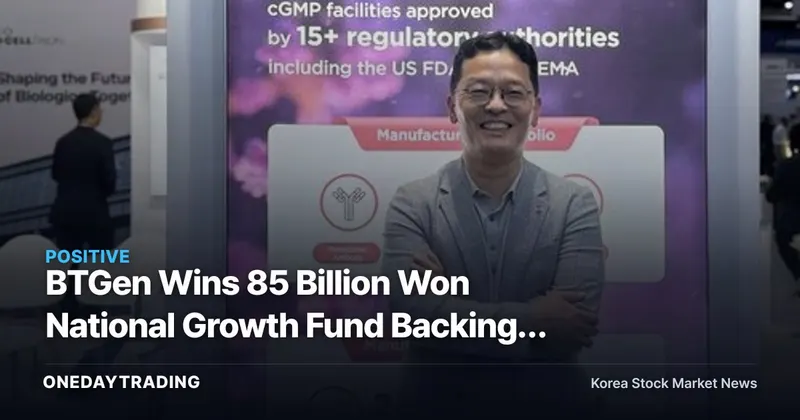
- The National Growth Fund has selected BTGen as an investment target, directing 85 billion won in support funding toward the expansion of Plant No. 1 to build out biopharmaceutical production capacity.
- This marks a case of government-led growth fund capital flowing into biotech capital expenditure, and it reads as a policy signal that could spur a broader wave of capacity expansion across Korea's bio CDMO and active pharmaceutical ingredient (API) makers.
- That said, since this is still a single-company expansion phase, it makes more sense to approach it as a mid-to-long-term capacity story rather than a near-term earnings story until utilization rates and order backlogs are confirmed.
What's Changing
The core of this story isn't the individual company's plant expansion itself, but the fact that a policy fund's capital is now confirmed to be flowing directly into biomanufacturing facilities. For investors, this carries two implications. First, as the structure of government capital backing biotech as a strategic industry becomes more visible, it builds expectations for the broader capex cycle across Korea's bio CDMO and API manufacturing sector. Second, expanding capacity through policy funding rather than equity or debt financing reduces the financial burden and dilution risk for the expanding company — making this a qualitatively different kind of positive catalyst.
BTGen will use the 85 billion won to expand Plant No. 1 and grow its biopharmaceutical production capacity. In CDMO and biomanufacturing, capacity effectively sets the ceiling on order volume, so this facility expansion represents a forward-looking investment that raises the company's future revenue ceiling. However, converting that capacity into actual revenue requires time — securing client contracts, completing validation, and ramping up utilization rates. In other words, this stage lays the groundwork for top-line growth; it isn't a phase where earnings jump immediately.
Numbers in Context
The figures disclosed so far are the 85 billion won in funding and its designated use — expansion of Plant No. 1. For a small-to-mid-sized biomanufacturer, 85 billion won is not a small sum, and the fact that policy funding is covering capex that would otherwise be difficult to self-finance carries real significance from a capital-efficiency standpoint. That said, details such as the scale of the expansion, the completion timeline, and the target capacity still need to be confirmed through additional disclosures — and only once those numbers are available can investors properly gauge the increase in production capacity relative to the capital deployed.
Stocks to Watch: Beneficiaries and Losers
- Samsung Biologics: As Korea's bio CDMO sector bellwether, the flow of policy capital into biomanufacturing facilities could lift industry-wide investment expectations and be read as a sentiment-driven beneficiary.
- ST Pharm: Having already pursued capacity expansion in oligonucleotides and API production, it stands as a direct, mid-cap beneficiary tied to this policy-backed capex theme.
- Binex: With a small-to-mid-sized biopharmaceutical contract manufacturing business, it tends to get grouped in whenever expectations build around expanding domestic CDMO capacity.
- Prestige Biologics: As a company centered on bio production facilities, whose fortunes hinge on utilization recovery and order wins, it directly reflects the volatility of the capex theme.
Risk Check
- Facility expansion is only a forward-looking investment — if client orders and utilization gains don't follow, depreciation costs will hit first, which could weigh on near-term profitability.
- Key figures such as the scale of expansion, completion schedule, and target capacity have not yet been finalized, making it difficult to quantitatively verify the return on the capital deployed.
- Selection for a policy fund is often treated as a thematic catalyst that triggers a sharp gain followed by frequent pullbacks — if expectations get priced in ahead of earnings visibility, valuation risk builds.
- Intensifying global competition in bio CDMO and shifting demand for pharmaceuticals are external variables that will determine how quickly the new capacity gets monetized.
Bottom Line
The fact that policy funding is flowing into biomanufacturing facilities is a positive signal — both for industry momentum and for easing the financial burden on the expanding company — but there remains a time lag before capacity converts into revenue, along with the unresolved question of order confirmation. Investors should keep thematic expectations and earnings verification separate when assessing this story.
Samsung Biologics: A Real-Time Data Snapshot
Samsung Biologics' most recent closing price was 1,385,000 won (0.00% versus the previous session), and the signal combining foreign and institutional investor supply-demand (order flow) with news and momentum reads 🟢 buy-leaning. With foreign investors, institutional investors, and news flow all positive, this stock (ticker) may be worth watching.
- ▲ Dual buying — foreign investors +25.3 billion won and institutional investors +3.3 billion won in combined net buying
Recent related news skews favorable, with 1 positive catalyst versus 0 negative catalysts.
※ Price and foreign/institutional investor supply-demand (order flow) data are provided by Korea Investment & Securities (KIS) and reflect figures as of publication time.
This article was automatically summarized and analyzed based on the original news report. View original (Yonhap News Industry)