
At a Glance
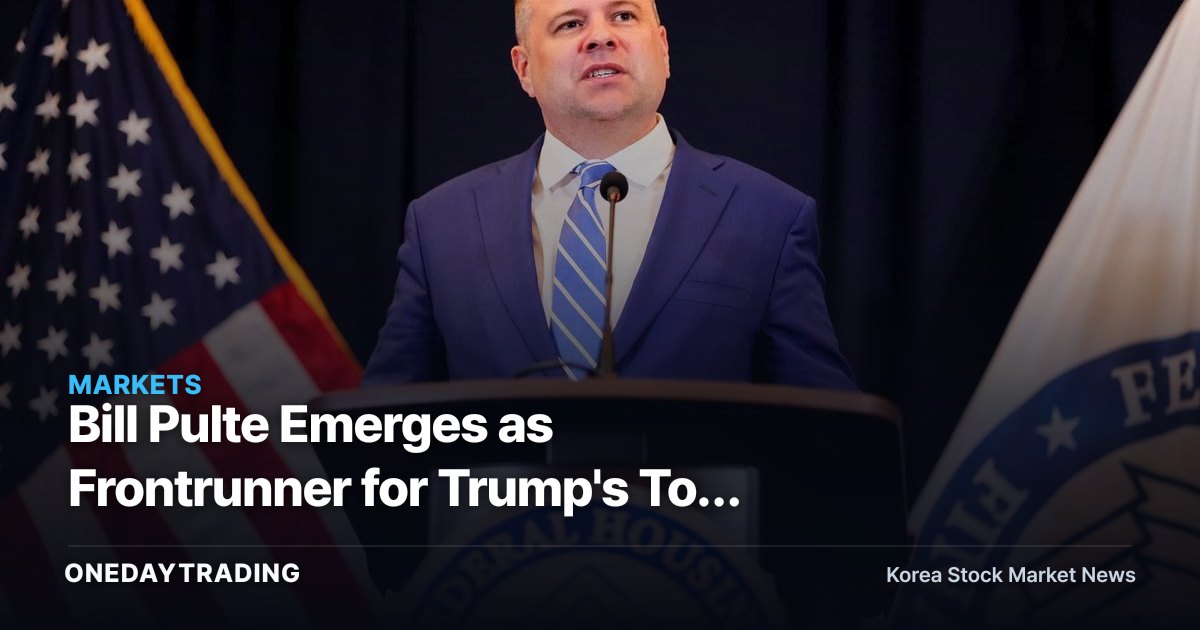
President Trump has halted Jay Clayton's nomination for Director of National Intelligence (DNI), raising the likelihood that Bill Pulte — who currently heads the Federal Housing Finance Agency (FHFA) — will take over as the nation's top intelligence official. Despite attempts at opposition from some quarters of Congress, the trajectory points toward Pulte gaining access to U.S. intelligence assets. For markets, the more direct variable is not the appointment itself but the seat he would vacate and the question of policy continuity.
Why It Matters Now
The key issue is the FHFA leadership post Pulte currently holds. The FHFA oversees housing-finance government-sponsored enterprises such as Fannie Mae and Freddie Mac, directly shaping the institutional framework of U.S. mortgage rates and the home-loan market. If Pulte moves to the DNI role, a vacancy or change in FHFA leadership would follow, adding uncertainty to discussions over the privatization (public listing) of Fannie Mae and Freddie Mac and to the direction of mortgage-guarantee policy. Because U.S. housing and financial policy is intertwined with the global interest-rate environment, this is not irrelevant to Korean investors.
In addition, Clayton previously served as chairman of the Securities and Exchange Commission (SEC), and the withdrawal of his nomination shows that personnel decisions across the Trump administration's financial and regulatory ranks remain in flux. Depending on who leads U.S. intelligence, the intensity of technology sanctions against China, export controls, and security-based investment reviews (e.g., semiconductors and telecom equipment) could shift — acting as an indirect variable for export-oriented and technology sectors that are sensitive to policy risk.
That said, this matter is a political process at the appointment stage, and no specific policy change has been finalized. Rather than producing an immediate market impact, the effects are more likely to become visible once the appointment is confirmed and actual policy signals emerge.
Frequently Asked Questions
- Who is Bill Pulte? He currently serves as director of the U.S. Federal Housing Finance Agency (FHFA), where he has overseen the supervision of housing-finance government-sponsored enterprises. The DNI is the role that coordinates the entire U.S. intelligence community.
- Why was Clayton's nomination withdrawn? President Trump halted the DNI nomination process for former SEC chairman Jay Clayton, leaving Pulte as the leading candidate to fill the vacancy.
- Is this directly relevant to the Korean stock market? Not directly. However, the choice of intelligence chief is linked to the stance on technology sanctions and export controls against China, which could act as an indirect variable for export sectors such as semiconductors and telecom.
- Will share prices move immediately? The appointment process itself carries weak directional force. Until actual policy signals emerge, the impact is likely to remain limited.
Impact on Related Stocks and Sectors
- Financial and securities sector — A shift in the standing of a former SEC chairman signals the direction of U.S. financial-regulatory appointments, influencing expectations around the intensity of capital-market regulation.
- Semiconductors (Samsung Electronics, SK Hynix) — Because the DNI is involved at the policy-input stage of security-based export controls and technology sanctions, this is an indirect variable for the memory and foundry sectors that carry exposure to exports to China.
- Defense sector (Hanwha Aerospace, LIG Nex1) — Appointments to the intelligence and security ranks are tied to U.S. defense and intelligence budget priorities, acting as a long-term variable for expectations of U.S.-bound defense cooperation.
- Telecom and network equipment — If the trend toward stronger security reviews continues, the dynamic of beneficiaries and casualties from the exclusion of Chinese-made equipment could come back into focus.
Points to Watch When Investing
- This news is at the appointment-process stage, so its causal link to individual stocks is indirect and comes with a long lag. Chasing short-term themes warrants caution.
- The subsequent FHFA appointment following Pulte's move and the direction of mortgage policy are the more substantive variables, so do not base judgments solely on the intelligence-chief appointment.
- Stronger export controls against China cut both ways for semiconductors. Expectations of security-related benefits must be weighed alongside the risk of a shrinking share of revenue from China.
- Political appointment news often heightens volatility without changing fundamentals, so confirming primary indicators such as earnings and new orders should come first.
Overall Outlook
If the appointment is confirmed and signals emerge of intensified technology sanctions and export controls against China under a new DNI regime, this could provide medium-term momentum for stocks that benefit from a security-based supply-chain realignment (domestic semiconductor materials/parts/equipment and defense). Conversely, if the appointment process drags on amid confusion or policy merely maintains the existing stance, the market impact of this news is likely to be absorbed as a minor political event. The indicators to watch are the subsequent FHFA appointment, the timeline for the privatization of Fannie Mae and Freddie Mac, and whether the U.S. announces additional export controls against China.
This article is auto-summarized and analyzed content based on original news reporting. View original (CNBC)