
At a Glance
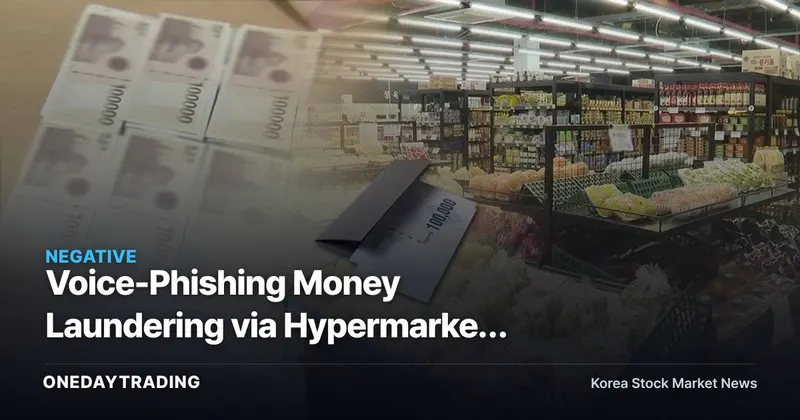
The consumer alert issued by the Financial Supervisory Service (FSS) on the 9th is not a simple voice-phishing caution notice. Because unmanned kiosks and gift cards at hypermarkets were used as a laundering channel for criminal proceeds, payment, refund, and limit management at retail channels are being drawn into the scope of financial regulation.
This issue is not the kind of news that delivers an immediate earnings shock to major retail stocks (tickers) like E-Mart and Lotte Shopping. Still, the market needs to newly price in the possibility that some of the cost savings from unmanning stores will come back as expenses for suspicious-transaction detection, identity verification, and purchase-limit controls.
Why It Matters Now
Voice phishing doesn't stop at bank accounts. As account tracing tightens, criminal organizations move toward cash-like assets. The core of this case is the conversion of victims' funds into gift cards via hypermarket unmanned kiosks. Gift cards sit in a gray zone between cash and cards — easy to purchase, transferable, and resellable — and tracing them can be slower than tracing bank transfers.
Viewed through a Kang Si-hyun-style lens, this news looks like a smaller variable than interest rates, but it actually touches the quality of valuation. Retail stocks (tickers) have already been trading at low multiples on concerns over slowing consumption, labor costs, and the shift to e-commerce. But if unmanned kiosks turn from a cost-saving device into a source of control costs, investors need to price in yet another discount factor. What the market has already reflected is weak consumption. What it has not yet fully reflected is the financial regulation of offline payment networks.
The fact that the FSS issued a consumer alert signals that regulators view this not as an isolated case of harm but as a channel with potential for spreading. A voice-phishing response system limited to financial firms alone is no longer sufficient, and the retail network spanning gift-card issuance, sales, and settlement is now being pulled under supervisory watch. Hypermarkets may need to tighten operational controls such as kiosk purchase limits, blocking repeated purchases, high-value purchase warnings, and monitoring by payment method. Convenience will decline while operating costs rise.
FAQ
- Why are gift cards used to launder voice-phishing proceeds? Gift cards are highly cash-like, but unlike bank accounts, transaction tracing may not be immediate. Unmanned kiosks have weak face-to-face verification, making them an easy repeat-purchase channel for criminal organizations.
- Is this an immediate negative catalyst for hypermarket earnings? The near-term revenue impact is limited. The bigger issue is not a decline in gift-card sales but rising costs and payment friction from strengthened control measures.
- What does this mean for financial stocks (tickers)? Banks and card companies could face growing pressure over voice-phishing compensation and prevention responsibilities. Investment in systems that slow the speed at which victim funds leave accounts becomes important.
- What should consumers watch out for? If someone impersonating investigators or financial-company staff demands a gift-card purchase or asks for the card code, it is highly likely to be a scam. This behavior is precisely what the FSS's consumer alert on the 9th aims to prevent.
Related Stocks (Tickers) and Sector Impact
- E-Mart As the operator of hypermarket unmanned kiosks, it is directly exposed to tighter regulation and on-site controls. The bigger burden is likely to be increased verification steps in the purchase process rather than gift-card sales themselves.
- Lotte Shopping As an operator with an offline retail network and gift-card channels, systems to prevent voice-phishing abuse could emerge as a new cost item.
- Financial holding companies and card issuers They need to catch suspicious transactions before victim funds are converted into gift cards. Failure to detect fraud raises consumer-protection costs and reputational risk.
- Simple-payment and kiosk operators The premise of expanding unmanned payments is low cost and fast processing. As criminal misuse cases increase, authentication, limit-setting, and alert features become standard requirements.
Points to Watch When Investing
- Watch the pace of policy before earnings Investors should check whether, following the FSS alert, tighter gift-card purchase limits or identity-verification rules develop into industry self-regulation.
- Don't overestimate the unmanning effect Kiosks reduce labor costs, but once fraud-prevention features are added, equipment, software, and customer-service costs could rise.
- Differentiate exposure by stock (ticker) The cost burden will vary depending on the share of gift-card sales, the scale of unmanned kiosk deployment, and the structure linking online gift cards.
- Voice phishing is a recurring regulatory risk This won't end with a single consumer alert. If harm cases continue, both the financial and retail sectors could face stronger controls.
Overall Outlook
The optimistic scenario is clear. If the industry quickly puts purchase limits and suspicious-transaction detection in place, gift cards remain a normal prepaid-payment method, and the increase in retailers' costs stays limited. In this case, the stock-price impact is likely to be no more than short-term noise.
The trigger for the opposite scenario is further harm and stronger oversight. If cases of voice-phishing funds being laundered through gift cards recur, the efficiency logic behind unmanned kiosks weakens. Investors should watch for the FSS's follow-up measures, retail-industry self-regulation announcements, and any changes to gift-card purchase limits. The variable the market has not yet fully priced in is not consumption — it's control costs.
E-Mart: Real-Time Data Snapshot
E-Mart's most recent closing price is 81,600 won (+0.25% vs. the previous day), and the composite signal combining foreign investor and institutional investor supply-demand (order flow) with news and momentum is 🟡 neutral / wait-and-see. With positive and negative signals mixed, this is a range to watch closely.
- ▲ Trend alignment — Short- and medium-term uptrend alignment (same-day +0.3% · 1-week +2.3% · 1-month +0.6%)
Recent related news shows 1 positive catalyst and 0 negative catalysts, a favorable mix.
※ Price and foreign/institutional investor supply-demand (order flow) data are provided by Korea Investment & Securities (KIS) and are as of the time of publication.
This article was automatically summarized and analyzed based on the original news report. View original (Yonhap News Agency, Securities)