
3-Line Briefing
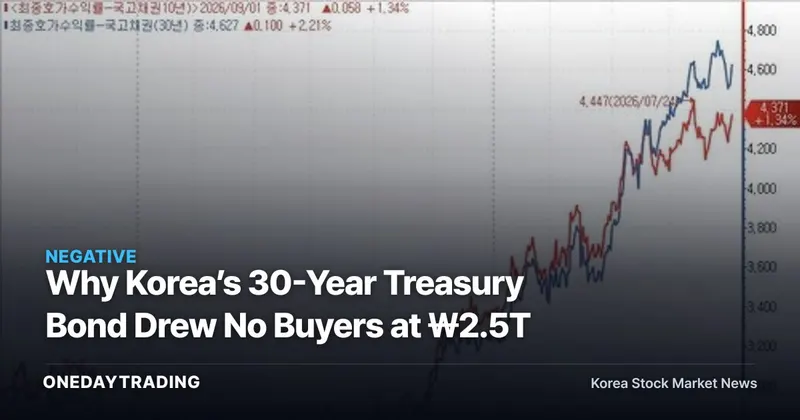
- The weak auction for 30-year government bonds was more than a simple supply-demand (order flow) event; it signaled resistance to declines in long-term yields.
- The government cut September’s 30-year issuance by 300 billion won to 2.5 trillion won from the previous month, but this failed to fill the demand gap from insurers, funds and foreign investors.
- The 2027 government-bond issuance plan totaling 222.8 trillion won and the U.S. 10-year yield at 4.789% continue to exert upward pressure on Korean long-term yields.
What Is Changing
The weakness in 30-year government bonds tells investors more than that bond prices are falling. It indicates a market phase in which long-term discount rates are again weighing on the fair value of growth stocks, REITs and high-dividend stocks, rather than a rally in which falling yields lift equity multiples.
The core of this issue, reported by Yonhap News on September 2, 2026, is that demand failed to recover despite the supply reduction. Because 30-year government bonds have long maturities, buying capacity among long-term investors such as insurers and pension funds determines prices. When insurers focus on K-ICS solvency pressures and valuation losses on existing bond holdings, they do not automatically buy even when yields are high.
The weak 30-year government-bond auction means that even if the government cuts issuance, structural buyers capable of absorbing ultra-long-term bonds have weakened. Further yield increases may offer some defensive benefit to banks’ net interest margins, but they increase bond valuation losses at securities firms and capital-ratio pressure at insurers.
Numbers and Context
September’s 30-year issuance of 2.5 trillion won is 300 billion won below the previous month. Supply cuts are normally positive for prices. However, weak demand even in the advance sale of the new benchmark issue 26-8 shows that the market is focusing more on next year’s supply path than on near-term issuance.
The government has budgeted 2027 total spending at 820.9 trillion won, with total government-bond issuance at 222.8 trillion won. This coincided with the U.S. 10-year Treasury yield briefly reaching 4.789% in Asian trading. If U.S. long-term yields remain elevated, Korean government-bond long-term yields will also struggle to decline independently; if August consumer inflation exceeds market expectations, prices may reflect an earlier timing for additional rate hikes.
Beneficiary and Affected Stocks
- Samsung Life Insurance: Higher ultra-long-term bond yields are favorable for returns on newly invested assets, but weigh on valuations of existing bonds and the K-ICS ratio. Re-rating of insurance stocks depends first on capital-ratio stability, not the yield level itself.
- Hanwha Life Insurance: Its long-term liability structure makes it sensitive to 30-year yields. If yields continue rising, the cost of managing solvency may appear more significant than gains from replacing investment assets.
- Mirae Asset Securities: Rising bond yields weigh on valuation gains and losses on holdings and on brokerage sentiment. However, the impact would be limited if stability in short-term bonds and resilience in credit spreads are confirmed.
- KB Financial: Higher long-term yields provide some support for expectations of banks’ net interest margins. Yet rising equity-market discount rates weigh on financial-holding-company valuations overall, so the benefit will not necessarily flow straight through to the share price.
- Korea Investment Holdings: Greater rate volatility affects both investment results and the pace of recovery in the investment-banking market. If government-bond yields turn lower, the rebound in securities stocks could gain momentum quickly.
Risk Check
- If the 2027 issuance mix by maturity is skewed toward long-term bonds at year-end, supply-demand (order flow) pressure on 30-year bonds will rise again.
- If August consumer inflation exceeds the base effect and comes in high, the Bank of Korea’s caution over additional hikes will spread from long-term bonds to three-year bonds as well.
- If U.S.-Iran tensions push up oil prices, they will simultaneously stimulate U.S. long-term yields and Korean inflation expectations.
- Conversely, if U.S. yields stabilize and foreign investors reduce selling of government-bond futures, long-term yields could stage a technical retracement.
Bottom Line
The weak 30-year government-bond auction is not only a negative catalyst for the bond market; it is also an issue of the equity-market discount rate. Until there is a reason for yields to fall, rebounds in insurers, securities firms and growth stocks will depend more on rate triggers than on earnings.
Frequently Asked Questions
Why is a weak 30-year government-bond auction a negative catalyst for stocks?
A weak auction signals that long-term yields are unlikely to fall easily. When long-term yields remain high, the rate used to discount future earnings to present value rises, increasing valuation pressure on growth stocks, REITs and high-dividend stocks.
Are rising government-bond yields a positive catalyst for insurance stocks?
Rising government-bond yields can lift insurers’ returns on new investments, but they also increase valuation losses on existing bonds and K-ICS solvency pressure. For Samsung Life Insurance and Hanwha Life Insurance, capital-ratio defense and the pace of replacing investment assets matter more than the rise in yields itself.
When can a bond-market rebound be confirmed?
A bond-market rebound should be assessed through the August consumer inflation release, supply-demand (order flow) around the September 10 government-bond maturity, and the year-end announcement of issuance shares by maturity. If the U.S. 10-year yield stabilizes and bidding participation in long-term government bonds recovers, the probability of a downward yield correction increases.
KOSPI Index IndicatorsAs of 2026-09-02
| Period Trend | 1 Week -1.12% 1 Month +20.70% |
|---|
Index, commodity and exchange-rate data are based on global markets and reflect values at publication.
Samsung Life Insurance Key IndicatorsAs of 2026-09-02
| Period Return | 1 Week +8.60% 1 Month -0.64% |
|---|---|
| Supply-Demand (Order Flow) | Foreign Investors −11.3 billion won net selling (4 consecutive days) Institutional Investors +18.4 billion won net buying |
| Recent News Tone | Positive Catalyst 1 · Negative Catalyst 1 |
Price and supply-demand (order flow) data are real-time values from Korea Investment & Securities (KIS); supply-demand and news-tone aggregates are calculated independently by One-Day Trading.
Upcoming Dates to Watch
- 09.10Futures and Options ExpiryMediumQuadruple witching — watch for volatility and order-flow disruptions
- 09.16FOMC Policy-Rate DecisionHighU.S. Federal Reserve monetary-policy announcement — direction of rates and the dollar
- 10.08Index-Options ExpirationLowKOSPI200 options expiration
- 10.22Bank of Korea Monetary Policy BoardHighBenchmark interest rate decision meeting
This article is automatically summarized and analyzed based on the original news report. View Original (Yonhap Securities)