
Key Takeaways
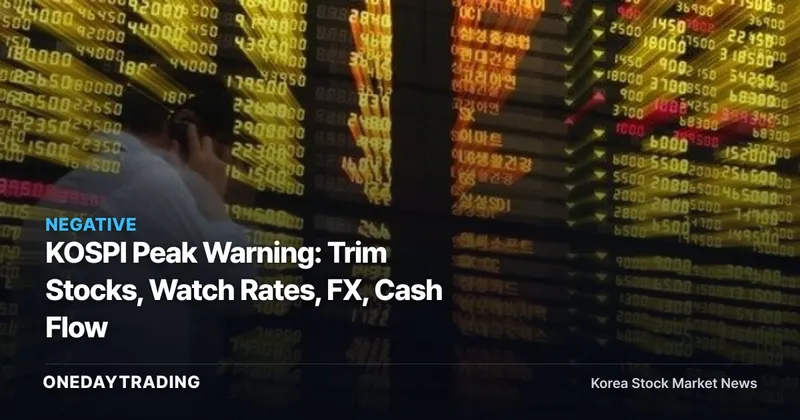
The core issue in the KOSPI peak debate isn't how far the index has climbed, but that the leading economic indicator is nearing its peak. When economic momentum slows, valuation multiples on stocks tend to come under pressure before earnings estimates do. Investors may want to consider shifting part of their equity holdings into short-term government bonds and cash-equivalent assets to reduce volatility.
That said, a peak in the leading indicator doesn't necessarily mean a bear market is starting right away. If rate-cut expectations remain intact and exports and corporate earnings stay solid, the index could undergo a time correction near its highs rather than an outright decline.
What Happened
According to expert commentary reported by Maeil Business Newspaper's securities desk, with the leading economic indicator nearing a peak, investors should trim stock exposure and add safe assets such as short-term government bonds. The leading indicator reflects future economic direction in advance based on production, consumption, and financial conditions, and when its growth rate slows or turns down, expected returns on risk assets tend to decline.
What the market has already priced in is optimism about an economic recovery and improving corporate earnings. What hasn't been fully priced in yet are the growth slowdown that follows the recovery and the path of interest rates. If growth forecasts are revised lower, investors will pay a lower price-to-earnings ratio for the same level of earnings, weighing on the index's upside.
Background and Context
In the later stages of an economic expansion, central bank rate-cut expectations and an actual economic slowdown can appear at the same time. Falling rates support bond prices, but if the slowdown damages earnings outlooks, it becomes a negative catalyst for stocks. In this environment, short-maturity government bonds carry relatively less interest-rate risk and are easy to convert to cash at maturity, making them a buffer within a portfolio.
Domestic investors also need to watch the won-dollar exchange rate. A weaker won can support exporters' earnings, but it raises foreign investors' concerns about currency losses, which can weaken domestic stock supply-demand (order flow). If the leading economic indicator turns down and the won-dollar rate surges, a scenario in which both stocks and the won come under pressure at the same time becomes a real possibility.
Market and Stock Impact
- Large-cap KOSPI growth stocks: A slowing leading indicator can lower the multiple applied to future earnings. If rate cuts are delayed, richly valued growth stocks could see steeper corrections.
- Exporters: The semiconductor and automotive sectors benefit from the currency-translation effect of a higher exchange rate, but if slowing global demand cuts export volumes, that FX benefit gets offset. Foreign investor supply-demand (order flow) direction can move ahead of earnings.
- Financials: Falling rates lower funding costs, but they also come with narrower net interest margins and rising provisioning costs tied to the economic slowdown. Bank stocks should be assessed on both dividend expectations and asset-quality indicators.
- Short-term government bonds and money markets: If the policy rate stays elevated, short-duration instruments accumulate interest income steadily. Conversely, if rates fall quickly, reinvestment yields decline.
- Won-denominated assets broadly: If a peak in the leading indicator coincides with a rising exchange rate, foreign capital could exit rapidly. If the exchange rate breaks above a key resistance level, that becomes a trigger to accelerate cuts to stock allocations.
Investor Checkpoints
- Watch how the timing of rate cuts and the inflation outlook shift at the Bank of Korea's Monetary Policy Board decisions. If rate-cut expectations retreat, stock multiples could adjust first.
- Track the leading economic indicator's month-over-month change alongside manufacturing and export data. If the indicator falls for two to three consecutive months, the reliability of the slowdown signal increases.
- Compare the won-dollar exchange rate with foreign investors' KOSPI cash and futures supply-demand (order flow) on the same day. If foreign buying continues even as the exchange rate rises, it suggests risk aversion is limited.
- Short-term government bond investors should check maturities and after-tax yields. If rates drop sharply, interest income on newly purchased bonds declines, so laddering maturities is advisable.
Outlook
The optimistic scenario is one where the leading indicator moves sideways near its peak and export and earnings estimates hold up. In that case, the KOSPI could digest its highs through sector rotation and a time correction rather than a sharp drop (plunge). If rate cuts come into clearer view, a flow of capital back from short-term government bonds into stocks is also possible.
The downside scenario is one where the leading indicator turns down, the won-dollar rate rises, and foreign selling expands. In that case, downward earnings revisions and multiple compression would proceed together, deepening the index correction. The current read isn't a confirmed top — it's closer to a call to raise cash-equivalent holdings to keep optionality open until a slowdown signal is confirmed.
Frequently Asked Questions
If the leading economic indicator peaks, does the KOSPI fall right away?
No. A peak in the leading indicator means upward momentum is weakening, not that the market is immediately shifting into a bear phase. If corporate earnings and rate expectations hold up, the index can move sideways near its highs.
Who are short-term government bonds suitable for?
They suit investors who want to reduce stock volatility while having a clear timeline for getting their principal back. However, if rates fall quickly, interest income on bonds purchased afterward can decline, so maturities should be laddered.
When trimming stock exposure, what indicator should investors check first?
Investors should look at the direction of the leading economic indicator, the won-dollar exchange rate, and foreign investor supply-demand (order flow) together. If the leading indicator falls, the exchange rate rises, and foreign selling continues, that provides grounds for a more conservative adjustment to risk-asset allocations.
KOSPI Index MetricsAs of 2026-09-03
| Period Performance | 1W -2.00% 1M +17.33% |
|---|
Index, commodity, and exchange-rate figures are based on global markets and reflect values at the time of publication.
This article is automatically summarized and analyzed based on the original news report. View original article (Maeil Business Newspaper, Securities)