
Key Takeaways
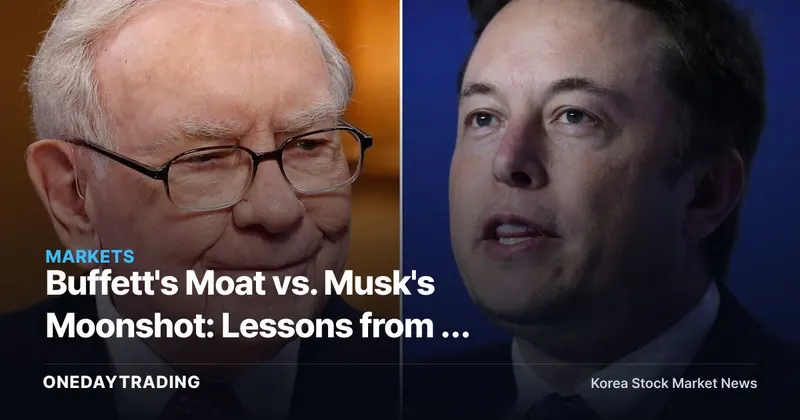
The economic moat strategy championed by Warren Buffett and the moonshot innovation investing symbolized by Elon Musk have long remained a subject of debate among investors. The indirect exchange between the two men in 2018 lays bare the fundamental difference between value investing, which pursues stable returns, and growth investing, which bets on future expansion. Rather than either side being the single right answer, the real question is how an investor combines the two philosophies to fit their own temperament and the prevailing market phase.
What Happened
Buffett holds that a company's strong barriers to entry—moats such as brand loyalty, cost advantages, and network effects—keep competitors at bay over the long run and generate stable cash flow. He built enormous wealth by buying companies with already-proven moats, like Coca-Cola or Apple, at reasonable prices and holding them for the long term.
Musk, by contrast, counters that the very concept of a moat reflects stagnant thinking. He argues that the pace of technological innovation rapidly neutralizes moats, and that true competitiveness comes from relentless innovation and moonshots that open entirely new markets. His attempts to seize vast future markets in electric vehicles, space, and autonomous driving—even when near-term profits are unclear—are prime examples.
This debate is not a mere squabble but a distillation of the choice modern investors face every day: the dilemma between proven stability and explosive growth potential.
Background and Context
In an environment of low interest rates and abundant liquidity, moonshot-style stocks (tickers) that command high valuations on future growth enjoyed the spotlight. Yet during periods of rising rates and slowing economic activity, moat-type companies with solid earnings and cash flow showed relatively greater defensive strength. The superiority of the two philosophies has shifted back and forth endlessly depending on the market environment.
Impact on the Market and Stocks
- Berkshire Hathaway, the emblem of moat investing, stands out for its defensive character in down markets thanks to its stable holdings and massive cash-like assets.
- Tesla is the flagship case of moonshot investing; expectations around electric vehicles and autonomous driving drive its share price, but with high volatility.
- In the Korean market, technology-moat companies like Samsung Electronics on one hand, and future-growth theme stocks such as secondary batteries and AI on the other, correspond to the two philosophies respectively.
- Adjusting the weighting between defensive value stocks and aggressive growth stocks directly governs an investor's returns and risk.
- In fast-innovating sectors like semiconductors and platforms, existing moats can erode quickly, making a balance between the two perspectives essential.
Investor Checkpoints
- Clearly classify whether your holdings are moat-type or moonshot-type, and set their weighting to match your own risk tolerance.
- For high-growth hopefuls, examine both valuation burdens and the risk of earnings misses.
- Even for moat-type companies, periodically reassess whether technological change could weaken their competitiveness.
- Consider a diversification strategy that flexibly adjusts the weighting of the two types as the market phase changes.
Outlook
Viewed optimistically, the two philosophies are complementary rather than opposed. By securing portfolio stability with proven moat companies and allocating a portion to innovative growth stocks, an investor can pursue both defense and growth at once. That said, moonshot investing translates directly into heavy losses when expectations fail to materialize as earnings, while moat-type investing also offers no guarantee of safety in the face of an industry paradigm shift. Ultimately, rather than placing blind faith in any one philosophy, the key for investors is to coolly analyze a company's intrinsic value and the market environment to find their own point of balance.
This article is content automatically summarized and analyzed based on an original news report. View original (CNBC)