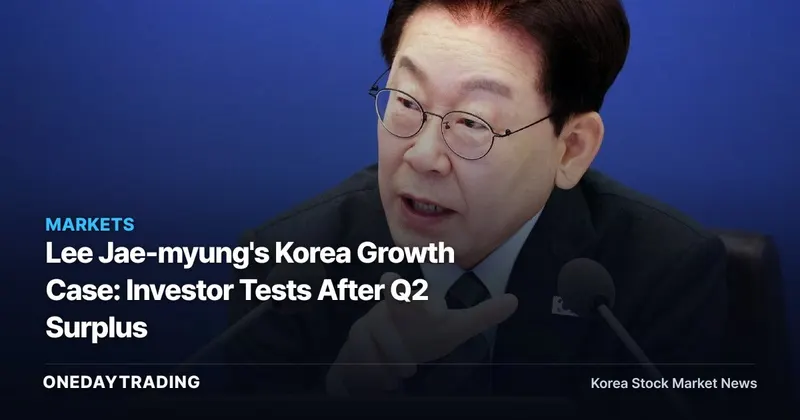

Lee Jae-myung’s Growth Case: What Markets Must Distinguish First
President Lee Jae-myung emphasized Korea’s growth potential on the 25th, calling for stronger industrial competitiveness and for the benefits of growth to be shared with the public. Maeil Business Newspaper’s comparison of Korea’s current account surplus in the second quarter of this year supports that optimism, but investors should focus more closely on whether those gains translate into corporate investment, jobs and income.
The remarks did not provide an earnings outlook for any specific company or support measures for individual industry sectors. They were closer to a statement setting out the direction of Korea’s economic growth agenda. Investors should therefore distinguish between confirmed external-sector gains and implementation measures that have yet to be announced, rather than immediately selecting related stocks (tickers).
What the Second-Quarter Current Account Surplus Actually Shows
President Lee said Korea’s current account surplus in the second quarter of this year exceeded the combined surpluses of Germany and Japan. He linked this result to the global-market performance of Korean companies, including semiconductor firms, and said, “A major wave of opportunity is also rising for our economy.”
The comparison presented by President Lee confirms only that Korea’s current account surplus in the second quarter was larger than the combined surpluses of Germany and Japan. The data do not provide the surplus amounts or detailed composition for the three countries. This single figure cannot be used to determine domestic demand, company-level profits or the direction of share prices by industry sector.
The current account surplus was cited as evidence of Korea’s external economic performance. However, the disclosed information did not identify the semiconductor companies President Lee referenced or specify their results. Concluding that semiconductor earnings are improving across the board or that a particular listed company will benefit would go beyond the available evidence.
From Industrial Competitiveness to Household Income: The Missing Links
The core of the remarks was not the scale of growth but how its benefits flow through the economy. President Lee stressed the need to strengthen industrial competitiveness and raise potential growth, while ensuring that economic vitality leads to investment, jobs, higher incomes and greater financial security. His statement that “What matters is ensuring this wave of growth becomes a force that changes the lives of all citizens” reflected the same theme.
From an investment perspective, the process has three distinct stages. Korean companies must first deliver results in global markets, those gains must then spread into investment and employment, and finally they must translate into income and greater financial security. What has been confirmed so far is that this process has been presented as a policy objective; targets and timelines for each stage remain undisclosed.
Once efforts to strengthen industrial competitiveness are converted into specific policies, investors will have a basis for assessing individual industry sectors. Without policy details, it is impossible to distinguish the intended beneficiaries, implementation methods or the channels through which the measures could affect corporate profits and losses. That is why a growth slogan cannot immediately be translated into higher stock valuations.
What Investors Should Look for Next
- Specific policies: The first question is what measures will be introduced to strengthen industrial competitiveness and raise potential growth. Only when implementation tools are announced will investors be able to identify the industries and companies likely to be affected.
- Company-level results: The global-market performance of Korean companies, including semiconductor firms, was mentioned, but neither company names nor details of those results were provided. Investors should look to upcoming corporate announcements for evidence that these gains are leading to investment, jobs and income.
- Broadly shared growth: The ultimate test set out in the remarks is whether economic vitality translates into investment, employment and income. If that connection strengthens, the growth case will become more convincing. If it does not, the gap between the current account surplus and the benefits felt by the public will remain.
- Downside condition: If expectations run ahead without specific policies or company-level evidence, the investment case for individual industry sectors will weaken. A fresh assessment will become possible when implementation details and verifiable results emerge—not when another slogan is announced.
The growth message, framed through an expression borrowed from former U.S. President John F. Kennedy, made the intended direction clear. Markets must now look beyond the rising-tide metaphor to the actual links connecting industrial competitiveness, corporate performance, investment and jobs, and income. Only once those links are confirmed will investors have a basis for translating macroeconomic optimism into company valuations.
This article was automatically summarized and analyzed from the original news report. View the original article (Maeil Business Newspaper Economy)