
Summary
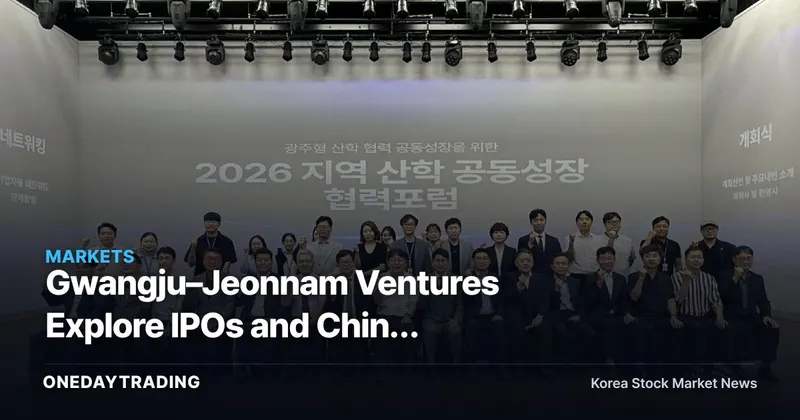
Universities, venture companies, and affiliated institutions in the Gwangju–Jeonnam region jointly discussed startups, investment, and global expansion built around the region's strategic industries. On the surface this was a local event, but because IPOs and re-entry into the Chinese market were treated as core agenda items, it is a matter that could affect the pool of KOSDAQ listing candidates and venture capital (VC) investment flows with some lag.
From an investor's perspective, the significance of these discussions is that they were not merely a balanced-regional-development event, but rather a sign that the pipeline carrying companies from the pre-IPO stage to the listed stage could broaden into regions outside the greater Seoul area.
What Happened
The region's industry, academia, research institutes, and government bodies—that is, the business sector, academia, research organizations, and the public sector—gathered in one place to share strategies for energizing startups, attracting investment, and opening up global markets on the basis of the region's strategic industries. The key themes can be distilled into two. One is securing funding and exit routes through initial public offerings (IPOs) for growth-stage companies; the other is finding ways to expand into China, a massive market.
Behind the IPO agenda lies the issue of exit channels for early-stage capital. In the venture ecosystem, once angel and seed investment comes in, capital must be recovered through subsequent rounds and ultimately through a listing or merger and acquisition (M&A) before the next round of investment can circulate again. Only when more local companies reach the point of listing will the incentive for regional VCs and accelerators to invest be revived.
The fact that China expansion was discussed alongside this is also noteworthy. Since the domestic market alone places a clear ceiling on revenue, China remains a key forward market where ventures in consumer goods, content, and components can still grow their top line.
Structural Background
A long-standing weakness of Korea's venture ecosystem is that capital, talent, and listed companies are excessively concentrated in the greater Seoul area. Regional startups are at a disadvantage in attracting follow-on investment, securing top talent, and accessing listing underwriters. Attempts like this one—where the public sector takes the lead in connecting universities' technology, companies' commercialization, and institutions' capital—are part of a trend aimed at bridging this structural disconnect.
Impact on Stocks and Industry Sectors
- KOSDAQ/KONEX listing infrastructure: If the pool of regional IPO candidates grows, demand for listing underwriting will expand, creating the potential for gradual benefits to the IB and corporate finance divisions of small and mid-sized brokerages.
- Venture capital and startup-investment-related stocks: As exit cases accumulate, the incentive for fund-of-funds contributions and private matching capital to flow into the region will grow.
- Regional strategic industries (secondary batteries, bio, content, etc.): Materials, parts, and equipment companies in the fields Gwangju–Jeonnam is nurturing are the first targets for funding and market-access support.
- China-bound consumer and component exporters: If the China re-entry strategy actually translates into orders, it could be a clue to a recovery in forward demand.
Bullish vs. Bearish Scenarios
The bullish scenario is one in which regional policy funds and private investment actually connect to real listing and export results, creating a virtuous cycle that newly supplies non-Seoul-area ventures to the capital market. On the other hand, the bearish scenario is just as clear. There have been many cases where such cooperation events ended as mere declarations and never led to actual investment execution and listings. The Chinese market, too, is exposed to regulatory volatility, intensifying local competition, and external variables like a "Hallyu ban"—so there is no guarantee that expansion will translate directly into revenue. Another limitation is that it is hard to view this as an immediate catalyst directly tied to the earnings of any specific listed company.
Investor Action Points
- Watch whether these discussions take concrete shape in the form of actual fund formation and contribution amounts, and check the schedule of follow-up press releases and policy announcements.
- See whether preliminary KOSDAQ listing review applications or IPO schedule disclosures from Gwangju–Jeonnam-based companies actually increase.
- Use whether order and contract disclosures bound for China emerge in the regional strategic-industry fields as an indicator of the expansion strategy's effectiveness.
- Gauge the temperature of the venture exit market through the trends in IB fee income at small and mid-sized brokerages and the earnings of startup-investment firms.
This article is content automatically summarized and analyzed based on the original news report. View original (Maeil Business Newspaper, Corporate)