
Key Takeaways
Government personnel news is usually unrelated to share prices, but this vice-ministerial appointment ties directly into a specific policy theme — the Arctic shipping route — giving the shipping, shipbuilding, and port sectors room to read it as a signal of policy continuity. That said, commercializing the route is a multi-year, long-term undertaking, so it makes more sense to approach this from a thematic-momentum perspective than as a near-term earnings driver.
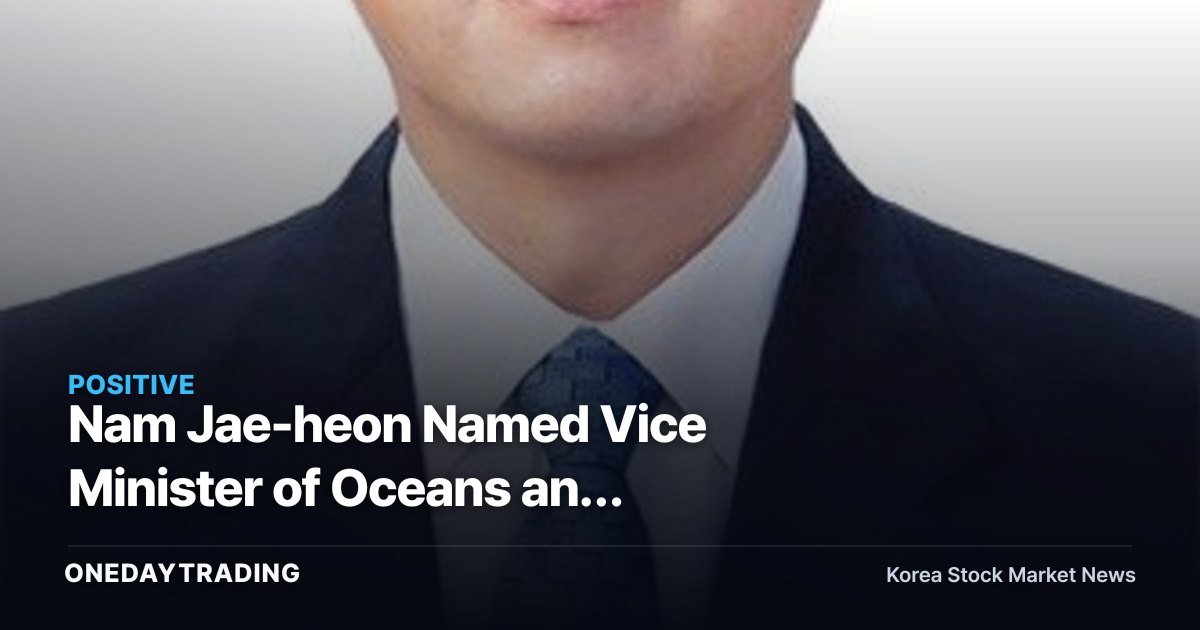
New Vice Minister of Oceans and Fisheries Nam Jae-heon is a career bureaucrat who built his experience in the port sector and has been described as a figure who has driven the development of the Arctic route. The promotion of an official who has led the policy is read as a move to sustain and reinforce momentum behind the related initiatives.
What Happened
The Ministry of Oceans and Fisheries newly appointed Vice Minister Nam Jae-heon, who brings expertise in ports and logistics. Among the core tasks he has pursued, the development of the Arctic shipping route stands out — an effort tied directly to the government's vision of growing Busan Port into a Northeast Asian logistics hub.
The Arctic route has drawn attention as an alternative path that can shorten the distance linking Asia and Europe compared with the existing Suez Canal route. With the potential to cut both sailing days and fuel costs, sustained policy commitment at the government level provides a favorable backdrop for the related sectors.
The appointment of a single vice minister does not immediately change corporate earnings. But because the odds that the policy-responsible line will keep pushing this agenda have risen, the group of stocks tied to route infrastructure and fleet investment may be bundled together as a theme.
Background and Context
Commercialization of the Arctic route has progressed slowly due to climate and seasonal constraints, Russia's control over the route, and geopolitical risk. Even so, its long-term potential is consistently cited, driven by demand to diversify global supply chains and the advantage of shorter sailing distances. South Korea has pursued a strategy of combining Busan Port's transshipment competitiveness with its shipbuilding technology to expand its foothold in this trend.
Impact on the Market and Stocks
- Shipping (HMM, Pan Ocean, Korea Line): If the new route takes hold as an actual cargo lane, it could lead to improved sailing efficiency and the securing of new routes. However, the benefit will only become visible once the route enters the commercial-operation stage.
- Shipbuilding (Hanwha Ocean, Samsung Heavy Industries, HD Korea Shipbuilding & Offshore Engineering): Navigating Arctic waters requires ice-class vessels with icebreaking capability and icebreaking LNG carriers, making the path to anticipated high-value specialized-vessel orders the most concrete.
- Ports and Logistics Infrastructure: If the policy of building up Busan Port as a transshipment hub is reinforced, indirect benefits could arise for port-operation and hinterland-logistics businesses.
- Energy and Resource Transport: Should Arctic LNG and raw-material shipping volumes rise, there is room for related transport demand to expand, though this depends heavily on global supply-demand (order flow) and sanctions-related variables.
Investor Checkpoints
- Watch for whether the Ministry of Oceans and Fisheries follows up with concrete schedules, such as policy announcements, budgets, and pilot-voyage plans.
- Check whether shipbuilders actually add disclosures of orders for ice-class vessels and icebreaking LNG carriers.
- Track changes in the preconditions for commercialization, including Russia-related sanctions, the geopolitical situation, and the timing of when the route becomes navigable.
- For stocks that have posted a short-term sharp gain (surge) on thematic expectations alone, weigh the gap between valuation and actual order and shipping-volume metrics.
Outlook
If the agenda of the Arctic route continues to be discussed thanks to the settling-in of an official who drives the policy, shipbuilding's specialized vessels and shipping- and Busan Port–related stocks could catch thematic momentum. Conversely, since commercializing the route is a long-term task that must clear the high hurdles of climate, geopolitics, and economic viability, it is a stretch to read a single appointment directly as grounds for an earnings improvement. Whether real-world indicators — concrete orders or operating results — accompany the theme is what will determine its staying power.
HMM Through Real-Time Data
HMM's latest closing price is 20,150 won (-1.47% versus the prior day), and the composite signal light combining foreign and institutional investor supply-demand (order flow) with news and momentum is 🔴 Caution. With foreign investors, institutional investors, and momentum all negative, caution is warranted right now.
- ▼ Dual selling — combined selling of foreign investors −1.8 billion won and institutional investors −2.8 billion won
- ▲ News flow — 10 positive catalysts vs. 1 negative catalyst — positive catalysts in the lead
Recent related news is favorable, at 10 positive catalysts and 1 negative catalyst.
※ Price and foreign/institutional investor supply-demand (order flow) data are provided by Korea Investment & Securities (KIS) and are as of the time of publication.
This article is content automatically summarized and analyzed based on the original news report. View original (Yonhap News)