
At a Glance
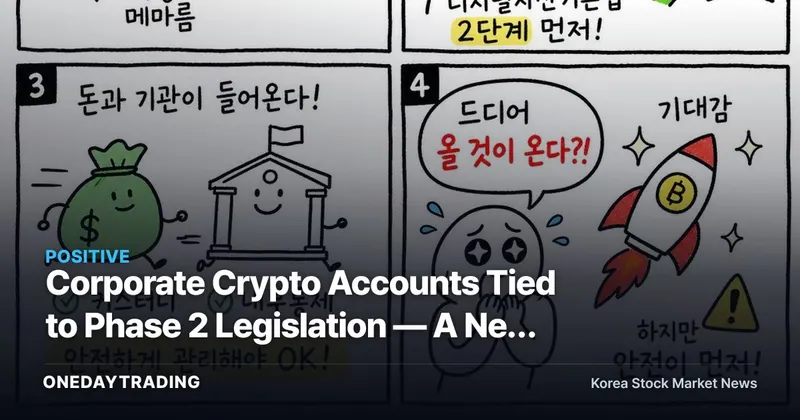
Allowing corporate virtual asset accounts isn't a coin-price headline — it's a regulatory headline that reshapes the composition of market participants. If a path opens for corporate capital in a domestic crypto market that has long been dominated by retail investors, exchange revenue, Bitcoin liquidity, and the discount rates on stocks holding related equity stakes could all move at once.
That said, the Financial Services Commission (FSC) has stated its policy of linking the guideline's release to passage of the Digital Asset Basic Act, the so-called "Phase 2" legislation. The direction of the positive catalyst is clear, but the timetable rests with the National Assembly, not with policymakers.
Why It Matters Now
Corporate accounts aren't simply about a higher account count — they're a channel that changes who is buying in the virtual asset market. Retail investors are sensitive to price swings and trade with high turnover. Corporations, by contrast, need internal investment rules, accounting treatment, custody structures, and risk limits in place before they can act. That means once corporate participation opens up, it first generates demand for institutional-grade infrastructure rather than an immediate wave of short-term buying.
This is exactly why the FSC tied the guideline to the Digital Asset Basic Act. Exchange account approval alone isn't enough to bring in corporate capital — issuance, listing, disclosure, and unfair-trading rules all need to be sorted out before an internal-control officer can sign off. The Phase 2 law is the mechanism meant to fill in those blanks. Put plainly: what matters before price action isn't on-chain data — it's the entry permit.
The market may well read this news as a positive catalyst. Domestic exchanges earn fee revenue tied to trading value, and allowing corporate accounts is material that broadens the base of that trading value. But if the bill's passage is delayed, expectations get priced in first while actual earnings lag behind — and that gap is what widens volatility in related stocks.
FAQ
- Is the approval of corporate virtual asset accounts confirmed? The FSC has stated its policy of pursuing the guideline in tandem with passage of the Phase 2 law. The direction toward approval is confirmed, but the detailed requirements and implementation timing remain variables.
- What does this mean for Bitcoin? If corporate participation becomes possible, the base of buyers in the domestic won-denominated market would expand from retail investors to include some corporations. However, the actual price impact can only be assessed once trading value and holding demand are confirmed after account approval takes effect.
- Why do exchange-related stocks move on this? Exchanges' core revenue comes from trading fees. An inflow of corporate clients raises expectations for higher trading value, and for listed companies holding equity stakes in exchanges, this feeds into a re-rating logic for those stakes.
- What's the biggest risk? That discussion of the Phase 2 law gets delayed, or that the requirements for corporate accounts end up designed conservatively. It would be excessive to take the word "approval" at face value and immediately translate a rise in trading value into earnings.
Related Stocks (Tickers) and Sector Impact
- Woori Technology Investment. Trades as the leading proxy for the domestic crypto-exchange theme through its stake in Dunamu. Expectations around corporate account approval could feed into a narrowing-discount logic for its equity stake, via the possibility of rising trading value at Upbit.
- Hanwha Investment & Securities. Has exposure through its Dunamu-related stake and could react to news of exchange institutionalization. That said, its core business is securities brokerage, so it's difficult to pin its earnings direction solely on crypto momentum.
- Bitcoin. Corporate accounts are an institutional variable that broadens the domestic demand base. But the bigger drivers of the global price remain spot ETF fund flows, dollar liquidity, and risk-asset appetite.
- Domestic virtual asset exchanges. The direct beneficiaries are the exchanges themselves. Corporate clients face tougher screening and internal controls than retail investors, but if they do come in, the quality and durability of trading value could shift.
Points to Watch When Investing
- Legislative timeline. Investors should track when discussion of the Digital Asset Basic Act picks up in earnest. Since the guideline is said to move together with the bill, any schedule delay is effectively a delay in momentum.
- Scope of account approval. It matters whether this applies to all corporations or starts with a subset — nonprofits, listed companies, financial firms, and so on. A narrower scope means a more limited effect on trading value.
- Confirming trading value. Even if related stocks move first, earnings are ultimately validated by trading value. Watch whether won-market trading value keeps rising after approval takes effect.
- Valuation burden. Stocks holding exchange equity stakes see their discount rates shrink quickly once expectations get priced in. Conversely, if a legislative delay is confirmed, that premium could unwind first.
Overall Outlook
The key point of this news is that the government has not carved out corporate participation as a standalone event, but has folded it into the institutional package of the Digital Asset Basic Act. That's a drag on near-term speed, but a way of building long-term market credibility. Exchanges and related equity-stake stocks may price in the positive catalyst first.
The opposite scenario also needs to stay on the table. If passage of the Phase 2 law is delayed and the requirements for corporate accounts end up strict, actual capital inflows could fall short of expectations. The indicators to watch next are the National Assembly's legislative schedule, the FSC's draft guideline, and won-market trading value once implementation begins. Corporate capital moves on procedure before it moves on rhetoric.
Woori Technology Investment: Real-Time Data
Woori Technology Investment's most recent closing price was KRW 4,475 (-2.93% from the prior session), and the signal combining foreign investor/institutional investor supply-demand (order flow) with news and momentum reads 🟡 Neutral / Wait-and-see. With positive and negative signals mixed, this is a stock to watch.
- ▲ Supply-demand (order flow) continuity — Foreign investors net buyers for 5 straight sessions (+KRW 0 hundred million)
- ▼ 52-week position — Near 52-week low, at the 4% mark
Recent related news skews favorable, with 1 positive catalyst and 0 negative catalysts.
※ Price and foreign/institutional investor supply-demand (order flow) data are provided by Korea Investment & Securities (KIS), as of the time of publication.
This article was automatically summarized and analyzed based on the original news report. View original (Maeil Business Newspaper, Securities)