
Key Takeaways
The Nasdaq's 1.3% gain is not simply a signal that tech stocks are strong again. At the heart of this rebound is a combination of demand resilience confirmed during earnings season and bargain-hunting in semiconductor stocks.
For Korean investors, this is a market where you need to distinguish the varying degrees of impact across SK Hynix, Samsung Electronics, and semiconductor equipment makers. Share prices moved first, and now actual shipments and customer orders need to justify those prices.
What Happened
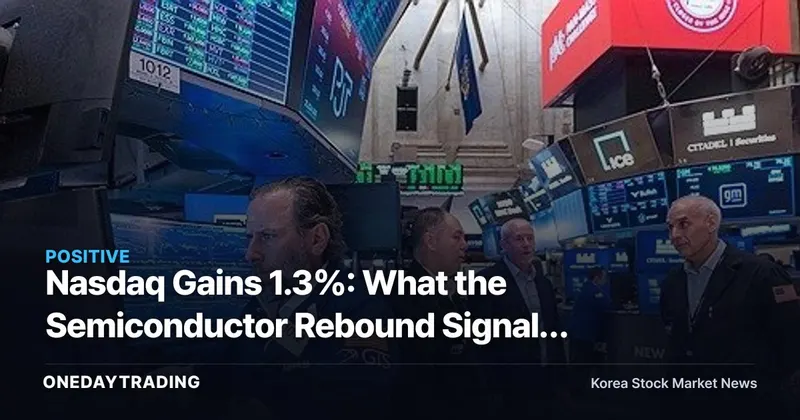
On July 21 (local time), all three major U.S. stock indexes rose together on solid corporate earnings and a rebound in semiconductor stocks. The tech-heavy Nasdaq index gained 1.3%. The market placed greater weight on the resilience of second-quarter earnings than on Middle East risks or tariff-related variables.
A semiconductor rebound changes the character of the entire index. When financials or cyclical stocks rise, it's a matter of expectations for economic recovery; when semiconductors rise, profit estimates move across the entire value chain — AI servers, memory, foundry, and equipment investment. In the Korean market in particular, moves in the U.S. Philadelphia Semiconductor Index often translate directly into foreign investors' supply-demand (order flow) for SK Hynix and Samsung Electronics on the next trading day.
Still, it's too early to read this rally as an outright return to an uptrend. The recent gains in semiconductor stocks also carry the character of a bounce-back after a recent decline. The fact that earnings are good is a different proposition from the claim that the AI-related investment cycle will keep expanding. The former is a number already reported; the latter needs to be confirmed by next quarter's order books.
Background and Context
The technical center of this market move is semiconductors. AI infrastructure investment doesn't end with GPUs — spending flows downstream into HBM, high-bandwidth substrates, test equipment, packaging, and power semiconductors. That's why, when U.S. semiconductor stocks rise, large-cap memory makers and back-end equipment makers in the Korean market tend to move together.
The catch is that sensitivity differs by stage of the value chain. SK Hynix reacts more directly to HBM supply and pricing. Samsung Electronics is required to deliver both a recovery in the memory cycle and a restoration of confidence in its foundry business. For equipment makers, profits only follow once customers' capacity-expansion plans turn into actual orders. Not every stock (ticker) rises at the same pace just because it's a semiconductor rally.
Impact on the Market and Individual Stocks
- SK Hynix (000660): Most sensitive to expectations that demand for AI-server memory will hold up. Its HBM supply capacity and customer qualification status will determine its valuation multiple.
- Samsung Electronics (005930): The Nasdaq rebound is favorable, but the market treats the recovery in commodity memory prices and improvements in HBM competitiveness as separate issues. Whether the rebound has staying power needs to be confirmed through upward revisions to earnings estimates.
- Hanmi Semiconductor (042700): Gains momentum sharply whenever expectations build for expanded HBM back-end process investment. That said, equipment makers face a lag between order announcements and revenue recognition at delivery, which can heighten short-term share price volatility.
- Leeno Industrial (058470): Demand for test sockets and inspection components is closely tied to rising chip shipments. The faster its customers' new-product cycles turn, the higher its earnings sensitivity.
- KOSPI Tech Stocks Broadly: Nasdaq strength stimulates foreign investors' risk appetite. If the won-dollar exchange rate stabilizes, the odds increase that supply-demand (order flow) will flow into large-cap Korean tech names.
Investor Checkpoints
- U.S. Big Tech Earnings: Watch whether cloud and AI capital-spending plans hold up rather than shrink. Capex commentary matters more here than revenue figures.
- Semiconductor Customer Orders: Watch whether orders for HBM and high-performance server memory continue into next quarter.
- Won-Dollar Exchange Rate: Foreign buying is sensitive to the exchange rate. If the won weakens further, positive catalysts originating in the U.S. could be diluted in the Korean market.
- Domestic Q2 Earnings Releases: For stocks (tickers) whose share prices have already rallied, operating profit margins and inventory valuations need to live up to expectations.
Outlook
The bullish scenario is straightforward: U.S. corporate earnings prove sturdier than expected, Big Tech doesn't scale back AI investment, and semiconductor orders spread into memory and equipment. In that case, it would be natural for SK Hynix to move first in the Korean market, followed by Samsung Electronics and equipment makers.
The trigger for the bearish scenario isn't earnings but guidance. Even on a day when the Nasdaq rose 1.3%, what the market was really buying was next quarter's demand, not past earnings. If Big Tech signals it will slow the pace of capital spending, or if valuation concerns around semiconductor stocks resurface, this rebound could end up as a brief pullback rather than a trend reversal. The next checkpoints are U.S. Big Tech earnings releases and commentary on shipments, pricing, and yields from Korean semiconductor companies.
This article is content automatically summarized and analyzed based on the original news report. View Original Article (Yonhap Infomax, Securities)