
Financial Services Commission HFT Rules: Trading Methods Matter More Than Volume
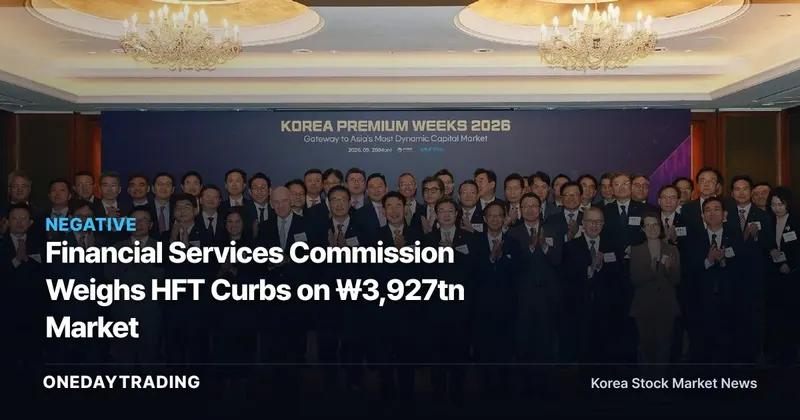
The Financial Services Commission said on the 28th that it plans to consider additional rules for high-frequency trading and strengthen oversight of leverage, margin loans and unsettled trades. The investment implication of the policy, reported by Maeil Business Newspaper’s securities desk, is not that investors should assume trading will contract. Rather, once the scope and severity of the rules are determined, both brokerages’ order-management practices and investors’ use of leverage could change.
High-frequency trading uses algorithms and dedicated order systems to repeatedly place, amend and cancel orders within short periods. For now, only the policy direction has been confirmed. The specific form of the rules and their implementation date must be announced before any actual market impact can be calculated.
What the Korea Exchange (KRX)’s 3,927 Trillion Won in Trading Value Says About the Scope of Regulation
High-frequency trading value on the Korea Exchange (KRX) totaled 3,927 trillion won in February, representing 58% of overall trading value. The figures come from data submitted by the Financial Supervisory Service to the office of lawmaker Kim Seung-won. What they show is that high-frequency trading is not a peripheral technique, but a major component of market order flow.
The same data showed that 2,266 high-frequency trading accounts were registered with the Korea Exchange (KRX) in February. Viewed alongside the scale of trading value, the number of registered accounts suggests the policy may focus more on the effectiveness of order identification and management systems than on simply restricting participation. However, the data do not indicate which measures will be adopted.
Mirae Asset Securities Member Warning Highlights the Starting Point for Oversight
The Korea Exchange (KRX) Market Oversight Commission announced that it had issued a member warning to Mirae Asset Securities for failing to report an ETF liquidity-provider account as a high-speed algorithmic trading account. The case shows that compliance with existing reporting and identification systems is already subject to active supervision, even before additional rules are introduced.
For brokerages, the key issue is not order speed itself but account classification, reporting and identification of trading entities. If future rules expand the scope of these controls, scrutiny of the related operations will also intensify. The scale of change will be limited if the rules remain within the existing framework, but the calculation changes if they introduce separate costs or trading restrictions.
Why Leverage, Margin Loans and Unsettled Trades Were Addressed Together
Byeon Je-ho, director general of the Financial Services Commission’s Capital Markets Bureau, outlined a policy direction under which the market should grow on the strength of corporate earnings and investors’ own capital rather than leverage. The Financial Services Commission plans to strengthen oversight not only of leveraged investment products but also of margin loans and unsettled trades.
High-frequency trading and leverage are not the same product, but the announcement placed both under the broader objective of responding to market volatility. The aim is to oversee both structures involving rapidly repeated orders and trading that relies on borrowed funds. The government’s plan to reinforce emergency market-stabilization measures is part of the same response framework.
Low-PBR Disclosure and KOSDAQ Reform Form a Separate Structural-Reform Pillar
Alongside tighter trading rules, reforms to corporate value and market structure are also moving forward. The Financial Services Commission plans to fully implement a disclosure program for low-PBR companies in November. It will cover companies whose PBR over the past three years ranks in the bottom 25% of their respective KOSPI industry sector or the bottom 10% of the KOSDAQ.
As of May, the Financial Services Commission estimated that 120 to 220 companies would be covered. The bear-hug framework is intended to encourage the target company’s board to evaluate a takeover proposal from the perspective of all shareholders during a tender offer. In the KOSDAQ market, authorities plan to strengthen the removal of distressed companies and introduce KOSDAQ Select.
How the Measures Could Affect the Market and Mirae Asset Securities
- Mirae Asset Securities: The confirmed direct development is the member warning issued by the Korea Exchange (KRX) Market Oversight Commission. If additional rules broaden reporting and identification obligations, oversight of high-speed algorithmic trading accounts will become a direct area of scrutiny.
- Securities trading environment: Stronger oversight of leveraged investment products, margin loans and unsettled trades would affect the terms of trading that relies on borrowed funds. Because the severity and scope have not been disclosed, there is not yet enough evidence to quantify any change in trading activity.
- KOSPI and KOSDAQ: Low-PBR company disclosures and KOSDAQ structural reforms should be viewed separately from high-frequency trading rules. The former targets corporate-value assessments and board decisions, while the latter focuses on market entry and exit and inflows of institutional investor funds.
Policy Signals Investors Should Watch Next
- Watch for disclosure of the specific form and implementation date of additional high-frequency trading rules.
- Check whether the proposal includes an excessive-order surcharge. The available information is insufficient to determine whether it will.
- Monitor how the covered products and scope of oversight are defined for leveraged investment products, margin loans and unsettled trades.
- Track the November launch of the low-PBR company disclosure program separately from follow-up details on the bear-hug framework.
Conditions for the Rules to Support Market Stability
If the policy operates by improving the accuracy of order identification and risk management, it will be aligned with the goal of strengthening the market-response framework. Conversely, if the scope is expanded without sufficiently distinguishing among trading methods and product characteristics, investors will need to assess the risk of restrictions spilling over into normal trading.
For now, only the direction of tighter supervision can be priced in. Once detailed proposals are released and the scope of application expands, the additional management burden on brokerages and changes to the trading environment will become clearer. Before looking at next quarter’s earnings, investors should focus on the wording of the proposal, the accounts covered and the scope of leverage oversight.
Mirae Asset Securities Key MetricsAs of 2026-09-29
| Period Returns | 1 Week -0.47% 1 Month -12.81% |
|---|---|
| Trading Value · Trading Volume | 800 million won · 979,928 shares |
| Supply-Demand (Order Flow) | Foreign Investors Net sold 3.8 billion won Institutional Investors Net sold 1.3 billion won |
Price and supply-demand (order flow) data are real-time figures from Korea Investment & Securities (KIS), while supply-demand (order flow) and news-tone assessments are calculated independently by OneDayTrading.
Supply-Demand (Order Flow) and Momentum Assessment🔴 Caution
Foreign investor, institutional investor and momentum indicators are showing negative signals.
- ▼Joint SellingForeign investors sold 3.8 billion won · institutional investors sold 1.3 billion won
- ▼Trend AlignmentShort- and medium-term trends aligned downward (day -1.9% · 1 week -0.5% · 1 month -12.8%)
Upcoming Dates to Watch
- 10.08Index Options ExpirationLowKOSPI200 options expiration
- 10.22Bank of Korea Monetary Policy BoardHighBenchmark interest rate decision meeting
- 10.28FOMC Policy Rate DecisionHighU.S. Federal Reserve monetary policy announcement — direction of interest rates and the dollar
- 11.12Index Options ExpirationLowKOSPI200 options expiration
This article was automatically summarized and analyzed from the original news report. View the original article (Maeil Business Newspaper Securities)