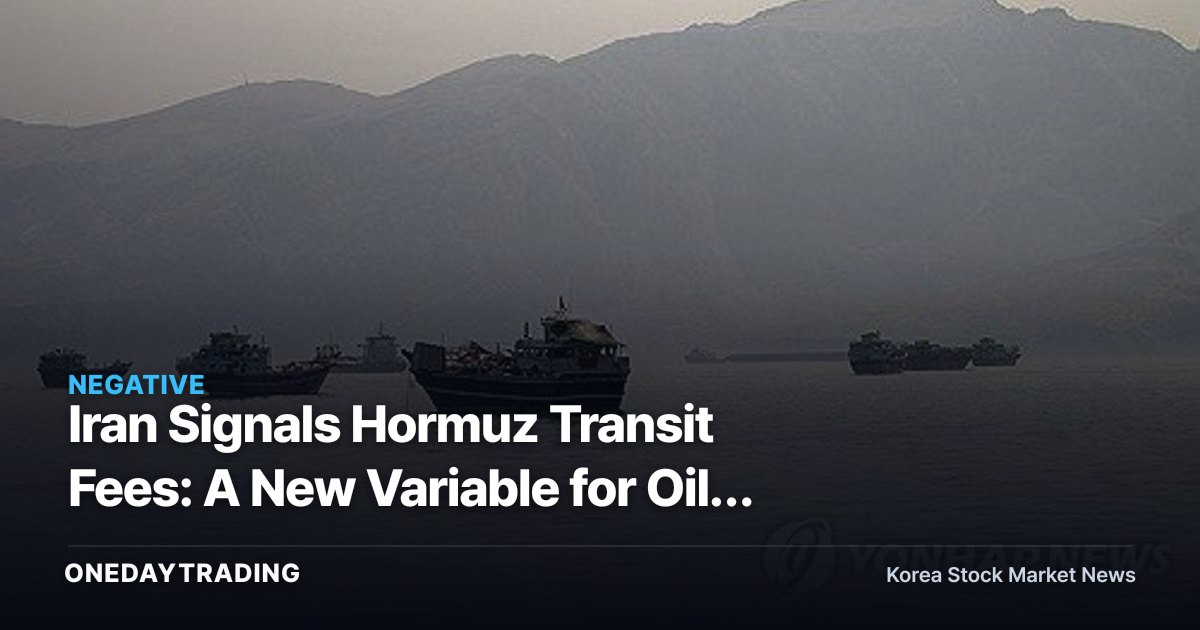

The crux of this development is not merely a diplomatic remark, but a signal that the cost structure for transit through the Strait of Hormuz — through which roughly one-fifth of the world's seaborne crude oil passes — could change. If a transit toll is introduced, the cost equation for Korea's refining, airline, and shipping industries, which are heavily dependent on Middle Eastern crude, would be directly shaken. What investors must therefore assess first is not the headline, but which industry sectors this cost gets passed through to in their profit-and-loss statements, and how quickly that pass-through occurs.
Three-Line Briefing
- Citing a memorandum of understanding with the United States, Iran has signaled it may impose insurance-style fees on vessels transiting the Strait of Hormuz.
- While transit will remain free for the time being, the door has been left open to future charges, which could bring Middle Eastern crude shipping costs and geopolitical risk premiums back into focus.
- Korea depends on the Middle East for a substantial portion of its crude oil imports, so refining, airline, and shipping stocks will diverge through the channels of oil prices, freight rates, and exchange rates.
What Changes
The Strait of Hormuz is effectively the sole exit for crude oil and LNG flowing out of Saudi Arabia, Iraq, the UAE, Kuwait, and Qatar. While Iran's remarks do not immediately imply a blockade, if a new cost item in the form of a transit fee becomes institutionalized, carriers and refiners will reflect it in their shipping rates. The reason the market reacts so sensitively is that, more than whether the fee is actually imposed, the willingness to exert control over the strait is once again being priced in.
A particularly important mechanism is the direction of the cost pass-through. When crude acquisition costs rise, refiners can temporarily benefit through refining margins and lagging effects, whereas airlines — for which fuel costs are a major component of their cost base — see rising oil prices translate directly into deteriorating earnings. It is a structure in which the same event works in opposite directions depending on the industry sector.
The Numbers and Context
Crude oil and condensate passing through the Strait of Hormuz are estimated at roughly 20% of global seaborne shipments on a daily basis. Because Korea depends on the Middle East for the majority of its crude imports, even a small additional cost on freight or insurance is reflected cumulatively across overall acquisition costs. That said, with no specific rates or implementation timing disclosed at this point, it must be distinguished that what is being priced in is closer to an uncertainty premium than the actual amount.
Beneficiary and Adversely Affected Stocks
- Refining stocks (S-Oil, SK Innovation, GS, and HD Hyundai Oilbank affiliates): Room for inventory valuation gains and improved refining margins in a rising-oil-price environment. However, if accompanied by slowing demand, margin expansion will be limited.
- Shipping and tankers (HMM, Pan Ocean): Potential for short-term widening of freight spreads if geopolitical risk pushes up detour routes and freight rates. Conversely, a contraction in shipping volumes would be a burden.
- Airline stocks (Korean Air, Asiana): With a high share of fuel costs, rising oil prices are a direct cost pressure. A weakening exchange rate on top of that would create a double burden.
- Chemicals and logistics: Rising raw material and shipping costs are a cost burden, with a greater risk of margin erosion for companies with weaker ability to pass prices on to products.
Risk Check
- The fee remains at the signaling stage, and with the actual rate and implementation uncertain, there is a risk of reversal if it is overly priced in.
- Even if oil prices rise, a concurrent slowdown in global demand could offset improvements in refining margins.
- If signals of easing Middle East tensions or production increases emerge, the geopolitical premium could unwind quickly.
- A simultaneous rise in oil prices and the exchange rate could stimulate inflation and interest-rate channels, weighing on domestic-demand and growth stocks broadly.
Bottom Line
The Middle East shipping-cost variable carries a dual nature, splitting into short-term momentum for refining and shipping versus a cost burden for airlines and domestic demand. The next indicators to watch are whether actual rates are disclosed, the price level of Brent crude, the won-dollar exchange rate, and refiners' quarterly refining margins; when these three variables move in the same direction, sector differentiation could begin in earnest.
S-Oil Through Real-Time Data
S-Oil's most recent closing price is 105,300 won (+0.19% from the previous day), and the signal light combining foreign investor and institutional investor order flow with news and momentum is 🟢 Buy-leaning. With foreign investors and news positive, it may be worth keeping an eye on.
- ▲ Order-flow continuity — Foreign investors net buyers for 6 consecutive days (+9.5 billion won)
- ▲ News flow — 12 positive catalysts vs. 1 negative catalyst — positive catalysts dominate
Recent related news is favorable, with 12 positive catalysts and 1 negative catalyst.
※ Price and foreign/institutional investor order-flow data are provided by Korea Investment & Securities (KIS), as of the time of publication.
This article is auto-summarized and analyzed content based on the original news. View original (Yonhap News Securities)