
3-Line Briefing
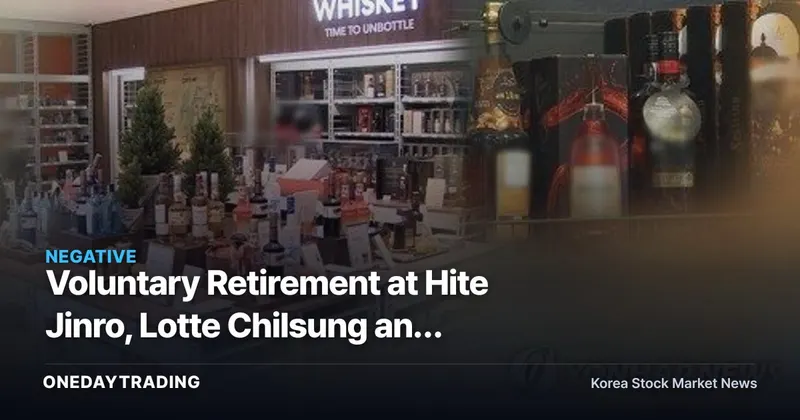
- Major domestic liquor makers such as Hite Jinro and Lotte Chilsung Beverage are downsizing through voluntary retirement programs amid worsening earnings.
- The companies cite an "economic slowdown" as the reason, but the data points to a structural decline in consumption driven by shrinking corporate dinner culture and rising demand for low-alcohol and non-alcoholic drinks.
- The real risk of this restructuring is that even with lower labor costs, profit improvement will be limited unless sales volume itself recovers.
What's Changing
The contraction in Korea's liquor market is not a one-year blip but a long-term trend. As company dinners decline and drinking-at-home culture takes hold, bulk consumption has fallen, while low-alcohol and non-alcoholic products along with alternative drink categories such as highballs and wine are eating into the territory of traditional soju and beer. Demographic shifts are also a factor: as the population of people in their 20s to 40s—the core drinking-age group—shrinks, older generations are cutting back on alcohol consumption for health reasons, meaning the overall market pie itself is shrinking.
Against this backdrop, liquor makers have limited options. Raising prices pushes consumers toward cheaper alternatives or imported liquor, while freezing prices lets cost pressures eat directly into margins. In the end, the only option left is to cut the cost structure, and the first step is workforce reduction. The problem is that voluntary retirement does nothing to boost sales volume. It is merely a defensive move to protect the profit-and-loss structure by lowering fixed costs—unless consumption itself recovers, the case for an earnings rebound remains empty.
Numbers in Context
The fact that the earnings deterioration at liquor makers has progressed so "rapidly" reads as a signal that the market has already reached an inflection point rather than experiencing a gradual decline. Companies typically weather a slowly worsening business environment through cost-cutting or marketing adjustments, but a decision like voluntary retirement that touches the workforce structure itself is closer to a sign that a company does not expect a short-term rebound. Signs of a turnaround can be confirmed in year-end peak-season sales volume and next quarter's earnings—if sales volume itself fails to grow and only cost savings show up in profit, that would mean the companies are merely "holding on" rather than achieving a genuine "structural improvement."
Winners and Losers
- Hite Jinro - With both its soju and beer businesses directly exposed to Korea's shrinking drinking population, cost-cutting measures such as voluntary retirement are likely to remain no more than a profit-defense tool unless revenue recovers.
- Lotte Chilsung Beverage - Since its beverage division has offset much of the weakness in its liquor business, business diversification within the group is the key variable determining its resilience.
- Muhak, Bohae Brewery - Small and mid-sized companies built on regional soju markets have weaker economies of scale, so the margin hit from declining sales volume shows up more immediately than at larger players.
- Non-alcoholic and low-alcohol beverage makers - As an alternative category benefiting from the pullback in company dinners and the health-conscious trend, they stand to gain the market share ceded by traditional liquor makers.
- Imported whiskey and wine distributors - Riding the premiumization of at-home drinking, they are expanding their relative footing by eating into domestic demand for soju and beer.
Risk Check
- One-off severance costs from voluntary retirement could actually worsen the bottom line in the short term.
- If restructuring only cuts labor costs without accompanying a recovery in sales volume, profit improvement may not be sustained.
- If rebound catalysts such as export expansion or a hit new product fail to materialize, the structural contraction could become prolonged.
- That said, the possibility of a technical improvement in some quarterly earnings due to the year-end peak season or new product launches cannot be ruled out.
Bottom Line
Voluntary retirement is a pragmatic choice for liquor makers to defend their cost structure, but it is not a solution that reverses the structural trend of shrinking drinking culture itself. Next quarter's sales volume and year-end peak-season revenue will be the watershed that determines whether a genuine rebound is underway or the improvement is merely a temporary effect of cost cuts.
Frequently Asked Questions
What is the biggest reason domestic liquor makers' earnings are worsening?
Consumption of traditional drink categories like soju and beer is itself declining as company dinner culture shrinks and preference spreads toward low-alcohol and non-alcoholic drinks. Add to that the shrinking population of people in their 20s to 40s—the core drinking demographic—and the structural factor of a shrinking overall market pie becomes significant.
Is voluntary retirement a positive catalyst or a negative catalyst for liquor makers' stock prices?
In the short term, one-off costs such as severance pay weigh on profit and loss, but over the medium to long term, lower fixed costs could help defend earnings. However, without a subsequent recovery in sales volume, it is difficult to view this as a fundamental improvement in earnings.
How long will the decline in liquor consumption continue?
It is difficult to pinpoint an exact end date, but factors such as shrinking company dinner culture and demographic change are structural elements that are unlikely to reverse in the short term. Whether a rebound is underway can be gauged from year-end peak-season sales volume and the next quarterly earnings release.
Hite Jinro by the Numbers: Real-Time Data
Hite Jinro's most recent closing price was 15,240 won (+0.73% versus the previous day), and the signal combining foreign/institutional order-flow (supply-demand) with news and momentum reads 🟢 Buy-leaning. Foreign investors, institutional investors, and momentum are all positive, making it worth watching.
- ▲ Dual buying — foreign investors +300 million won · institutional investors +0 won, buying together
※ Price and foreign/institutional order-flow (supply-demand) data are provided by Korea Investment & Securities (KIS) and are current as of publication time.
This article was automatically summarized and analyzed based on the original news report. View original article (Yonhap News, Securities)