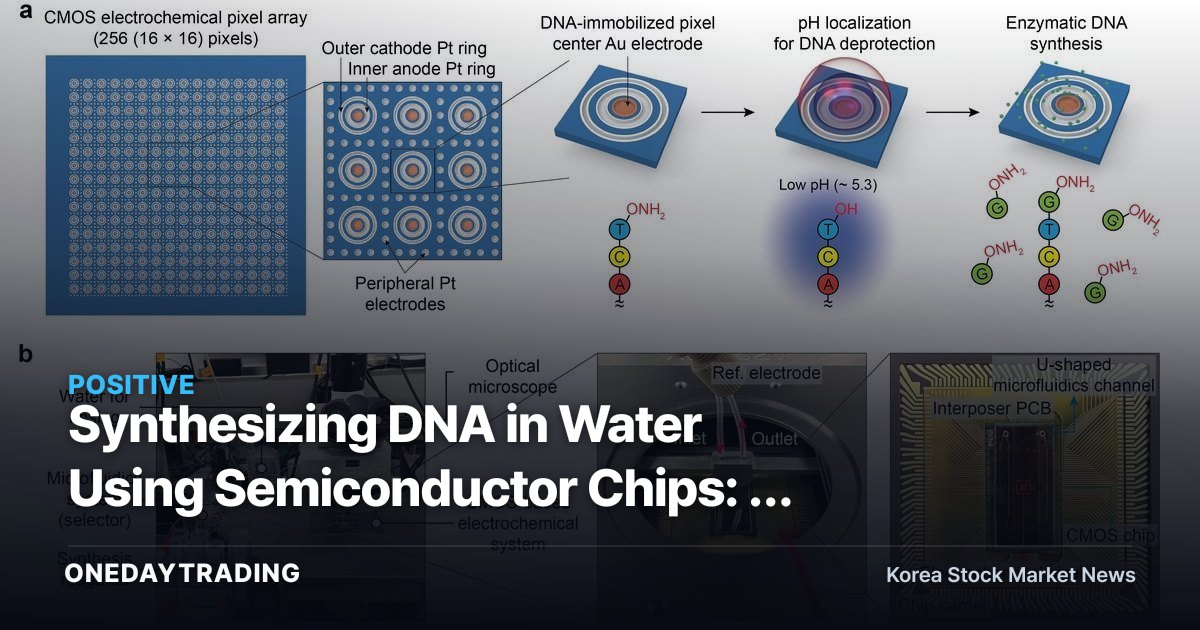

More than a single research achievement, this technology is a signal that could reshape the cost and speed structure of bio-manufacturing, making it a catalyst for re-rating the entire synthetic biology value chain. If a method that prints DNA in parallel on a chip—much like mass-producing semiconductors—is commercialized, the entry barriers in DNA synthesis, gene therapy, and cell therapy, long held back by synthesis costs and throughput, will fall. From an investment standpoint, the key is who secures an early lead in the equipment, materials, and services driving this trend—an issue best approached as mid-to-long-term thematic momentum rather than short-term earnings.
Three-Line Briefing
- A technology has been developed that uses semiconductor chips to simultaneously synthesize dozens of different DNA base sequences in water.
- With greater potential for parallel processing and miniaturization compared with conventional chemical synthesis, it could drive changes in the cost and speed structure of bio-manufacturing.
- It is a catalyst that strengthens the mid-to-long-term growth narrative for the synthetic biology, DNA synthesis, and bio-CDMO themes.
What Changes
Traditional DNA synthesis has relied on a chemical process that reacts reagents sequentially, limiting throughput and causing error rates to accumulate as synthesis lengthens. The newly unveiled method aims for parallel synthesis that handles multiple base sequences at once by using the microelectrodes and integrated architecture of semiconductor chips. The essential differentiator is that the integration and automation expertise of advanced semiconductor processes is being applied to bio-synthesis.
This approach matters because the bottleneck in synthetic biology has not been ideas but the manufacturing stage—producing designed genes quickly and cheaply. Once DNA can be synthesized in bulk at low cost, the iterative experimental cycles for gene-circuit design, DNA for data storage, and enzyme and biomaterial development will shorten. In other words, this should be read not as an improvement in research tools but as a transformation of bio-manufacturing infrastructure.
The Numbers in Context
The disclosed facts themselves center on a throughput improvement—the simultaneous synthesis of dozens of base sequences. That said, it should be viewed separately that, at this stage, concrete metrics on commercial yield, unit cost, and mass-production feasibility have not been confirmed. In the global market, companies touting silicon-based DNA synthesis are already listed, so the direction of chip-based synthesis itself is not new; the same principle applies in this case—technical validation and the pace of the shift to mass production are what matter.
Beneficiary and Adversely Affected Stocks
- Macrogen: A leading domestic stock (ticker) whose DNA analysis and synthesis services mean that improvements in synthesis throughput could, over the long term, be directly linked to an expansion of its business scope.
- Seegene: With technological capabilities rooted in molecular diagnostics, it has potential to benefit indirectly from the expansion of the DNA synthesis and amplification ecosystem.
- Samsung Biologics: A large-cap whose CDMO contract-manufacturing demand and efficiency structure could be affected over the long term by innovations in bio-manufacturing cost and speed.
- Global synthetic biology stocks (Twist Bioscience and others): A direct comparison group for the chip-based DNA synthesis theme, serving as a valuation benchmark for domestic investors.
- Advanced semiconductor process materials and equipment stocks: A potential beneficiary group for which new downstream demand could open up if bio-semiconductor convergence spreads.
Risk Check
- As a research-stage achievement, validation of commercial yield, unit cost, and mass production will take time, so the link to short-term earnings is weak.
- Synthetic biology and bio themes form a high-volatility sector where valuation burden can build quickly once expectations are priced in ahead of time.
- With numerous overseas first movers, the technological and patent competitiveness of domestic companies acts as a differentiating variable.
- Depending on macro variables such as interest rates and bio investment sentiment, capital inflows and outflows from growth stocks could drive the share price.
Bottom Line
The direction—potentially reshaping the cost and speed structure of bio-manufacturing—is clear, but given the gap between research and mass production along with the volatility of theme stocks, a reasonable strategy is to scale in gradually while monitoring yield, unit cost, the commercialization timeline, and follow-up disclosures.
Macrogen by Real-Time Data
Macrogen's latest closing price is 12,540 won (-7.11% from the previous day), and its signal light combining foreign and institutional investor supply-demand (order flow) with news and momentum is 🟡 Neutral / Wait-and-See. With positive and negative signals mixed, it is a zone to watch.
- ▼ Trend Alignment — Short- and mid-term downward alignment (today -7.1% · 1 week -9.5% · 1 month -10.4%)
- ▼ 52-Week Position — Near 52-week low, 11%
※ Price and foreign/institutional investor supply-demand (order flow) data is provided by Korea Investment & Securities (KIS) and is as of the time of publication.
This article is content automatically summarized and analyzed based on the original news. View original (Yonhap News, Industry)