
Rebound Conditions, Not Supply-Demand Alone, Will Drive KOSPI
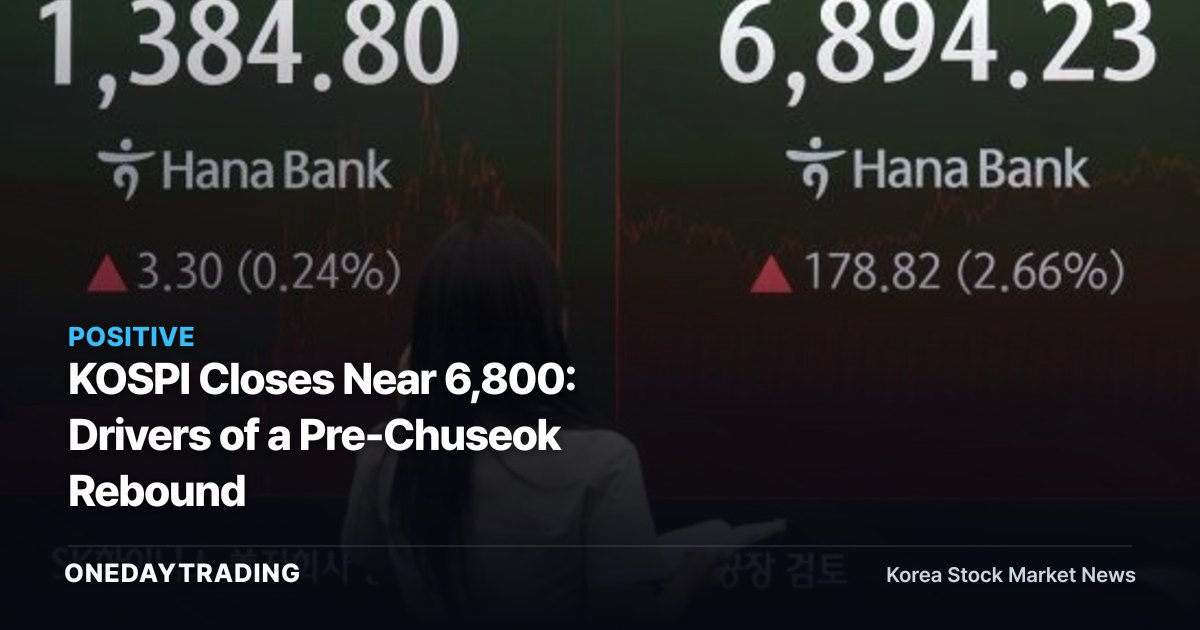
KOSPI’s pause near the 6,800 level last week was less a sign that the index had chosen a direction than the result of semiconductor stocks and foreign investors temporarily absorbing selling pressure. Asia Economy Securities reported that KOSPI is expected to attempt a rebound as caution intensifies ahead of the Chuseok holiday on September 20, 2026. Investors should focus less on the rebound itself than on whether foreign buying and bond-yield stability persist ahead of the holiday.
Index Performance Diverged Last Week
KOSPI fell 0.23% last week, while KOSDAQ rose 0.79%. On a weekly return basis, KOSPI posted a decline in the -0.2% range and KOSDAQ a gain in the 0.7% range. KOSPI showed a “weak-first-half, strong-second-half” pattern during the week, but its upward momentum did not hold through the closing price.
Lim Jeong-eun, a researcher at KB Securities, said on the 18th that strength in large-cap semiconductor stocks drove KOSPI higher. Foreign investors switched to net buying for the first time in eight trading days, and institutional investors also posted institutional net buying, but KOSPI failed to reclaim the 6,900 level. This suggests that even when supply-demand (order flow) enters during the session, the index ceiling will not open easily unless buying strength holds through the close.
Market Absorbed Rate Events, but Volatility Remains
Kim Jong-min, a researcher at Samsung Securities, said global asset markets have maintained a firm trend as they digest monetary-policy events. However, he warned that short-term volatility could expand if slower global liquidity growth overlaps with geopolitical uncertainty. Even if markets have partially priced in policy uncertainty, the direction of liquidity has not yet been confirmed.
Lee Kyung-min, a researcher at Daishin Securities, highlighted the stabilization of bond yields after the hawkish September U.S. FOMC and forecast that rebound attempts based on stable oil prices and bond yields would continue for the time being. Stable rates reduce the discount-rate burden on equities and allow valuation normalization, but if rates rise again, the index ceiling will be calculated differently even under the same earnings outlook.
Semiconductor Order Flow Is the First Test of Index Momentum
In this rebound phase, KOSPI’s most index-sensitive area is large-cap semiconductor stocks. The fact that large-cap semiconductor stocks led the advance on the 18th also means there is still insufficient evidence that supply-demand (order flow) has spread across broader industry sectors. Continued foreign net buying could strengthen downside protection for the index, but if buying momentum turns lower again, pre-holiday profit-taking could weigh more heavily on the index.
Na Jeong-hwan, a researcher at NH Investment & Securities, said that if U.S. long-term yields reverse lower while domestic corporate earnings remain sound, share prices could lift the top of their range through valuation normalization. NH Investment & Securities’ projected KOSPI range for this week is 6,400–7,500. This range is not a fixed target confirming a direction; it should be read as a benchmark for gauging the index’s response range according to the combination of rates and earnings.
Four Things Investors Should Check Before the Holiday
- Persistence of foreign investors’ order flow: Check whether the net buying after eight trading days is a one-day event or continues alongside institutional net buying.
- Exports from September 1–20: South Korea’s exports, due on the 21st, are the first data point for reassessing domestic growth and corporate earnings expectations.
- U.S. manufacturing data: The Richmond Federal Reserve manufacturing index on the 22nd and the U.S. September S&P Global manufacturing and services PMIs on the 23rd could again shake rate expectations.
- New durable-goods orders: U.S. August new durable-goods orders, due on the 25th, could change how investors interpret growth-sensitive assets.
Rebound Scenario and Conditions That Could Undermine It
The optimistic scenario is one in which bond yields and oil prices remain stable, foreign net buying continues, and economic data does not add to rate pressures. Under this combination, large-cap semiconductor stocks could serve as the index’s support, giving KOSPI room to test the upper end of the 6,400–7,500 range.
Conversely, if caution grows before the holiday, profit-taking increases, and foreign buying weakens, KOSPI could repeatedly fail to reclaim 6,900. The valuation-normalization argument would also weaken if U.S. PMIs and durable-goods orders come in stronger than expected and push long-term yields higher again. The key this week, therefore, is not whether a rebound occurs, but whether supply-demand (order flow), rates, and oil prices can all hold simultaneously.
KOSPI Index MetricsAs of 2026-09-20
| Period trend | 1 week -0.23% 1 month +0.61% |
|---|
Index, commodity and exchange rate data are based on global market benchmarks and reflect values at publication.
This article was automatically summarized and analyzed based on the original news report. View original (Asia Economy Securities)