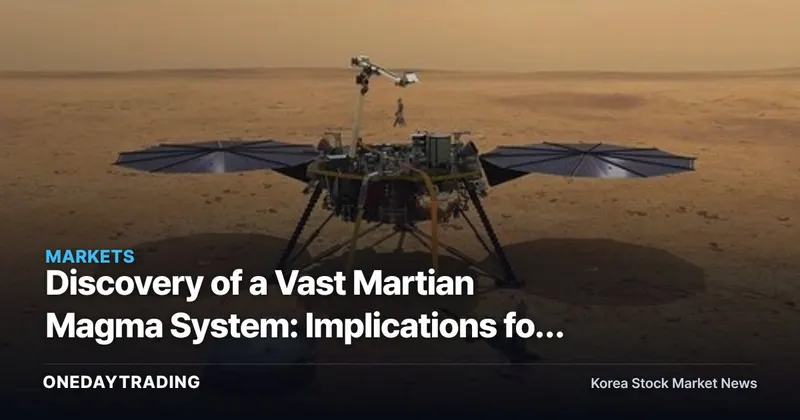

Key Takeaways
Evidence has been presented that a large-scale magma system, comparable to Earth's, once existed deep within Mars. The finding suggests that ancient Mars was not simply a dead planet, but rather one with vigorous internal thermal activity — conditions under which liquid water and chemical energy could have coexisted — adding a new clue to the debate over Mars's potential habitability.
Rather than being an immediate earnings variable, this development is better understood as scientific justification underpinning long-term space exploration demand. The stronger the case for Mars exploration becomes, the greater the potential for expanding the medium-to-long-term order pipeline for launch vehicles, satellites, and deep-space communications.
What Happened
Researchers reported that by analyzing traces left in the Martian crust and mantle, they confirmed evidence of widespread melting activity within the planet's interior. Much like mantle convection on Earth, internal heat circulated and drove magma formation and migration — a process that may have influenced surface conditions.
The existence of such a magma system carries two implications. First, if an internal heat source was present, conditions may have been in place to sustain liquid water underground. Second, volcanic and hydrothermal activity can supply chemical energy that microorganisms can utilize, raising the likelihood that the basic chemical prerequisites for life were once met.
It should be noted, however, that this is historical evidence. It does not constitute direct proof that life currently exists on Mars or that magmatic activity is ongoing. The critical distinction is that this points to potential habitability — not confirmed habitation.
Background and Context
Mars exploration is a long-term endeavor encompassing NASA's Perseverance rover, sample return missions, and private-sector plans for crewed Mars missions. Scientific discoveries that hint at habitability tend to be used to justify exploration budgets and mission mandates.
South Korea, following the launch of its Korea AeroSpace Administration (KASA), has also designated the development of launch vehicle, satellite, and deep-space capabilities as a national priority. Global momentum in Mars exploration therefore creates an indirect demand environment for the domestic space ecosystem as well.
Market and Stock Impact
- Launch Vehicles & Space Systems: Hanwha Aerospace holds the system integration contract for the Nuri rocket and operates launch services — making it the most direct beneficiary in the medium-to-long term should demand for space exploration and satellite launches expand.
- Satellite & Aviation Infrastructure: Korea Aerospace Industries (KAI) handles both satellites and aviation platforms, meaning its order base could widen if government space budgets increase.
- Earth Observation & Small Satellites: Satrec Initiative specializes in Earth and space observation satellites and imaging solutions, and would benefit from a technology-reference standpoint should demand for deep-space and observation missions grow.
- Satellite Communications Components: Intellian Technologies supplies satellite antennas and communications equipment; increased investment in deep-space communications and satellite networks would expand its addressable market.
Investor Checklist
- This discovery is a thematic narrative, not an earnings catalyst. Any stock price reaction may be limited to short-term momentum, so it is important to assess it separately from actual order wins and budget allocations.
- It is more prudent to use domestic KASA and government space budget plans, launch schedules, and Nuri follow-on program announcements as fundamental confirmation indicators.
- Monitor how budget approvals and scheduling changes for global missions — such as NASA's Mars Sample Return — affect sector market sentiment.
- Aerospace and space stocks frequently trade at elevated valuations relative to earnings, so when a thematic catalyst drives a sharp gain (surge), entry-point valuation risk must always be assessed carefully.
Outlook
On the optimistic side, as scientific advances hinting at habitability accumulate, the justification for Mars and deep-space exploration strengthens — providing a more durable long-term demand foundation for the launch vehicle and satellite industries. With South Korea continuing state-led space investment, order opportunities for related companies could expand gradually.
On the other hand, this discovery is merely a clue about past internal activity and does not connect directly to near-term business opportunities or revenue. Aerospace and space stocks carry high government budget dependency, are prone to mission delays, and offer limited earnings visibility — meaning that volatility driven by thematic narratives can itself become a risk factor. A disciplined approach that distinguishes scientific significance from investment merit is warranted.
Hanwha Aerospace — Real-Time Data Snapshot
Hanwha Aerospace's most recent closing price was 1,011,000 won (−5.43% vs. prior day). Its composite signal — incorporating foreign investor and institutional investor supply-demand (order flow) alongside news and momentum — reads 🟡 neutral / wait-and-see. Positive and negative signals are mixed, suggesting a period of observation is appropriate.
- ▼ Trend Alignment — Short- and medium-term downtrend alignment (day: −5.4% · 1 week: −9.9% · 1 month: −18.7%)
- ▲ News Flow — Positive catalysts 5 vs. negative catalysts 2 — positive catalyst lead
Recent related news counts 5 positive catalysts and 2 negative catalysts, skewing favorable.
※ Price and foreign investor/institutional investor supply-demand (order flow) data are provided by Korea Investment & Securities (KIS) and reflect conditions at the time of publication.
This article is an automatically summarized and analyzed content based on the original news source. View original article (Yonhap News — Industry)